Tower of Buddhist Incense (Foxiangge)
 |
| Tower of Buddhist Incense |
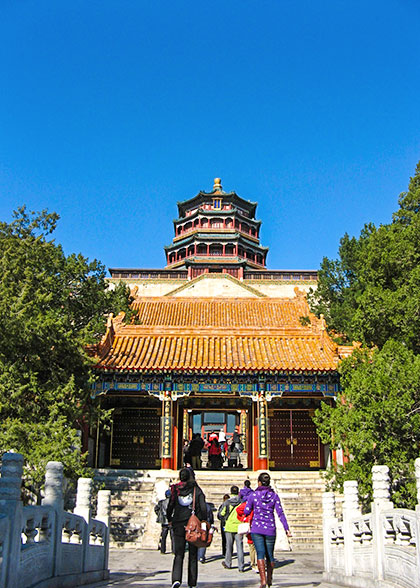
The three-level tower is octagonal with four layers of eaves. It is 41meters (about 135 feet) high, built on a 21 meter-high (68.9-foot-high) stone foundation. It faces Kunming Lake southward, back on the Hall of the Sea of Wisdom, and is also flanked by symmetrical buildings. While climbing up a number of steep steps, visitors are offered a wider perspective of the beautiful scenery around Kunming Lake and even further.
The building was built on the mountain side 60 meters above water level. A part of the mountain was enclosed in the huge stone foundation and the tower was outstandingly held up, enjoying the attention from all over the front-hill area. The tower, the main structure of the building, faces south and is backed up by the mountain in the north. The appearance of the tower imitated the design of Yellow Crane Towerin Wuhan. It is situated on a 1.75-meter-high Buddhist pedestal made of white marble. There are porch rooms around the tower based on the huge square stone foundation. The south and the north gates are decorated with yellow glazed tiles and green brims between the yellow tiles and red walls.
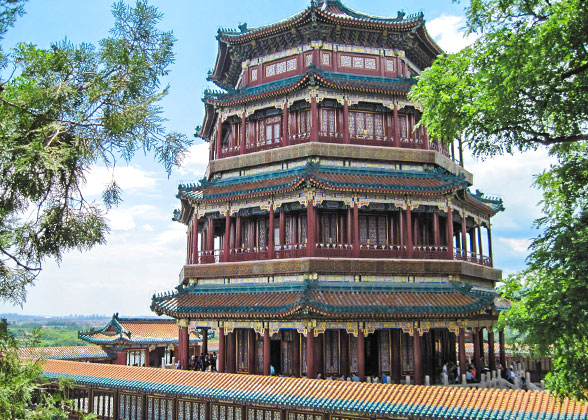 There are eight big ironwood pillars supporting the tower. It has a plaque hanging in each level of the tower. A gilded statue of the thousand-handed Kwan-yin Buddha stands inside on the first floor, which has important historical, cultural and artistic value. According to the record, this statue, five meters high and five tons in weight, was cast in bronze and gilded with gold during the reign of Emperor Wanli of the Ming Dynasty. There is a rubbing hanging in the middle, which records the inscription written by Emperor Qianlong. The excavation process of Kunming Lake is mentioned in the rubbing.
In 1989, the Tower of Buddhist Incense was opened to the public, and underwent reconstruction in 2006. The Tower of Buddhist Incense now retains its original beauty as it was in the celebration of Empress Dowager Cixi’ 60th birthday. Please note: the ticket of Tower of Buddhist Incense, together with the Hall of Dispelling Clouds, is an individual scenic spot excluded in the admission fee of the Summer Palace.
On the north (back) of the Tower of Buddhist Incense is a colored glazed archway, called Fo Xiang Jie, literally the Realm of Popular Fragrance. It leads to the way to the building complex on the highest point of the Longevity Hill, - Hall of the Sea of Wisdom.
To visit this place (together with the Hall of Dispelling Clouds), an additional charge of CNY 10 is necessary for those visitors who hold Summer Palace entrance tickets, but not necessary for through ticket holders.
 Next: Baoyun Pavilion
 Related Link: Summer Palace Travel Tips
- Last updated on Dec. 01, 2023 by Kate Liu -
Questions & Answers on Tower of Buddhist Incense
Asked by Eliza | Feb. 25, 2022 05:47 Reply
Reply
ReplyHow many sides does the building have?
Answers (1)
Answered by Doris | Mar. 04, 2022 17:45 0
0 0Reply
00ReplyTower of Buddhist Incense has eight sides and three floors.
Asked by Mr.Gerd from GERMANY | Jan. 01, 2011 13:04Reply
ReplyHi there,
does a direct footpath exist between Tower of Buddhist Incense to the Sea of Wisdom and further to Suzhou Street?
does a direct footpath exist between Tower of Buddhist Incense to the Sea of Wisdom and further to Suzhou Street?
Answers (1)
Answered by Mr.James | Jan. 02, 2011 02:5910Reply
10ReplyDirect footpath from the tower to the Sea of Wisdom. Then get down the hill to Suzhou Street.