 |
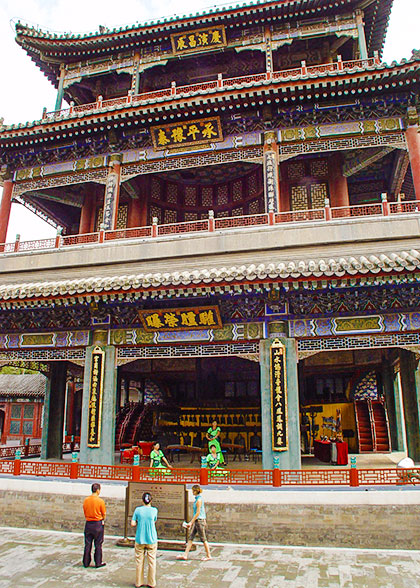
| Grand Theater |
Walking northward from the
Hall of Benevolence and Longevity, visitors will see the Garden of Virtue and Harmony (Deheyuan), where Emperor Guangxu and Empress Dowager Cixi watched performances of the Peking opera. Borrowing from the meaning of a sentence in Zuo Commentary (the first historical annals in Chinese history), the name "Dehe" suggests "listen to a fine melody and the mind will becalm". This garden has one of the three most famous opera theaters of the Qing Dynasty (the other two being the Qingyin Pavilion in the
Mountain Resort of Chengde, and the Changyin Pavilion in the
Forbidden City). This, the Grand Theater, is the best preserved and largest palace theater extant in China.
The Garden of Virtue and Harmony building complex has four courtyards set on a traditional south-north axis. Behind the garden gate is the first courtyard. The Grand Theater and Hall of Nurtured Joy are the main buildings, located in the second courtyard. The Hall of Celebrating Virtue (Qingshantang) is the central structure of the third courtyard. The small back yard has an exit gate to the hill path to Hall of Utmost Blessing (Jingfuge).
Grand Theater
Whenever there was a celebration in the Qing imperial palace, Peking opera was a must and it had become especially popular from the reign of Emperor Qianlong. Opera was the prevailing passion of Dowager Empress Cixi. When she came to the Summer Palace, she would watch opera on the second day. She was not satisfied with the little theater in the Hall for Listening to Orioles. So when the Summer Palace was undergoing renovation in 1891 following destruction during the 1860 war, the site of previous Yichuntang was chosen as the place to build a new larger theater. More than two hundred different opera performances were put on here for her, during the period from the completion of the theater until her death.
The theater is 21 meters in height (68.9 feet), with three storeys. From top to bottom, are the Fu Stage (Happiness Stage), the Lu Stage (Affluence Stage), and the Shou Stage (Longevity Stage). The floors of each stage have trapdoors and under the Shou Stage there are a deep well and five ponds. The well and ponds were used to amplify the sound effects through acoustic resonance and to make water appear to spout from a dragon's mouth. Special effects could be performed from beneath the three stages. This made scenes involving immortals and apparitions more vivid and realistic as they emerged or flew onto the stage by means of a winch installed on the ceiling of the theatre.
The two-storeyed Dressing House is behind the stages and connected to the theater. This was where the actors put on their costumes and make up. It now houses an exhibition of opera costumes and props, Cixi’s sedan chair, and an oil painting of Cixi.
Hall of Nurtured Joy
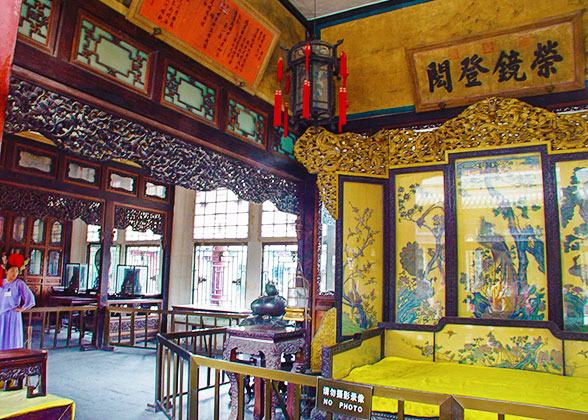 |
| Inside of Hall of Nurtured Joy |
Directly facing the Grand Theater, the Hall of Nurtured Joy was for the exclusive use of the Empress Dowager Cixi when she watched the opera. Her luxurious throne, carved with a hundred larks flying toward a phoenix, plus a collection of caged songbirds from faraway lands, and a florid jade-inlaid screen with flower and bird motifs are on display. It was said that Cixi didn’t like to watch opera performances on the throne, but from the kang bed behind the west window. There are side corridors between the hall and the theater which were for the princes and ministers to admire the performances. From an old draft treasured in National Library of China, this hall was originally designed to have two levels, but turned out to be a spacious one-decked hall. The base of the hall is 22cm higher than the first stage of the theater, so as to provide a better view of the opera shows.
Hall of Celebrating Virtue
This was where Cixi would rest during the opera intermissions. In 1903, American artist Carl painted Cixi’s portrait here.
Visitors can go into the Garden of Virtue and Harmony with a Summer Palace through ticket, or for an additional CNY 5 can get in with a Summer Palace entrance ticket.
- Last updated on Nov. 30, 2023 by Kate Liu -
 Next: Hall of Jade Ripples
 Related Link: Summer Palace Travel Tips