Problems Caused by Three Gorges Dam
More Sediment in Upper Riverbeds and Three Gorges Reservoir
The increasing sediment is one of the main Three Gorges Dam disasters. After the Three Gorges Dam was constructed and the water level of upper reaches was raised, the upper river flows more slowly than before and the sand and rocks cannot be rushed down in time and are piled up in the river beds and reservoir. As time passes by, the upper stream river beds will be raised higher and higher, which leads to flood more easily.
Threat to Downstream Riverbanks and Yangtze River Delta
Due to the sedimentation in the upper stream, the water becomes purer and erodes the downstream river banks more easily. In such a situation, the banks are easier to collapse, which is a great danger to people and the country, especially when there is a flood. In addition, less sediments make the land of Yangtze Estuary shrink and seawater pours backward to the coast. In the past, Shanghai in the Yangtze estuary stretched 40 meters (44 yards) a year averagely to the sea; now the city faces the threat from ocean instead.
Many Aquatic Creatures Are Endangered.
Because of the dam, fishes cannot pass the Three Gorges and migrate like before, and thus their living habits and heredity change. Meanwhile, the reservoir area was the spawning site of some fishes, which was destroyed with the construction of dam. A number of rare water creatures living in the Yangtze are in the danger of extinction, such as the Yangtze hilsa herring and Chinese sturgeon.
Increased Geological Disasters.
As the construction of Three Gorges Dam forced the surrounding geological environment change, geological disasters occur more frequently in the reservoir area. Landslide, debris flow and earthquake are the common occurrence. Possible disastrous sites also increased by 4,000.
Climate Change of Yangtze River Basin
A Lot of Cultural Relics and Historical Sites Were Submerged.With the Three Gorges Dam, the water area in the upstream becomes much larger, but the area of lakes and wetlands downstream decreases. More water area, more water evaporates. Similarly, less water, less evaporation. The change impacts the microclimate of Yangtze River Basin. Therefore, the conditions of drought, flood and temperature along the Yangtze River are different from the past. For instance, within a range of 1 - 2 kilometers (0.6 - 1.2 miles) of the Three Gorges Reservoir, the average annual temperature increases by 0.1-0.2 ° C, the average temperature in winter and spring increases by 0.3-1.3 ° C, but in summer decreases by 0.9-1.2 ° C.
A Lot of Cultural Relics and Historical Sites Were Submerged.
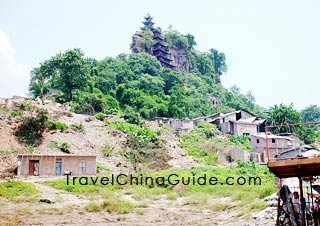
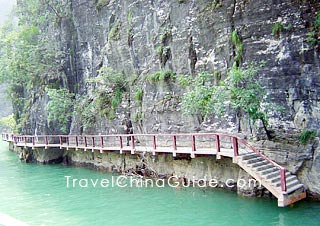
To build Three Gorges Dam, a great amount of historical sites with cultural relics are submerged or partly submerged, including over 60 sites of Paleolithic Age, over 80 Neolithic Age sites, and more than 470 historical sites from Han Dynasty (202 BC - 220 AD) to Ming (1368 - 1644 AD) and Qing (1644 - 1911 AD) Dynasties. It is an indelible Three Gorges Dam disaster and a great cultural loss of Chinese ancient civilization, although some cultural relics were moved away and relocated in advance. The flooded cultural sites include Qu Yuan Temple, Baiheliang (White Crane Ridge), Daxi Culture Heritage Site, Zhang Fei Temple, Qutang Gorge Ancient Plank Road, White Emperor City, Shibaozhai (Precious Stone Fortress), etc. What a great pity! See also: Scenery Change after Three Gorges Dam Completed
|
|
The Spread of Schistosomiasis Westward
Schistosomiasis is a kind of parasitic disease that seriously endangers human health. In the past, schistosomiasis occurs in lower reach of Yangtze River only, for the river snail that carry germs of schistosomiasis cannot survive in rapid flowing water. Now, the water in Three Gorges Reservoir is clam and flows gently, which provides the suitable living conditions for the river snail. Thus schistosomiasis spread westward to Three Gorges area, Chongqing and Sichuan province.
A Large Human Migration of Over 1.2 Million
Migration is one of the biggest Three Gorges Dam problems. After the reservoir began to store water, about 129 cities and towns are flooded, and more than 1.2 million people in Hubei and Chongqing needed to migrate in batches. They had to leave their beloved hometowns and be allocated to Hubei and Chongqing outside the reservoir area, Anhui, Hunan, Sichuan, Jiangxi, Jiangsu, Zhejiang, Shanghai, Fujian and Guangdong provinces to start afresh.
 Further Reading
Three Gorges Dam Benefits: 5 Major Advantages
Three Gorges Dam Pros and Cons
 Reply
Reply 3
3 14ReplyReply513Reply67ReplyReply710ReplyReply1917Reply320Reply613Reply212Reply