Qinhuai River
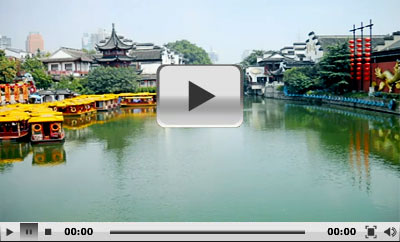
Qinhuai River, a branch of the great Yangtze River, is 110 kilometers (about 68 miles) in length and covers a drainage area of 2,631 square kilometers (about 1,016 square miles). It was originally called Huai River, and it is said that the river was channeled to the city of Nanjing during the reign of Emperor Qin Shi Huang, so it was named Qinhuai River from then on.
Qinhuai River is the largest river in the Nanjing City area and is the 'life blood' of the city. It is so fascinating that it captures the imaginations of people both at home and abroad.
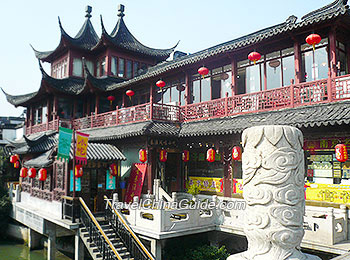
There are many famous sites of interest along the banks of the Qinhuai River, including Confucius Temple, Zhanyuan Garden, Zhonghua Gate, and the sights along the Taoye Ferry ride to Zhenhuai Bridge.
The Qinhuai River is divided into inner and outer parts. The most frequented place along the inner river is the Confucius Temple. It is a grand temple with an unassuming style, which was built to commemorate the famous Chinese sage, Confucius.
Zhonghua Gate, also found along the inner river, is the largest city door in China as well as the best-preserved and most intricate city door in the world.
Finally, there is the Zhanyuan Garden, which was constructed in the Ming Dynasty (1368-1644) and is the oldest existing garden in Nanjing City.
|
|
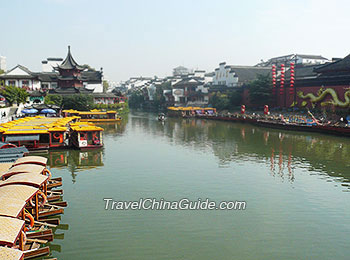
The outer river resides between Yangjiawan lock and Qinhuai lock. In June 2005, the area was designated by the government as a new tourist route, because it encompasses views of Nanjing City, a city wall from the Ming Dynasty, and the Jiangsu Nanjing TV Tower, etc. While floating on one of the traditional, recently modernized, painted boats of the region, visitors will have the opportunity to fully appreciate the beautiful sights of the Qinhuai River.
Qinhuai River Cruise
Cruise ships are available at the Panchi Wharf in front of Dacheng Hall of the Confucius Temple. Luxury cruise ship is for tour group; ordinary cruise ship is for individual travelers which costs CNY60 per person at daytime, CNY80 per person at night. The while journey is about 50 minutes. The route is Panchi Wharf - Bai Lu Zhou Cultural Theme Park - Dong Shui Guan - Qi Cai Shui Jie - Zhong Hua Men - Li Xiangjun's Former Residence. The cruise operates from 9:00 to 22:00. The former residence is removed in the night route, but go back to Panchi at last.
For more information, click Qinhuai River Cruise to see details.
How to get to the Panchi Wharf
1. Take Metro Line 3 to Fuzimiao (Confucius Temple) Station and leave from Exit 2, and then walk southwest for 10 minutes to get there.
2. Take bus 14, 23, 26, 33, 43, 46, 63, 81, 87, 88, 301, 317, 701, or 703 to Shi Diyi Yiyuan and walk southwest for 5 minutes to the wharf.
Nanjing Bus / Metro Search Further Reading:
Top 10 Things to Do in Nanjing