Hot Topics on Qin Shi Huang Mausoleum
 How long did it take to build the Mausoleum of Emperor Qin Shi Huang?
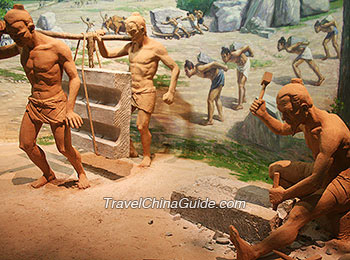
Among all the imperial mausoleums, the Mausoleum of the Emperor Qin Shi Huang features the longest construction time, largest number of labors and most gigantic project. The project started immediately after the emperor ascended to the throne. The construction can be divided into three stages. The first stage lasted for 26 years from the accession of the emperor to the unification of China. In this stage, the foundation of the mausoleum such as the dimension and basic pattern were identified. The second stage lasted for nine years from the unification of China to the 35th year of Qin Shi Huang's rule. In this stage, the large-scale construction project was completed. The third stage lasted from the 35th year of Qin Shi Huang's rule to the winter of the second year of the 2nd Qin Emperor Hu Hai's rule. The remaining part of the project and the earth-up were finished. The whole project took as long as 37 or 38 years, which is even eight years longer than the construction of the Great Pyramid.
|
|
 Was the cemetery park built with Xianyang (Qin's capital) as a model?
Yes, it was built according to the layout of Xianyang City, the ruling center of the Empire. Qin Shi Huang wanted to bring the aboveground palace to the underground kingdom to continue his rule and luxuary life. The sites of the resting hall, officials' room and park in the inner city and the horse skeletons in the outer city that were found in recent years were all the component of the royal palace of the Emperor when he was alive. The inner and outer cities were built by the capital Xianyang, and the underground palace was built by imitating the universe, all reflecting the ancient burial concept, that is, to treat death as life.
Who presided over the construction of the Mausoleum of the Emperor Qin Shi Huang?According to the Historical Book, Li Si, the prime minister of Qin Dynasty, presided over the construction of the Mausoleum of the Emperor Qin Shi Huang. Li Si, due to his extraordinary talents, was always trusted and appreciated by the Emperor. Before took over the prime minister, he had participated in the charge of the construction of the mausoleum. After became the prime minister, he formally presided over the construction work. The contribution of Li Si to the mausoleum is greatest, that is to explain why Li Si is the only one to be recorded in the Historical book as the person who presided over the tomb construction.
However, many other important figures in Qin history were once also in charge of the construction work. They were Zhuang, Wang Wan, Wei Lin and Lu Buwei, all of whom were prime ministers besides Li Si in Qin Dynasty. The prime minister was the chief executive of the country second only to the emperor. Therefore, the decision of ordering prime ministers to take in charge of the construction work deeply reflects the great attention from the country to the Mausoleum of the Emperor Qin Shi Huang.
 Qin Shi Huang Mausoleum (Mausoleum of the First Qin Emperor)
 9 Mysteries of Qin Shi Huang Tomb You May Want to Know City Walls to Protect Qin Shi Huang Mausoleum Underground Palace of Qin Shi Huang Mausoleum Why Don’t They Excavate the Qin Shi Huang Mausoleum? Has Qin Shi Huang Tomb ever been robbed in the past? Where was Qin Shi Huang buried? Pit K0006 - Civil Official Figures Pit K0007 - Bronze Aquatic Birds Pit K9801 - Stone Armor and Helmets Pit K9901 - Acrobatics Figures
- Last updated on Apr. 12, 2021 -
Questions & Answers on Hot Topics on Qin Shi Huang Mausoleum
Asked by Glenda from UNITED STATES | May. 30, 2011 11:39 Reply
Reply
Replyplease tell me about the chariots and horses, how they were reproduced and sold
does the chariot have a driver and 4 horses and is it bronze
Answers (1)
Answered by Jack from CHINA | Jun. 02, 2011 22:21 0
0 2Reply
02ReplyDo you mean the chariots sold in the souvenir stores out of the museum? They are just reproduction of the real ones exhibited in the museum by the artists. The appearance of the chariots is almost the same with the real one, but even the high-quality ones are only coated with a layer of copper.
Asked by Mr.teresa cambridge from USA | Mar. 17, 2011 12:37Reply
ReplyWas the location of the tomb of the first Chinese Emperor Qin known prior to the discovery of the Terra Cotta Warriors in 1974? And if the location of the tomb was known prior to 1974, when was the tomb discovered?
Answers (2)
Answered by Mr.Bruce | Mar. 18, 2011 03:2824Reply
24ReplyThe first exploration of the tomb was in 1962.
Answered by mary from AUSTRALIA | Nov. 10, 2014 20:1020Reply
20Replythank you Mr.tereasa cambridge