Shandong Provincial Museum
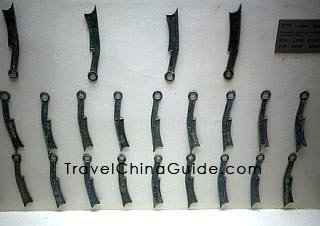 |
| Knife-shaped Coins |
The original museum built in 1954 closed and has been replaced by the new one on a large square in Jingshi Road, east of Yanshan Overpass. This was opened to the public on November 16, 2010. The new five-storey Shandong Provincial Museum has fifteen exhibitions halls where eleven permanent displays are on show. These include figure paintings from the Han Dynasty (202BC - 220AD), Buddhist sculpture, Shandong history and culture and a Confucian Culture exhibition. There is also a collection of calligraphy and paintings, Lu embroidery, fine porcelain articles, etc.
After a security check, visitors follow the sign to enter the 3,000-square-meter (3,600 square yards) main lobby supported with eighteen big pillars. The dominant hue of the lobby is yellow, symbolizing the Yellow River which gave birth to the culture of Shandong and entire China.
Shandong History and Culture Display Area
In addition, for the first time there is a display of all the things unearthed from Zhu Tan (known also as Prince Lu, the 10th son of the first emperor of the Ming Dynasty (1368 - 1644AD) – Zhu Yuanzhang). A batch of precious cultural relics is also on show for the first time. This includes a standing Bodhisattva sculpture with a crown of cicada decoration and mural painting from Dongping Han Dynasty Tombs. The Bodhisattva sculpture was created 1,500 years ago, and now restored to China having been lost to overseas collections for fourteen years.
|
|
Confucius Culture Exhibition
New techniques are employed to give a much more impressive experience for visitors. A visit to Shandong Provincial Museum is like a dialogue with history, revealing the wonders of Shandong.
Note on Qi and Lu Culture
During the Spring and Autumn Period, Confucianism came into being in the Lu State which was located east of Lu and adjacent to the ocean, where industry and commerce developed rapidly. Qi, close to the East China Sea, represents an open atmosphere, while Lu, close to Mt. Taishan, shows relative conservatism promoting farming. Later in the Warring States Period, Mencius (the Lesser Sage as distinguished from Confucius the Sage) in Lu traveled to Qi twice for education and cultural exchange, and the fusion of the Qi and Lu cultures began.
 Related Link: Refer to China History for details of every historical period
How to get to Shandong Provincial Museum
Jinan Bus Search
| Entrance Fee | Free but visitors need to take their passports to get the tickets. |
|---|---|
| Opening Hours | 09:00-17:00 (closed on Mondays); No admission after 16:00. |
- Last updated on Jul. 04, 2022 -
Questions & Answers on Shandong Provincial Museum
Asked by Irina from RUSSIA | Mar. 03, 2021 09:02 Reply
Reply
ReplyCould you help to know e-mail address of the Museum to write there in English
Answers (1)
Answered by Dylan | Mar. 07, 2021 19:24 0
0 0Reply
00ReplySorry, I can only find the contact number: 0531-85058202.
Asked by Jen Delaney from UNITED STATES | Aug. 11, 2017 14:13Reply
ReplyHow can I find an email address for the museum store at the Shan Dong Art Museum in Jinan China?
If you know how I can find out the email address and phone number I would greatly appreciate it.
Thank you.
Thank you.
Answers (1)
Answered by Susan from UK | Aug. 15, 2017 04:2200Reply
00ReplyThe service line of SD Art Museum is 0531-82953407. You can contact with this number for the detailed information.
Asked by CP from CHINA | Mar. 31, 2015 11:41Reply
ReplyWhat is the bus stop name and the name of Shandong Provincial Museum in Chinese?
Hello, are the bus stops for the museum still the same as listed above?
And what is the museum's full name in Chinese?
Thanks.
"Take bus 115, 119 or K139, get off at Xia Jing Cun Station;
Or take bus 18, 62 or 150, and get off at Yi Jian Xin Cun station"
And what is the museum's full name in Chinese?
Thanks.
"Take bus 115, 119 or K139, get off at Xia Jing Cun Station;
Or take bus 18, 62 or 150, and get off at Yi Jian Xin Cun station"
Answers (1)
Answered by Cathy from UNITED KINGDOM | Mar. 31, 2015 21:2710Reply
10ReplyYes, you still can take the above list as a reference.
The name of the museum; 山东省博物馆
Xia Jing Cun Station: 下井村公交站
Yi Jian Xin Cun Station: 一建新村公交站
The name of the museum; 山东省博物馆
Xia Jing Cun Station: 下井村公交站
Yi Jian Xin Cun Station: 一建新村公交站
Asked by CP from CHINA | Mar. 23, 2015 01:53Reply
ReplyWhere exactly is Shandong Provincial Museum located in Jinan?
Hello,
is it located in the city center or on the outskirts, and is it near any of the other attractions like Daming Lake or Qianfo Shan? Thanks.
is it located in the city center or on the outskirts, and is it near any of the other attractions like Daming Lake or Qianfo Shan? Thanks.
Answers (1)
Answered by David from ITALY | Mar. 23, 2015 21:2110Reply
10ReplyIt is located at No. 11899 of Jingshi Road, Lixia District. Generally, it lies in the city center area, not outskirt. No an attraction is within walking distance from this mueum. It is about 6 miles around from Daming Lake, 3.6 miles from Qianfo Shan.
The bus No.115, 119, 152, 312, 325, K139, K145 and K160 can lead to the museum.
The bus No.115, 119, 152, 312, 325, K139, K145 and K160 can lead to the museum.