Five kilometers (3.1 miles) northeast of Kashgar, an ancient Islamic building nestles among poplar trees. With glazed tiles shining in the sun, its tower points to the azure sky. A masterpiece of Uigur architecture, this is Abakh Khoja Tomb, 17th Century family cemetery of the Kashgar area Islamic leader.
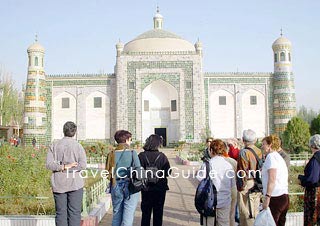 | | Exterior of the Abakh Khoja Tomb | | 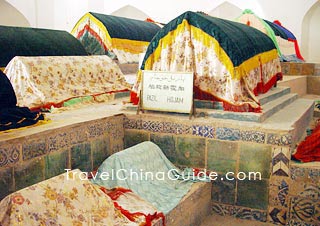 | | Coffins in the tomb chamber | |
In China the tomb is better known as the Tomb of Xiang Fei, the only Uigur concubine among the 41 wives of Emperor Qianlong in the Qing Dynasty (1644-1911). Legend has it that Iparhan, a descendant of Abakh Khoja, exuded an enchanting fragrance without using any perfume, hence the name Xiang Fei (Fragrant concubine in Chinese). She spent 28 years beside the emperor in Beijing, abiding strictly by Islamic doctrines. She wore ethnic costumes and was waited on by a special chef. Before her death at 55 she expressed her desire to be buried in her hometown of Turpan. The emperor so loved her that he had her coffin of clothes sent back to where it is now. This cost 124 people three years and a half. The ancient cart carrying the coffin of Xiangfei still stands in front of the mausoleum, adding a touch of mystery to the building. According to archeological findings, the authentic tomb of Xiang Fei is in the East Qing Tomb near Beijing.
Built from 1640, the tomb covers an area of about five acres. Just inside the gate is a large rectangular courtyard made up of a gate tower, worship walls, Doctrine-Teaching Hall, and tomb chamber.
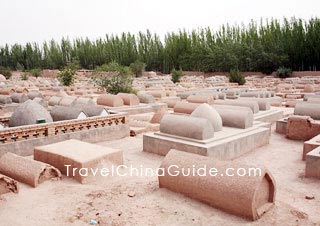 | | Graves in the Abakh Khoja Tomb | | 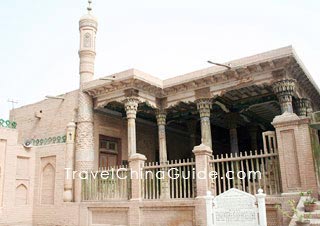 | | Abakh Khoja Tomb with the Islamic Style | |
The tomb chamber is the main building in the group, the most magnificent mausoleum in Xinjiang. Its base is rectangular with a huge brick column at each corner. The dome of the main chamber is semicircular with a diameter of 17 meters (55.7 feet). At its top is a circular edifice with a crescent. The chamber is 36 meters (118 feet) long and 27 meters
(88.5 feet) high. The tomb faces south with a staircase leading to its top. The gate to the tomb is decorated with exquisite plaster patterns.
The walls and the dome are covered with green glazed tiles. Ceramic tiles with colored patterns and Arabic words dot the four sides as well. Fifty-eight tombs provide resting places for five generations of 72 people in the Abakh Khoja family. All coffins are covered with gorgeous silk and satin. The stone coffin of Xiang Fei lying inconspicuously in the southeast corner attracts many visitors.
Abakh Khoja Tomb is admired as a well-preserved Islamic architectural complex not only in Xinjiang, but throughout Central Asia. Xiang Fei's love story intrigues tourists from home and abroad.
| Admission Fee: | CNY 30 |
| Opening Hours: | 08:50 to 20:00 |
| Recommended Time for a Visit: | One hour |
- Last updated on Apr. 12, 2021 -
