Black Dragon Pool
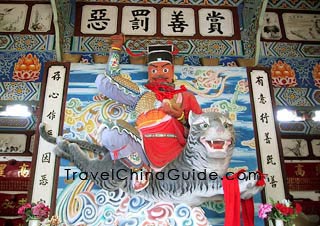 |
| Taoist painting in the temple |
Legend of Black Dragon Pool
Black Gragon Palace
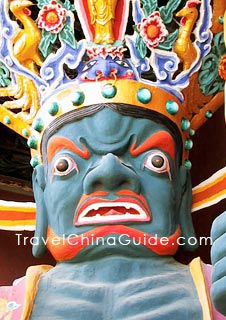 |
| Statue of Heavenly King |
Three Ancient Trees
Pavilion of Stele
Tombs of Local Patriots
Dragon Fountain Plum Garden
How to get to Black Dragon Pool, Kunming
Kunming Bus Search
| Entrance Fee | CNY 15; Free for children under 1.1m (3.6ft). |
|---|---|
| Opening Hours | 08:00 - 18:00 |
| Recommended Time for a Visit | 1 hour |
- Last updated on Dec. 11, 2018 -
Questions & Answers on Black Dragon Pool
Asked by Ar | Dec. 09, 2018 02:43 Reply
Reply
ReplyAnyone have accurate opening hours of Kunming Black Dragon Pool?
This page says it's open until 20:00, but that's not true on Sunday at least. It was closed. After 1800 when I showed up.
Answers (1)
Answered by Tina from USA | Dec. 10, 2018 19:44 0
0 0Reply
00ReplyThe opening hour is from 08:00 to 18:00.
Asked by Emiliano from ITALY | May. 31, 2018 03:45Reply
ReplyWhat is the time and price from Yuantong Temple to Black Dragon Pool by taxi?
Thanks :)
Answers (3)
Answered by Enya from SWAZILAND | Jun. 04, 2018 04:0800Reply
00ReplyIt takes about 2 hours and CNY 80. In fact, the bus is very convenient.
Answered by Emiliano from ITALY | Jun. 04, 2018 23:2700Reply
00ReplyWow. Okok. From Yuantong temple do you know which is the most convenient bus to get among 9, 79, 128 and 249. Thanks a lot.
Answered by Enya from SWITZERLAND | Jun. 05, 2018 20:2700Reply
00ReplyI’m sorry I made a mistake. If you take a taxi, it takes about 50 minutes and CNY 40. If you go by bus, you can take bus line 101 from Yuantong Street Station to Xiao Caiyuan Station and walk about 200m to another Xiao Caiyuan Station to take bus line 9. Get off at the No.2 People’s Hospital Station and walk about 600m you can get there.
Asked by Kcang from MALAYSIA | Apr. 14, 2018 03:58Reply
Replytake taxi from north coach to Kunming black dragon pool
what's the journey time and how much will it cost by taking taxi from north coach station to black dragon pool?
Answers (2)
Answered by Clair from AUSTRALIA | Apr. 16, 2018 01:2910Reply
10ReplyIt charges around CNY 15 and takes about 10mins.
Answered by K C Ang from MALAYSIA | Apr. 16, 2018 05:3600Reply
00ReplyThx a lot
Asked by Linda from NETHERLANDS | Jul. 11, 2012 09:19Reply
ReplyIs the Black Dragon Pool in Kunming the same with the one in Lijiang ?
Answers (1)
Answered by Nina | Jul. 11, 2012 22:1941Reply
41ReplyOf course not. One is located at the foot of Longquan Hill of Kunming and the other is at the foot of the Elephant Hill of Lijiang. The former is known as the Dragon Fountain Temple (Longquanguan) and the latter is also considered as Jade Spring Park (Heilongtan Park). They actually have different scenery.