Located at the southern foot of Qixia Hill near the West Lake and occupying an area of 1.57 hectares (3.9 acres), the Tomb of General Yue Fei, also known as Yue Fei Temple, was built in memory of this great hero.
Yue Fei (1103 - 1141) came from Tangyin in Xiangzhou of today's Henan Province. He was a great general famous for wars against the Jin Dynasty (1115 - 1234) in the Song Dynasty (960 - 1279). After he joined the army, he and his troops continuously won wars against the Jin. However, after Yue and his army had recovered most of the lost territory, Emperor Gaozong (1107 - 1187) embraced the evil plot of Qin Hui (1090 - 1155, Prime Minister of the Song Dynasty) and surrendered to the Jin. As a result, he was falsely accused and later secretly killed in jail. A few years later, the wrong was put right when Emperor Xiao Zong (1163 - 1189) came to power. The tomb was built in memory of this great hero. Yue Fei is always considered as a national hero.
The Tomb of General Yue Fei has been demolished and renovated several times. The existing one was rebuilt in 1715 in the Qing Dynasty (1644 - 1911) and comprehensively repaired in 1979.
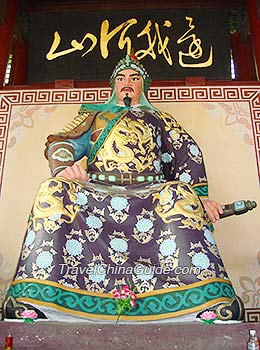
Entering the gate with double eaves of the Tomb of General Yue Fei, a patio with towering trees on both sides is found. The Shrine of Remembrance, the main hall, is right in the center. A sculpture of general Yue is set in the middle of the hall. He is in a colorful embroidered round cushion cover. Looking solemn and mighty, he has a sword in his hand and looks as if he is ready to protect his country. Over the sculpture is tablet in the original handwriting of Yue Fei, which states returning our territory and keeping it integrated. At the back of the hall are large pictures depicting his life stories. On the floor of the hall is a picture depicting 373 cranes. These cranes are the symbols of his integrity and faithful mind.
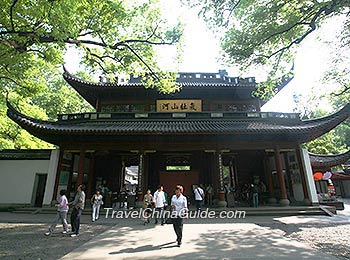 | | Gate to Visit the Tomb | | 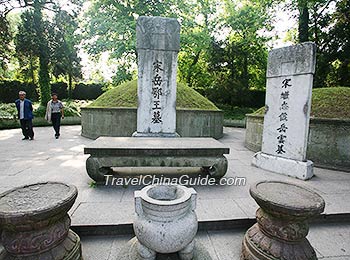 | | General 's Grave | |
To the west of the main hall of Tomb of General Yue Fei is a yard. There are two corridors exhibiting poems written to commend Yue. Striding over the bridge in the middle of the yard, there are the tombs of Yue Fei and his son's.
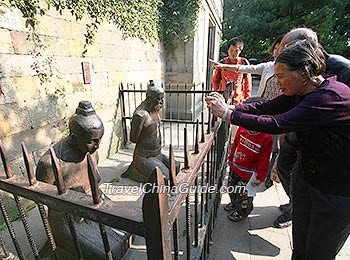 |
| Metal sculptures of sinners who killed Yue Fei |
The General Yue's tomb is right in the center, and to its left is the tomb of his son Yue Yun who had been a competent assistant of his father on the battlefields. Stone horses, tigers, and sheep of the Ming Dynasty (1386 - 1644) decorate both sides of the enclosure. The Tomb of General Yue Fei, which had been destroyed several times, was rebuilt and possesses the features of the Song Dynasty. Facing the tomb are four iron sculptures,
including Qin Hui the chief plotter, in kneeling position. Concerning these sculptures, people wanted them to atone for their crime forever.
How to get to Tomb of General Yue Fei
Take bus 7, 27, 51, 52 or 118, and get off at Yuemiao (Yue Fei Temple) Station.
Hangzhou Bus / Metro Search- Last updated on Apr. 12, 2021 -
 More Pictures
 Top 10 Things to Do in Hangzhou
 Reply
Reply 2
2 5
5