Sui Dynasty Great Wall
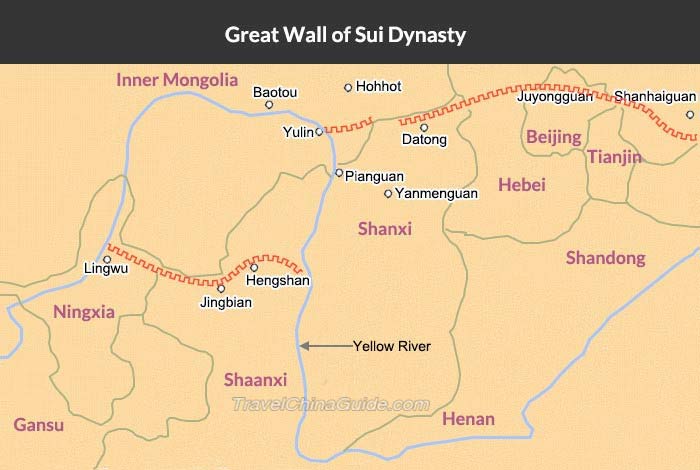 |
| Sui Great Wall Map (Click to enlarge) |
The Sui Dynasty undertook building the Great Wall seven times during its short reign from 581 to 618. Why did the Sui Dynasty expand the wall so many times? Just like other dynasties in Chinese history, the first five times were out of the need for national defense, for the reign of Sui over central China was always threatened by its northern neighbor, the Eastern Turkic people. However, the latter two times were completely different! The last two expansions of the wall were ordered by the fatuous Emperor Yang of the Sui to show off the dynasty's national power and his supreme dictatorship. This exhausted the civilians and incurred uprisings, eventually leading to the demise of the Sui Dynasty.
Apart from renovating the previous walls erected by the Northern Wei (386-534) and the Northern Qi (550-577), the China Great Wall of the Sui Dynasty was extended to Shaanxi, Ningxia, Gansu and Inner Mongolia. The entire wall ran from Shanhaiguan Pass near China's east coast along the Bohai Bay to Gansu Province in the western hinterland. Today, the relics can be found in Shanxi, Shaanxi, and Inner Mongolia.
Sui Dynasty Great Wall History: Expanded Seven Times
After overthrowing the Northern Zhou Dynasty (557-581), Emperor Wen of Sui established the Sui Dynasty in 581. The capital city was Daxing, today's Xi'an in Shaanxi Province. Later in 589, he unified China by annexing the Southern Chen Dynasty (557-589), putting an end to an era of chaos that had lasted two centuries. At the same time, the northern nomadic tribes, such as the Turkic and Tuyuhun people, became increasingly strong. They often assaulted the northern border of Sui. Therefore, the Sui Dynasty built the Great Wall. 1. When the allied army of the Turkic people with help from traitors of Sui captured Linyu Garrison, today's Shanhaiguan, Emperor Wen ordered the previous Northern Qi Great Wall restored to stop the attacks in 581. 2. In 585, 30,000 laborers were recruited to build the Great Wall. It started from the eastern bank of the Yellow River in Lingwu County, Ningxia, via Jingbian and Hengshan in Yulin, and ended at Suide in Yulin, Shaanxi. The wall spanned over 217 miles (300 kilometers).
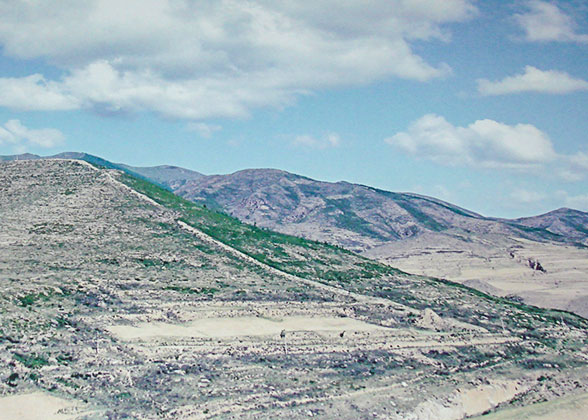 |
| Wall of Sui Dynasty |
3. In 586, a series of fortresses were erected to the east of Shuofang, today's Uxin Banner in Inner Mongolia. They were used to station troops and store grain. 4. In 587, another large-scale Great Wall construction took place, involving over 100,000 laborers. 5. After Emperor Wen's death, Emperor Yang ascended to the throne in 604. He moved the capital from Daxing to Luoyang in 605, and dug a moat around the capital. The moat spanned some 621 miles (1,000 kilometers) from Hejin in Shanxi Province, via Gaoping in Shanxi Province, Weihui, Xinxiang, Kaifeng, and Xiangcheng in Henan Province, to Shangluo in Shaanxi Province. 6. In 607, the wall was built from Yulin, today's Tuoketuo County of Inner Mongolia, to the Zihe River, today's Hunhe River between Horinger and Qingshuihe counties in Inner Mongolia. 7. The Sui Dynasty constructed a wall at the boundary of Gansu and Qinghai Provinces in 608.
Relics of Sui Dynasty Great Wall
The Great Wall of the Sui Dynasty leaves some relics in Kelan County of Shanxi Province, Yulin City of Shaanxi Province, and Otog Front Banner of Inner Mongolia.
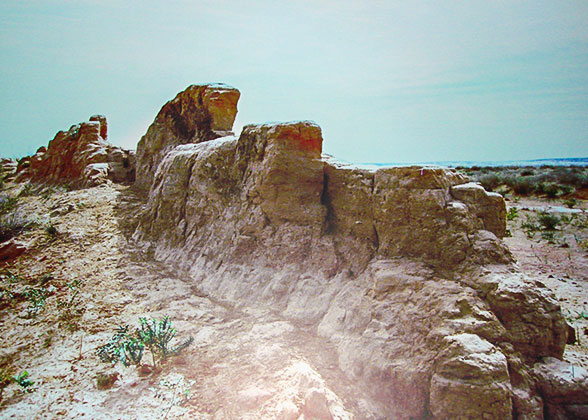 |
| Wall of Sui Dynasty in Yanchi County, Ningxia |
Relics in Kelan, Shanxi: the wall on the mountain ridges is made of stone, and is about 1.6 feet (0.5 meter) to 2 feet (0.6 meter) high. The wall on the mountainside is built of packed earth, with a height of some 5 feet (1.5 meters). In addition, a stone stele has been excavated, which is engraved with construction details of the wall. Relics in Yulin, Shaanxi: the wall is in Yuyang, Shenmu, Hengshan, Jingbian, and Dingbian. It has a total length of about 311 miles (500 kilometers). The wall was built on top of the Qin State Great Wall, and was later used as the foundation of the Ming Dynasty Wall. Relics in Otog Front Banner, Inner Mongolia: the packed earth wall goes across Tebude Village of Shanghaimiao Town in Otog Front Banner, and enters Gaoshawo Town of Yanchi County in Ningxia. It is about 4 miles (6.8 kilometers) long, 10 feet (3 meters) to 20 feet (6 meters) wide, and 1.6 feet (0.5 meter) to 3 feet (1 meter) high. The wall overlaps or runs parallel to the Ming Dynasty Wall in the desolate Gobi desert and grassland.
 Reply
Reply 1
1 1ReplyReply01ReplyReply210Reply