Meng Jiangnu Temple
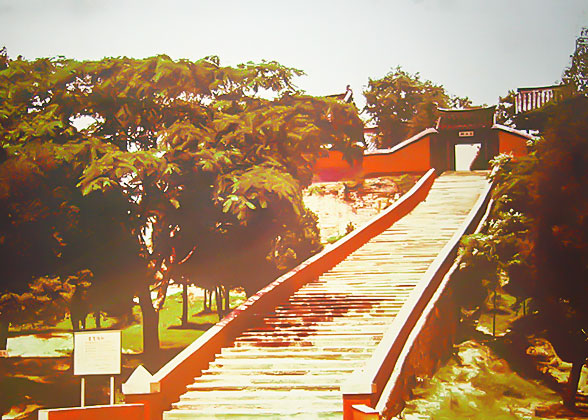 |
| Temple of Meng Jiangnu, near Shanhaiguan Pass |
Meng Jiangnu Temple is located on Fenghuang Mountain (Phoenix Mountain), four miles east of Shanhaiguan Pass. It is thought to have been built before the Song Dynasty (960 - 1279) and repaired in the Ming Dynasty (1368 - 1644).
Every Chinese household is familiar with the legend of 'Meng Jiangnu's Bitter Weeping'. The legend tells the story of the love between a pair of newlyweds in ancient China. The story goes like this:
Once at the Great Wall, she was told that her husband had already died of hunger and exhaustion. Meng Jiangnu cried and cried for several days, and while she wept her cries touched the Heaven. Suddenly a section of the Great Wall collapsed and her husband's body appeared amidst the rubble in front of her. Out of extreme grief, she buried her husband and then jumped into the sea.
Though only a legend, people have admired Meng Jiangnu's love and rebellious spirit for thousands of years. She is remembered in poetry, folk songs, and plays.
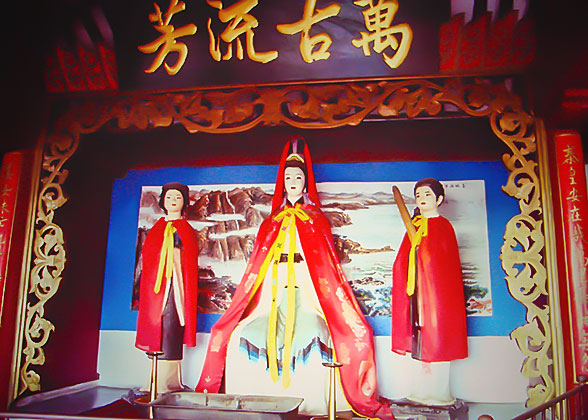 |
| Statue of Meng Jiangnu |
The Temple of Meng Jiangnu is a small and simple temple, with its dark green tiles and red walls nearly hidden by the dense woods that surround it. 108 steps lead to the temple from the foot of the mountain. The main hall pays tribute to Meng Jiangnu with a colored sculpture featuring Meng Jiangnu with two maidens standing by her side. The walls inside the temple are inscribed with poetry, letters, and calligraphy. Near to the temple you will find Zhenyi Pavilion, Waiting-Husband Rock, and Dressing-Table-Like Platform, all of which also relate to the story of Meng Jiangnu's Bitter Weeping.
Waiting-Husband Rock (Wangfu Shi): located behind the back hall of the Temple of Meng Jiangnu, Waiting-Husband Rock is a huge rock above which there are many pits. The legend says the pits were the footprints left by Meng Jiangnu when she climbed on this rock and waited for the return of her husband. Since then, the rock has become the indication of loyalty. Those visitors to Meng Jiangnu Temple would like to climb on this rock, gaze into the distance and have their pictures taken as souvenirs.
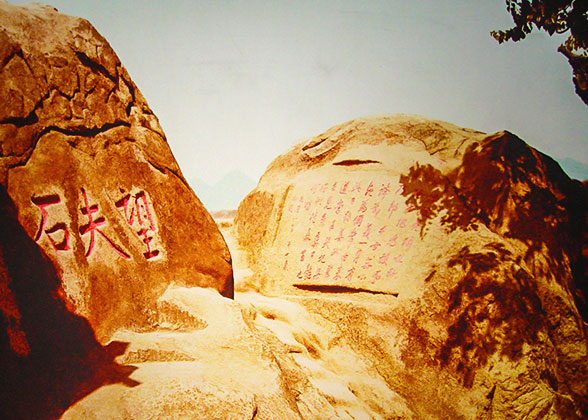 |
| Waiting-Husband Rock |
Dressing-Table-Like Platform: Beside Waiting-Husband-Rock, there is a small platform. This is the legendary dressing table of Meng Jiangnu. Story has it that Meng Jiangnu was very happy when she reached the foot of the Great Wall. She wanted to find a place to tidy herself up. But there was no household around, so she found a huge rock, ground a round pit on it, melted stone in the pit and washed up. The small platform we see today is the said to be the dressing table of Meng Jiangnu.
Besides, around the Temple of Meng Jiangnu, Zhenyi Pavilion is also worth visiting. According to the legend, it is the place where Meng Jiangnu dressed up before jumping into the sea. Occupying a high position, Zhenyi Pavilion is indeed a nice place to watch the Great Wall and Bohai Sea.
| Admission Fee: | CNY 25 |
| Opening Hours: | 08:00 - 16:00 |