Qiandongnan Facts
Chinese Name: 黔东南苗族侗族自治州 (qián dōng nán miáo zú dòng zú zì zhì zhōu)
Population: 4,811,900
Area: 30,282.34 square kilometers (11,692.08 square miles)
Location: in the southeast of Guizhou Province, southwestern China
Administrative Division: 15 counties (Huangping, Shibing, Sansui, Zhenyuan, Cengong, Tianzhu, Jinping, Jianhe, Taijiang, Liping, Rongjiang, Congjiang, Leishan, Majiang, Danzhai); 1 county-level city (Kaili)
Area Code: 0855
Zip Code: 556000
GDP (2019): CNY 112.304 billion (USD 16.278 billion)
Nationalities: Miao, Dong, Han, Buyi, Shui, Yao, Zhuang, Tu
Home to the Largest Miao Village and Dong Village
Situated in southeastern Guizhou Province, Qiandongnan Miao and Dong Autonomous Prefecture neighbors Qiannan Buyi and Miao Autonomous Prefecture to the west, Zunyi and Tongren to the north. It is also bounded to the east by Hunan Province in the neighborhood of Guangxi Zhuang Autonomous Region to the south. Miao and Dong people in Qiandongnan have formed their own unique cultures including architectural culture, clothing culture, song and dance culture, festival culture, custom culture and catering culture. The world's largest Miao village and Dong village are located here, which are respectively Qianhu Miao Village and Zhaoqing Dong Village. In the village, you can see the traditional stilts, Dong Drum Towers and Wind and Rain Bridges, and hear the fair-sounding Miao folk songs and Kam Grand Choirs. The local silver ornaments, embroidery and batik are very famous national crafts. Qiandongnan also has kept more than 320 traditional festivals of over 20 ethnic minorities. The famous festivals include Lusheng Festival, Sisters Meals Festival, Miao New Year Festival and Double Third Festival.
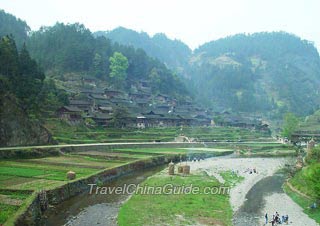 | | Local Scenery of Qiandongnan | | 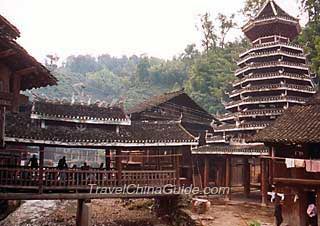 | | Zhaoxing Dong Village | |
Qiandongnan Attractions - Things to Do
Kaili
Kaili, the capital of Qiandongnan Prefecture, is famous for the Miao and Dong ethnic culture. Many of the nearby villages inhabited by the ethnic minorities are worth trying. It is praised to be the 'town of a hundred festivals'. International Lusheng Festival held annually should be the grandest. The festival aims to show the ethnic cultural of the region as the birthplace of Lusheng, the reed-pipe wind instrument.
Top Attractions:
 Xijiang Qianhu Miao Village
: Lying 37 km (23 miles) from Xijiang of Leishan County and 35 km (22 miles) from Kaili, Xijiang Qianhu Miao Village is the only village owning over one thousand
Miao households in China.
Transportation:
Kaili Huangping Airport is 12 kilometers (7.5 miles) away from Huangping County, and 54 kilometers (34 miles) away from Kaili city. The airport has operated direct flights from/ to Hangzhou and Chengdu, Shenzhen and Xishuangbanna. City bus or taxi is the good choice for visitor go downtown from airport.
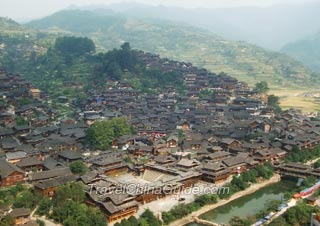 | | Xijiang Qianhu Miao Village | | 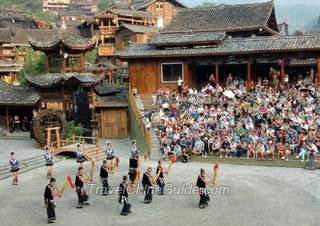 | | Performance in the Miao Village | |
Langde Miao Village: Located in Baode Village of Leishan County near Kaili, this village is inhabited by over one hundred Miao families. Here you can see the Miao people in their traditional long dresses, and enjoy the excellent local music and dance performance.
Zhenyuan
With a history of more than 2,200 years,
Zhenyuan Ancient Town boasts many historical relics especially the unique architecture complex on the cliff. The Green Dragon Cave (Qinglong Cave) on the cliff of Zhonghe Mountain in the east of Zhenyuan is a must-see site. Delicate structures like the Zhongyuan Temple, Ziyang Academy and Wanshou Palace are built on the 80 meters (262 feet) high and 300 meters (984 feet) long cliff. A cruise on the Wuyang River running through the town and a hiking to the picturesque Tiexi River Scenic Area are also recommended.
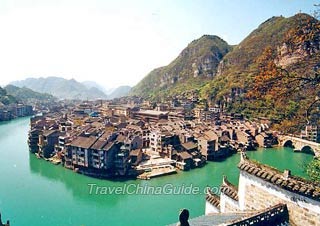 | | Zhenyuan Ancient Town, Qiandongnan | | 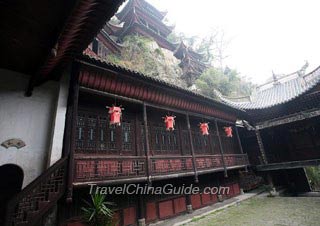 | | Building Complex in Black Dragon Cave | |
Liping
Liping located in the southeast of Guizhou is famed as the ‘Town of Dong People’. It gathers many Dong Villages, which attract visitors to explore the interesting Dong culture.
Zhaoxing Dong Village, being one of the largest Dong villages in Qiandongnan, is renowned for the traditional Dong drum towers and bridges. The quiet and peaceful rural life in Yandong Dong Village and the impressive terrances in Tang'an Dong Village are also amazing.
Transportation:
Liping Airport is located in Jichang Road, Gaotun Town, Liping County, Qiandongnan Miao and Dong Autonomous Prefecture, Guizhou Province. It is 20 kilometers (12.4 miles) away from the Liping County and adjacent to Hunan and Guangxi Provinces. Currently, it has opened direct flights to Changsha, which takes off at 08:15 and lands at 09:55 with a total travel time of 1 hour and 40 minutes. There is one flight on each day.
Huangping
Flying Clouds Cliff (Feiyun Cliff): Also named Flying Clouds Cave, it is located 12 km (7.5 mi) to the northeast of Huangping County. With a history of nearly 600 years, it is an ancient building complex blending the religious architectures, ethnic minorities’ style and the idyllic gardens.
Rongjiang
Sanbao Dong Village: Situated 5 km (3 mi) from Rongjiang County, it is the largest Dong ethnic minority area in China. Visitors can drop in to see the Zengchong Tower nearby. The tower is in Congjiang Count; however it is more convenient to go there from Rongjiang.
Congjiang
Basha Miao Village: It keeps the ancient mode of production and lifestyle of Miao nationality.
Zengchong Drum Tower: Being the largest and most famous drum tower of the Dong style in Guizhou, this fir wood construction was completed in 1672 during the Qing Dynasty (1644-1911).
Gaozeng Dong Village
Longli Ancient Town in Jinping County
Weather
-
Qiandongnan enjoys a subtropical humid monsoon climate bearing some features of plateau climate. Average temperatures of the coldest January and hottest July are respectively 5-8℃ (41-46.4℉) and 24-28℃ (75.2-82.4℉). The rainy season usually lasts from April to October, mainly concentrating on spring and summer.
When to Go: Visitors can visit there in spring, summer and autumn. It is notable that a spread of half a year in Kaili is in rainy season. A raincoat or umbrella should be carried for this trip.
Qiandongnan Travel Tips
History: Before the Spring and Autumn Period (770BC-476BC), this area was known as a place of southern barbarians and partly belonged to the Chu Kingdom and a local ethnic regime. It made great progress in development during the exploitation of the Miao region in Ming Dynasty (1368-1644).
Physical Features: Qiandongnan lies in the transition area from Yunnan-Guizhou Plateau to hills and basins in Hunan and Guangxi. Karst and eroded landforms are widely distributed in the prefecture. Its general terrain is higher in the north, south and west while lower in the east. Western and northwestern part of this prefecture is medium and low mountains, and its eastern and southeastern part has complex distributions of low mountains, hills and basins. On the whole, mountainous region occupies over eighty-seven percent of the prefecture's total area.
Local Highlights: Ethnic minorities in Qiandongnan have a population of 3,640,000, over eighty percent of the prefecture's total population. Miao and Dong minorities are the biggest groups. The colorful traditional festivals and local folk customs are the highlights of the prefecture.
Road-block drinking is the first ritual when the hospitable Miao people welcome guests. From the foot to the gate of the village, there are usually twelve barriers with full dressed Miao youths pledging wine to visitors.
- Last updated on Jun. 07, 2022 -