Tongren Travel Guide
Tongren Facts
Chinese Name: 铜仁 (tóng rén)
Population: 4,270,000
Area: 18,000 square kilometers (6,950 square miles)
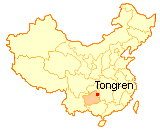
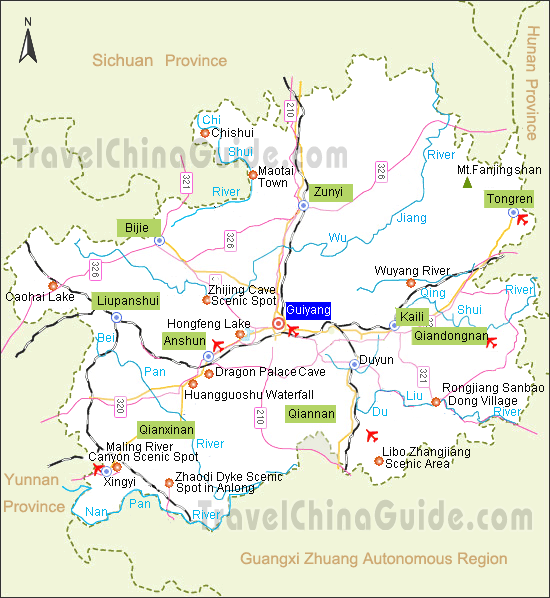
Location: in the northeast of Guizhou Province, southwestern China
Administrative Division: 2 districts (Bijiang, Wanshan); 4 counties (Jiangkou, Shiqian, Sinan, Dejiang); 4 autonomous counties (Yuping Dong, Songtao Miao, Yanhe Tujia, Yinjiang Tu and Miao)
Area Code: 0854
Zip Code: 558000
GDP (2019): CNY 124.916 billion (USD 18.002 billion)
Nationalities: Han, Buyi, Miao, Shui, Maonan, Yao
Famous for Fanjing Mountain
Tongren lies in the northeast part of Guizhou Province, neighboring Chongqing Municipality to the north and Hunan Province to the east. It is a vital nexus between Central China and the southwest frontier, and accordingly is known as the 'Gateway of the Guizhou Eastern Area'. Legend has it that during the Yuan Dynasty (1271-1368) a man found three bronze figures underwater, hence the name Tongren (bronze figure). Yongren is widely known for Fanjing Mountain, one of five famous Buddhist mountains in China. The mountain has been functioned as the place where the Buddhist rites are performed since ancient China, along with Huguo Temple and Chengen Temple. What is more magic is that people can see the huge halo of seven colors on the clouds opposite to the sun before 9 a.m. and after 4 pm. Visitors can also watch the Nuo Drama, called the "living fossil" in drama. It is a kind of religious sacrificial drama with masks.
There are well-known tourist destinations in Tongren Region including: the Nine-dragon Cave Scenic Spot (famous for Karst caves), Fanjing Mountain National Nature Reserve, and the beautiful Jinjiang River. There are also many well-known cultural destinations including: Dongshan Temple, China Nuo Opera and Nuo Mask Museum.
The transportation system is well developed in this region. Tongren Fenghuang Airport services flights to Guiyang, Chongqing, Guangzhou, Shenzhen and is the transportation hub of Hunan, Chongqing, Hubei and Guizhou. Several highways converge in this region and provide convenient transportation for tourists.
Weather
 Reply
Reply 0
0 0ReplyReply00ReplyReply00Reply00Reply00ReplyReply10ReplyReply
are they near each other ? should i take public transport between them ? is walkable?
thank u for info :)
10Reply