Tangshan Travel Guide
Tangshan Facts
Chinese Name: 唐山 (táng shān)
Population: 7,935,800
Area: 13,472 square kilometers (5,201 square miles)
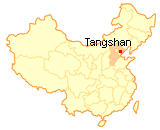
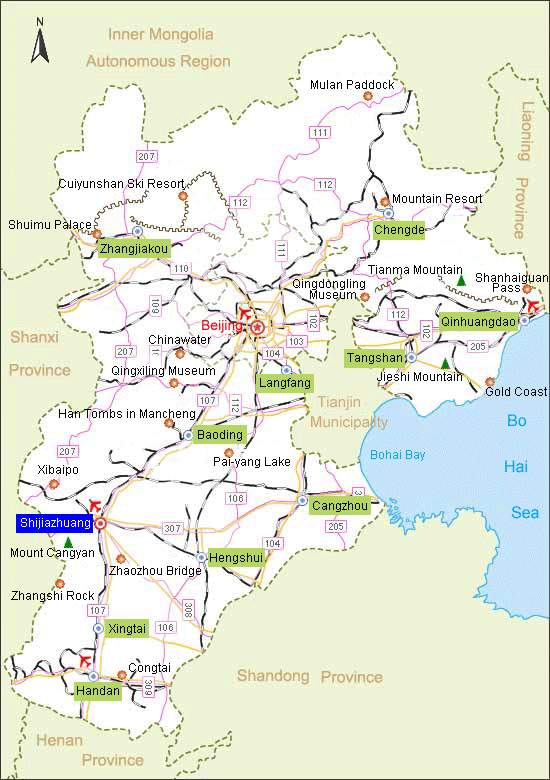
Location: in the east of Hebei Province, north China
Administrative Division: 7 districts (Caofeidian. Lunan, Lubei, Kaiping, Guzhi, Fengnan, Fengrun); 4 counties (Qianxi, Yutian, Luannan, Leting); 3 county-level cities (Zunhua, Qian'an, Luanzhou); 4 development zones (Haigang Economic Development Zone, New and High-tech Industrial Development Zone, Lutai Economic and Technological Development Zone, Hangu Management Zone)
Area Code: 0315
Zip Code: 063000
GDP (2019): CNY 689 billion (USD 99.87 billion)
Cradle of China's Industrialization
Tangshan city is located in the east of Hebei Province, bordering the Bohai Sea to the south, Yanshan Mountain to the north, Beijing and Tianjin to the west. It is about 154 kilometers (96 miles) from Beijing. Although Tangshan was damaged by the Tangshan Earthquake in 1976, turning into ruins in a flash, it is now one of the most modern Chinese cities after reconstruction and development. Here is also the place where China's first mechanized coal mine, standard gauge railway, steam locomotive and barrel of machine-made cement were born, which gave birth to China’s rich industrial civilization. Tangshan is also the birthplace of China's Ping Opera. Besides, visitors can find many historical and cultural relics here, such as the Eastern Qing Mausoleum and the Great Wall under Water (Xifengkou and Panjiakou Great Wall).
Tangshan Attractions - Things to Do
 Eastern Qing Mausoleum: the most magnificent and well preserved architectural complex of Imperial Tombs of Ming and Qing Emperor with 15 catacombs Jingzhong Mountain: a religious mountain well-known for its combination of Buddhist, Taoist, and Confucian buildings since Qing Dynasty (1644-1911). The Great Wall under Water (Xifengkou and Panjiakou Great Wall): a part of the Great Wall constructed in Ming Dynasty (1368-1644) in northern Tangshan City with several passes submerged under the water of Xifeng Lake
Other tourist attractions:
Islets: Puti, Jinsha, Yuetuo
Mountains: Lingshan Mountain, Jiufeng Mountain
How to get to Tangshan
Tangshan Sannühe Airport is about 20km (12mi) to downtown. It operates direct flights to/from 14 doemstic cities, including Shanghai, Guangzhou, Hangzhou, Shenzhen, Xi'an, etc. Shuttle bus, city bus and taxi are all available in the airport.
Tangshan Railway Station and North Railway Station serve the public. Trains to Beijing, Tianjin, Harbin, Qinhuangdao and other major domestic cities operate now.
How to get to Tangshan from Beijing/Tianjin
The transport from Tangshan to Beijing and Tianjin is convenient. There are many buses and trains a day to Beijing and Tianjing from the local West Bus Station taking about 2 to 3 hours.
See detailed Tangshan to Beijing Train
Weather
 C (51.8F), and its average yearly rainfall reaches 760 millimeters (30 inches). When to Go: Summer and autumn are the beat seasons to visit - with the calm sea in summer, cool and pleasant weather in autumn.
Tangshan Travel Tips
Dining: The local dishes have typical salty flavor of North China. Sea cucumber with pork joint, sliced fish with sauce and braised turtle rim are the specialties while the local honey sesame candy and Chinese chessman shaped pancake are the favorite snacks of locals. Physical Features: Situated at the bottom of Yanshan Mountain's southern slope, the north of the city occupies mountainous areas, the central plain and the coastline of 199.3 kilometers (124 miles) to the south. Coal, iron, petroleum, natural gas, and salt make up the main natural resources. History: According to archaeological discoveries, it was validated that this area was inhabited as far back as 45,000 years ago. It became a shire in Han dynasties (206BC-220AD) and obtained its name 'Tangshan' by the Dachengshan Mountain which was vouchsafed by the emperor in Tang Dynasty (618-907). Since Qing Dynasty (1644-1911), it has been an industrial center and was officially founded as a city in 1938. Local Highlights: Ping Opera and Leting Drums Song (the most characteristic local operas); Tangshan Shadow Puppetry Play. Special Local Products:
Handicrafts: shadow puppetry, willow knitting crafts
Foods: Jingdong chestnuts, Gushu golden thread small Jujube
 Reply
Reply 0
0 0ReplyReply00ReplyReply00Reply00Reply00ReplyReply20Reply00ReplyReply51Reply
For a D train, it costs CNY 44.5 or 52 for a second-class seat, and CNY 52.5 or 62 for a first-class seat. For a G train, you need to pay CNY 110.5 for a second-class seat, CNY 184 for a firs-class seat, and CNY 349.5 for a business class.
01Reply