Daxing'anling Travel Guide
Daxing'anling Facts
Chinese Name: 大兴安岭 (dà xīng ān lǐng)
Population: 540,000
Area: 84,600 square kilometers (32,664 square miles)
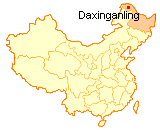
Location: in northwest of Heilongjiang Province, northeast China
Administrative Division: 4 districts (Jiagedaqi, Songling, Xinlin, Huzhong); 3 counties (Huma, Tahe, Mohe)
Area Code: 0457
Zip Code: 165000
GDP (2018): CNY 12.89 billion (USD 1.95 billion)
Nationalities: Manchu, Mongol, Ewenki
Daxing'anling Attractions - Things to Do
Huzhong National Nature Reserve
Located between Daxing'anling main range and Yilehuli Mountain, it is the largest primitive Eastern larch forest in northern China. It is home to many kinds of rare animals and plants. Dabai Mountain, the peak of north range of Daxing'anling Mountain, is the highlight of the area.
Mohe County
It is situated in the north end of China and borders Russia. Beiji Village (The Village of Northern-Pole) is the only place in China to enjoy polar day and polelight. The cross-border river Heilongjiang River rises from Mohe. The 'Gold Path' is said to be the way where gold was transported in ancient times. Yanzhizhou is the famous gold production base where tourists can experience the gold rush by themselves.
Shibazhan Oroqen Town
This town is where the Oroqen (a hunting ethnic minority group) people inhabit. The mysterious local custom and primitive life habit are most attractive.
Gaxian Cave
Located in northwest of Jiagedaqi District, it is an ancient cave where the ancestors of Sarbi people lived thousands of years ago. It is now under the first level state protection.
How to get to/around Daxing'anling
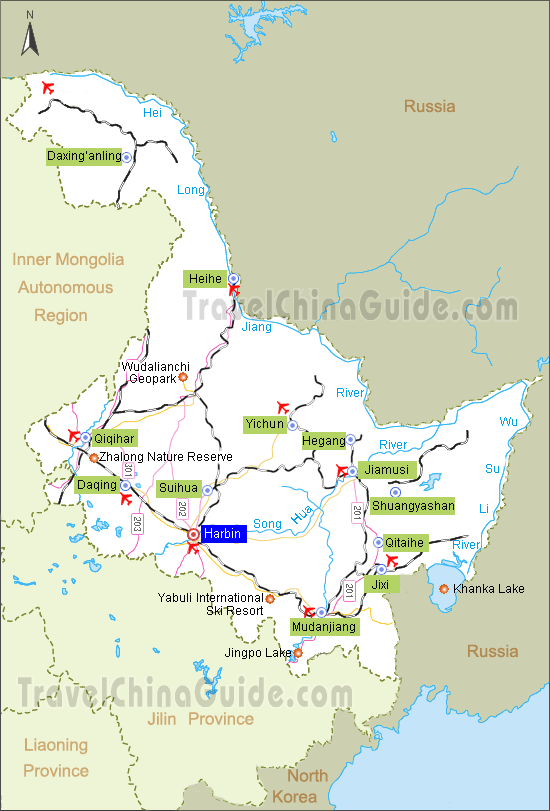
Jiegedaqi Gaxian Airport in Jiagedaqi District is 8 kilometers (5 miles) to downtown Jiagedaqi, which has flights to Beijing, Shanghai, Dalian, Harbin, Hohhot, Hailar and Mohe.
Mohe Gulian Airport in Mohe City has opened flights to/from Beijing, Chengdu, Harbin, Jiagedaqi and Jieyang. Taxi is the only way to travel between the airport and downtown.
Jiagedaqi also has direct railway lines to Harbin, Beijing, Shenyang, Hailar and Manzhouli. Highways are quite well constructed, linking Daxing'anling together with other cities and counties of Heilongjiang Province. To get to Mohe, visitors need firstly get to Harbin; take trains from Harbin to Jiagedaqi for about nine hours and then continue a ten-hour train journey to Mohe.
Weather
 When to Go: June to August is the best time to visit that place, when the daytime is long enough for visitors to explore the land. Moreover, every year when the Summer Solstice comes on June 21st or June 22nd, the rare polar days can be witnessed. Visitors can also enjoy the magnificent polelight if they're lucky enough. Winter is for those who would like to experience the extreme snow and ice scenery. Please remember to take thick clothes and keep warm if you visit in winter.
Daxing'anling Travel Tips
History: Early in the late Paleolithic Age, human beings started to live in this area. It was already a state of the Zhou Dynasty (770BC-221BC) empire. From Sui Dynasty (581-618) to Liao Dynasty (916-1125), it was controlled by the Shiwei people (the ancestor of Oroqen Nationality). In the 16th century, it was reigned by the Manchu people. In 1970, it became a district under the direct guide of Heilongjiang Province. Physical Features: With Daxing'anling mountain ranges lying in the west, this area inclines from high west to low east. The whole area is covered with mountains, hills and basins among mountains. Local Highlights: Daxing'anling is a natural unpolluted area with peculiar landscape of forest, rivers, ice and snow. It is the largest modern national forest area in China. Large areas of forest offer the locals with abundant wild plants and animals resources. In addition, it is rich in minerals especially gold. Special Local Products: Natural plants in the thick mountain forest provide rich food resources including daylily, needle mushroom, agaricus, and glossy ganoderma.
 Reply
Reply 0
0 0Reply00ReplyReply
We will land in mohe airport at 4pm. May i know how to do we go to the village?
Thank you.
00ReplyReply10ReplyReply10ReplyTo reach Mohe, you can head for Mohe from Harbin by flight or by train. Upon reaching Mohe, you can hire a local car to reach the China's Arctic Village.
Besides the Mohe, you can visit the Harbin city to see the Central Avenue and so on in summr time.
ReplyWhat else can i do at Mohe? Where to stay at that place? Sorry for many question.
01ReplyIf transfering is accepted, you can take bullet trains for Harbin and then fly to Mohe.
The average temperature is around 10 to 20C in the summer time for that place and it is a wonderful place for enjoying cool summer. For the northern lights, I think you may mean the aurora, right? If so, it is suggested to go there around June 20.
For living, the Mohe BeiBei International Youth Hostel and Lvyou Zhijia International Youth Hostel are suggested and you can find the detail information on the Youth Hostel Association website.
00Reply