Hebi Travel Guide
Hebi Facts
Chinese Name: 鹤壁市 (hè bì shì)
Population: 1,649,600
Area: 2,182 square kilometers (842 square miles)
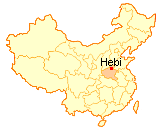
Location: in the north of Henan Province, east-central China
Administrative Division: 3 districts (Qibin, Shancheng, Heshan); 2 counties (Qixian, Junxian)
Area Code: 0392
Zip Code: 458000
GDP (2018): CNY 86.19 billion (USD 13.03 billion)
City at the Foot of Taihang Mountains
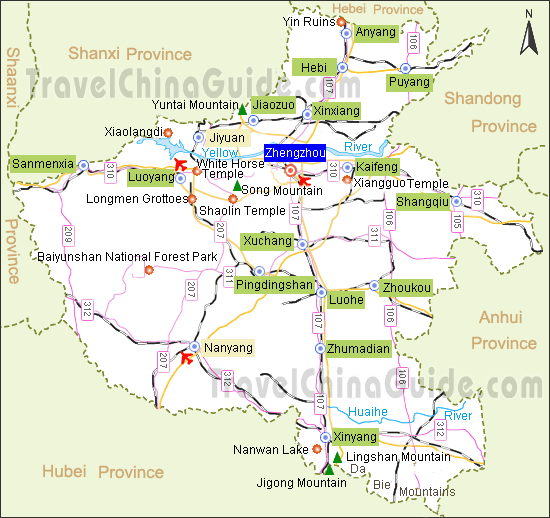
Hebi is located in northern Henan Province and sits on the foot Taihang Mountain. It is close to Anyang to the north, west and east and to Xinxiang to the west and south. Hebi has convenient transportation. The high speed train rides only take 30 minutes to Zhengzhou and 2.5 hours to Beijing, Wuhan, and Xi'an. It is 130 kilometers (81 miles) away from Zhengzhou Xinzheng International Airport. For a Hebi travel, Junxian County and Qixian County of Hebi are two must-go places which are famous for places of interest and historic sites. Dagu Mountain with a great number of temples and Fuqiu Mountain highlighting the grottoes of the Qianfo Temple are most popular in Junxian County. Qixian County features fascinating natural scenery along the Qi River including the beautiful Jiguan Mountain, stone tower and waterfalls. Qi River Natural Taichi Diagram is a well-known attraction.
Hebi Attractions - Things to Do
 Mt. Yunmeng: Located southwest of Qixian, it is famous for beautiful mountain scenery and its ancient strategic culture. Mt. Dapi and Mt. Fuqiu: Located in Junxian, the two mountains stand face-to-face, famous for their Taoist temples and ancient architecture. Qi River Natural Taichi Diagram: Located northwest of the urban city, it is the biggest natural Taichi diagram in China. With many historical sites and beautiful river scenery, it has become one of the most popular tourist resorts in Hebi. Historical Sites: Ancient Great Wall Site of Warring States Period, Ancient Porcelain Kiln Site of the Song Dynasty (960-1279), Ancient Coal Mine Site of the Song Dynasty
Other Scenic Spots: Lingshan Temple, Wulongdong National Forest Park, Sanxing Kangle Village
How to get to/around Hebi
The city has convenient transportation options. Jingguang (Beijing- Guangzhou) Railway, Jingzhu (Beijing- Zhuhai) Highway and other branch railways and national highways connect in the city, making it easy to get to most of China's other cities. Long distance buses run between Hebi and other provincial cities every day. City buses and rented cars offer visitors more convenience for getting around the city.
To get to Junxian, get to Anyang Railway Station, then catch a bus to Junxian.
Weather
Hebi Travel Tips
History: Dating back to the Xia Dynasty (21st - 16th century BC), this region was just three individual states belonging to different kingdoms. It was not until the West Han Dynasty (206BC-24) when the two counties Qixian and Junxian as well as Dangyinxian (today's Hebi inner city) formed. Later dynasties witnessed the change of the three areas, and finally in 1957, Dangyinxian was changed into Hebi City. In 1986, two more counties, Qianxian and Junxian, were brought under the control of Hebi City. Physical Features: Mainly hills between Taihang Mountain and Northern China Plain Local Highlights: The city has two counties, Junxian and Qixian, which are respectively national and provincial historical and cultural city. Qi River, one of the unpolluted rivers in Northern China, traverses Hebi and brings beautiful scenery along the bank. Special Local Products:
Handicrafts: stone statues, embroidery, willow knitting, wooden and mud dolls, copied ancient pottery, and natural stone tea set
Foods: Junxian tofu and Fenpi (sheet jelly made of bean or potato starch), Qi River crustaceans
 Reply
Reply 0
0 1ReplyReply32ReplyReply32Reply
The website may help.
https://www.travelchinaguide.com/china-trains/
Good Luck then!
11ReplyThe long distance bus will cost you more than 20 hours and so does the trains. However, there are many planes for Zhengzhou and cost you about 2 hours to reach Zhengzhou.
You need to take the plane from Shenzhen to Zhengzhou first and then take the airport shuttle bus to go there. There is only one bus for there everyday at 14:00, so you need to book the plane that can reach the airport before 14:00.