Huangshi Travel Guide
Huangshi Facts
Chinese Name: 黄石 (huáng shí)
Population: 2,470,700
Area: 4.583 square kilometers (1,770 square miles)
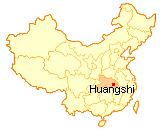
Location: in the southeast of Hubei Province, central China
Administrative Division: 4 districts (Huangshigang, Xisaishan, Xialu, Tieshan); 1 county (Yangxin); 1 county-level city (Daye)
Area Code: 0714
Zip Code: 435000
GDP (2018): CNY 159 billion (USD 24 billion)
A Textile and Clothing City and Raw Material Industrial Base
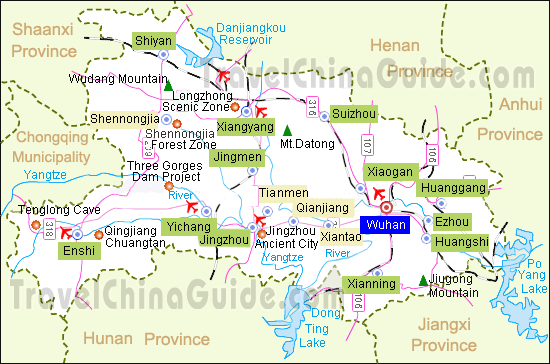
Huangshi is located in the southeast part of Hubei Province neighboring the Yangtze River to the north and Jiangxi Province to the southeast. Going up the Yangtze River, Wuhan is 143 kilometers (89 miles) away, while Jiujiang is 126 kilometers (78 miles) downriver. Huangshi is a new textile and clothing city, with more than 140 textile and clothing enterprises and over 30,000 employees. Every year, a large number of fabrics, clothing and sports shoes are sold to Japan, European and American countries. Huangshi is also one of the birthplaces of Chinese bronze culture and the cradle of the modern Chinese national industry. Now Huangshi is the most important raw material industrial base in central China. Despite the long mining history, Huangshi is still a green city with many beautiful scenic spots.
Huangshi Attractions - Things to Do
Xisai Mountain
Xisai Mountain is not as high as other mountains but it does boast an abundance of cultural relics. Hidden in the thick forest ancient architecture adds a piece of mystery to the mountain. Taohua Gudong (Peach blossom Ancient Cave) lies in the cliffs facing the river on the northern side of Xisai Mountain. Its gate looks like a temple gate measuring 9.9 feet tall. Legend says that the cave was once the place where Zhang Zhihe (an ancient poet living during the Tang Dynasty (618 - 907)) rested and sheltered from the rain. Longku Temple lying on the eastern side of Xisai Mountain was built in the Tang Dynasty and repaired in 1986. Beiwang Pavilion is located in the northern peak. It was built by imitating ancient architecture from where visitors can look down the splendid sight of water surging to the east.
In ancient times, Xisai Mountain was a battlefield where over a hundred battles took place. Moreover, due to its fine scenery, many scholars and men of letters have been moved to write poems and prose to praise its beauty. The most famous one is the poem “In Front of Xisai Mountain” written by Zhang Zhihe which describes a fabulous fairyland from which the poet was reluctant to leave.
Cihu Lake
Cihu bears witness to the glory and history of Huangshi. Together with the nearby Yangtze River, the chains of mountains and the modern buildings, it is a grand environmental resource, adding to the wealth of the local people.
How to Get Around Huangshi
It will take one hour and a half from Huangshi to Wuhan Tianhe International Airport, which operates fights to major cities of China and other countries.
Weather
Having a sub-tropical, continental climate, Huangshi has four distinct seasons. The average temperature in the hottest July on record is nearly 30 C (86F), while it was 4C (39F) in the coldest January. Huangshi has sufficient sunshine and abundant rainfall. However, cold snaps during the normally warm spring, as well as rainstorms, gales, and droughts may hit this area.
 When to Go: Visitors should visit Huangshi in the autumn and avoid going in the torrid days of July and August.
Huangshi Travel Tips
History: Before 967, Huangshi had always belonged to other counties and shires. In that year, Daye County was established. That is the earliest appearance of the city.
Geographical Features: The general terrain of Huangshi slopes downwards from the southwest to the northeast. Yangxin County includes more than four hundred hills and peaks. The Yangtze River flows through the city from the north to the east.
Special Local Product: Raisin-tree fruit, 'Jin' brand healthcare wine, camellia oil
 Reply
Reply 0
0 0ReplyReply00ReplyReply00ReplyReply00Reply00Reply