Jilin Travel Guide
Jilin Facts
Chinese Name: 吉林 (jí lín)
Abbreviation: Ji
Population: 27,040,600
Area: 187,400 square kilometers (72,356 square miles)
Location: in the northeast of China
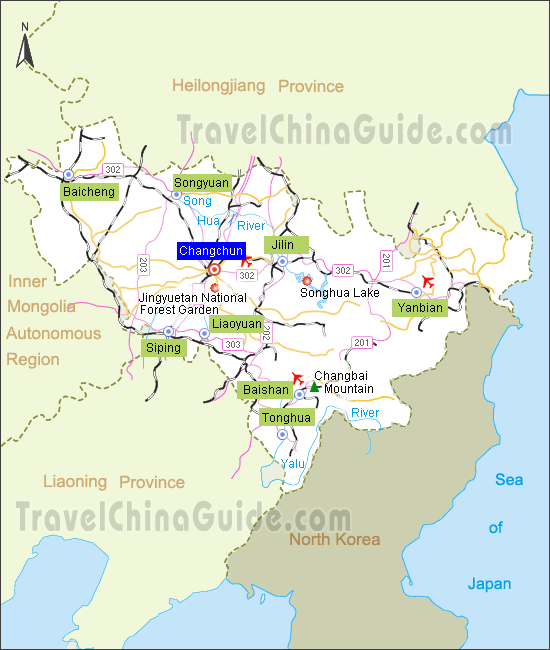
Administrative Division: 8 cities (Changchun, Jilin, Siping, Tonghua, Baicheng, Liaoyuan, Songyuan, Baishan); 1 autonomous prefecture (Yanbian Korean Autonomous Prefecture)
GDP (2019): CNY 1,172.68 billion (USD 169.978 billion)
Nationalities: Han, Chaoxian, Man, Mongolian, Hui, Xibe Jilin Weather
Popular Ski Destination in Northeast China
Jilin with Changchun as the capital, is situated in the northeast of China and adjacent to Russia and North Korea to the southeast and Heilongjiang, Liaoning and Inner Mongolia to the north, south and west. 49 ethnic groups live in Jilin, of which the Korean population ranks first in China.
Only 15 kilometers (9.3 miles) away from the Sea of Japan and 4 kilometers (2.2 miles) away from the Boshet Bay of Russia, the special location not only enhances active trade and exchanges of Jilin with Japan and Russia but also gives the province favorable temperate climate, which includes a lengthy winter with snow that can start as early as October and last until April. Despite the winter cold, people flock to this area for the Ice Lantern Festival and the winter sports. Jilin is known as an area for winter sports and has produced some of the best ski resorts in China. However, it has many other natural and historical attractions to entertain its residents and visitors like China’s largest nature reserve Changbai Mountain and Museum of the Imperial Palace of Manchukuo.
Cities in Jilin
What to See
Changbaishan (Tall White Mountain) includes several highlights that will delight any visitor. There is the mountain itself, which is a nature preserve that has tigers, deer, black bears, leopards, and sable among the more than 200 varieties of wildlife that live in its original, undisturbed forests. Within the forests are innumerable hot springs and a more than 1,500 species of plants. Rare birds, such as the flying Dragon Bird, also make their home in this mountain forest. On the very top of the mountain is Tianchi (Heavenly Lake). The view is nothing short of miraculous and perhaps, as a reward for climbing up this volcanic cone, you might be lucky enough to catch a glimpse of the lake's very own resident 'monster.' The mountain also includes a spectacular waterfall which is the source of the Song Hua River. The western side of the mountain range has three lakes: Songhua, Tai Lake, and Dongting Lake, as well as China's largest ice-skating training facility.
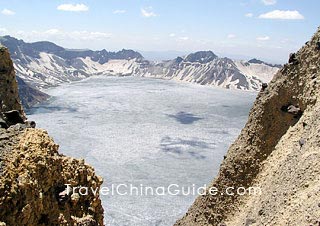 |
| Heavenly Lake, Changbai Mountain |
Interesting historical landmarks are also available in the Province. One of the most famous is the General's Tomb. This granite pyramid was built in the 4th Century for the king of the Gaogouli nation. Its seven stories sit on a base that covers almost 1,000 square meters (about 10,746 square feet). The stones of this pyramid each weigh several tons. The construction of this pyramid was an ominous undertaking for its time. Hiding within the massive stone structure, are a secret passage and the coffin of the king.
In Fu Yu County there is a stele monument called Deshengtuo. The stele was built in the Jin Dynasty (1115-1234 A.D.) and has a singular beauty.
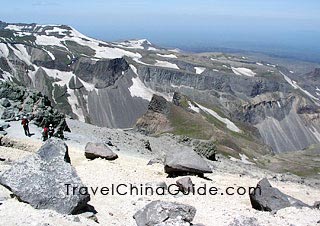 |
| Changbai Mountain |
Pu Yi, the last Emperor of the Qing Dynasty, lived in Chang Chun, the capital city of Jilin, in an Museum of the Imperial Palace of Manchukuo for 14 years (1931 - 1945). This luxurious palace, which also was the administrative departments of the 'Puppet Manchurian Government' has hills, gardens, ponds, swimming pools, and various other forms of recreational facilities. The architecture and design of this 12-hectare (30-acre) palace is a worthy site to visit for its beauty and unique historical importance. Photographs of the emperor, his weddings, wives, parents, and English teacher are on display in the museum.
Jilin has so much to offer in natural beauty and resources - fertile land, dense forests, and rich mineral deposits, countless plants and herbs, a wide variety of birds and animals, and vast grasslands. Did you know that in the city of Jilin there is a Meteorite Shower Museum that houses the largest piece of a meteorite found anywhere in the world? The province truly has a diversity of activities and sights.

 Reply
Reply 0
0 0ReplyReply00ReplyReply
Thank you.
10ReplyReplyThank you.
10ReplyHenan Street Pedestrian: near no.51 Henan Street
Dongshi Pedestrian: near the crossing of Chongqing Street and Changsha Road, Chuanying District
Hunchun Street Night Market: near no.182, Hunchun Street, Chuanying District
Accommodation recommendation: JL Shengjia Business Hotel located at no.14, Henan Street will be quite convenient for you to visit the pedestrian and the night market. It may charge around CNY150-200/night for a standard room.
Tonghua:
Xinzhan Pedestrian: near no.855, Xincheng Road, Dongchang District
Accommodation recommendation: Jinjiang Inn is located at no.508, Shengli Road, Dongchang District. It is only about 500 meters to the pedestrian. A standard room may cost CNY200 or so.
Baishan:
Jingyu Pedestrian: no.13, Shichang Street, Jingyu County
Accommodation recommendation: Jingyu Yimiyangguang Business Hotel is located at the intersection of Tuanjie Street and South Xidajie Road. It is only about 500 meters to the pedestrian. It may cost CNY150-200 for a standard room.
It is quite easy to find the local food along these pedestrians and markets.
Reply00ReplyOr you are suggested to hire a private car or mini van nearby train station or bus stations. Generally speaking, the fare is CNY500 or more in the night.