Who Built the Terracotta Warriors?
Workers Who Built the Terracotta Warriors
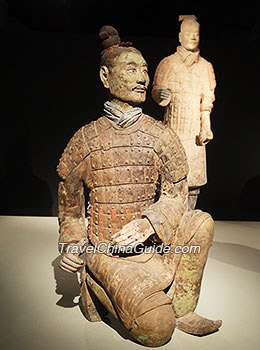 |
| An Exquisite Terracotta Warrior |
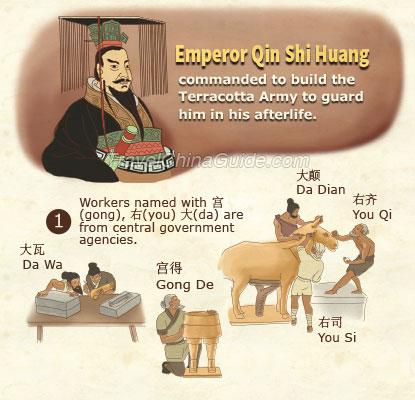
During the excavation and repair work on the terracotta warriors, experts discovered about 80 recognizable names carved or stamped on these figures. They were found hidden in such places as the hips or under the arms of the terracotta warrior statues. Related researches have shown that the names belong to workers who built the terracotta warriors.
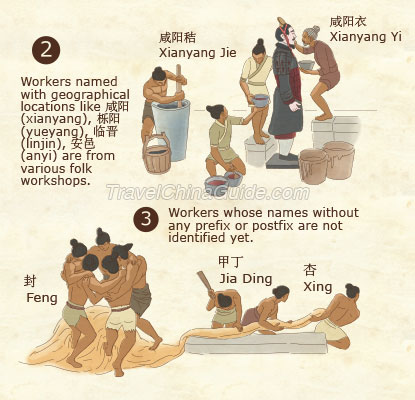
Generally, the recognized 80 names or so can be divided into three types: names beginning with the Chinese character “宫 (gong)”, “右 (you)” or “大 (da)” belong to those who work for government agency; names with geographical location prefixes show that the workers are collected from various regions across the country; and the remaining names without any prefix or postfix are categorized into the unknown workers.
Some names with the geographical location prefixes including Xianyang, Yueyang, and Linjin can prove that the Qin Government recruited countless skilled artisans from all parts of the country. They not only came from Shaanxi, where the warriors were discovered, but also from today's Henan, Hubei, Shandong and Shanxi Provinces. The number of the names carved with Xianyang is the greatest. It is concluded that Xianyang provided plenty of outstanding potters for the construction of Qin Shi Huang Mausoleum.
Different Terracotta Warriors Made by Governmental & Folk Workers
If you look carefully, you will see that the warriors created by the artisans from the central government look dignified and majestic; the figures carved by the folk artisans look lively and fresh, which is greatly related to their life experience and living environment. Also, the technical skill level is reflected in the appearance of the warrior figures. Generally speaking, the artistic skill of the artisans from the central government is higher than that of the folk ones.
How Many Workers Built the Terracotta Warriors?
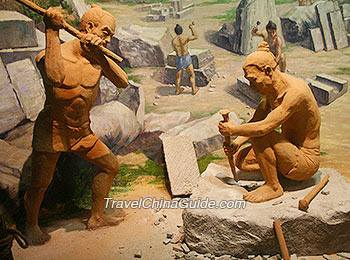 |
| Statues of Work Scene |
All in all, almost 720,000 workers were involved in the construction of Qin Shi Huang Mausoleum, about 8 times of those who built the Pyramid of Khufu. The exact number of those involved in the making of terracotta army is unknown; but it should not be a small number based on the scale of the project.
Sorrowful Ending of the Workers Who Built the Terracotta Warriors
Even though the technical skills of all the artisans were excellent, and their contribution to the construction of the Qin Shi Huang Mausoleum was incalculable, their fate was sealed. After the death of the Emperor Qin Shihuang, Hu Hai, the second emperor of Qin, ordered to bury them alive in the tomb passages so that the secret of the mausoleum would not be revealed. The poor artisans became the victims of the death of Emperor Qin Shihuang and have guarded the entrance to his tomb ever since. Further Reading:
 Ancient Greek Art Inspired China’s Terracotta Army? Impossible! What is the Terracotta Army? 10 Things You should Know Where are the Terracotta Warriors Located? Why was the Terracotta Army built? When was the Terracotta Army Built? Why are the Terracotta Warriors Important? Who found the Terracotta Warriors? Recommended Tour Itinerary:
Terracotta Warriors Tour: One-day to visit Terracotta Army Museum and more
More Xi'an Tours
 Next:
Next:  Reply
Reply 19
19 14Reply00ReplyReply
Thank you,
T J Griffith
1321Reply78Reply00Reply