Lijiang Transportation
Neighboring the Qinghai-Tibet Plateau, Lijiang is easily reachable since becoming a popular tour destination at the end of the 1990s. The earliest vehicle in the region was the horse caravan to Tibet which passed through the Ancient Tea-Horse Avenue all year round. Long journeys through a dangerous natural environment were a great challenge for those caravans.
To promote the development of the local economy and communication with other cities, the local government has continued to pay great attention to improving transportation. As one of the World Cultural Heritage Sites of UNESCO, Lijiang attracts a large number of visitors all year round. Catering for the needs of a greater number of visitors from home and abroad, the city provides improving public transportation, although it possibly has a little way to go to catch up with other large cities in the country.
Air
Lijiang Airport (LJG) is located about 28 kilometers (about 17.4 miles) to the south of the city center, having an elevation of about 2242.6 meters (about 7357.6 feet). Currently, there are connections from Kunming, Xishuangbanna, Beijing, Shanghai, Guangzhou, Chengdu, Shenzhen and Guiyang. However, most visitors prefer to fly to Kunming first, and then get to the city by air, train or long-distance bus.
Train
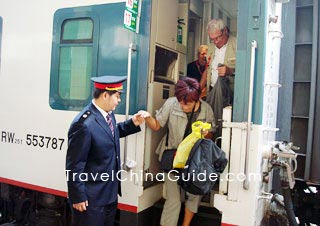 |
| Travel by Train |
About 6 miles (10 km) from the Old Town, Lijiang Railway Station is currently the second largest train station in Yunnan after Kunming Railway Station. The station mainly operates trains to/from Kunming and Dali. How to get to the Railway Station from Old Town?
Passengers can take special line 4 at the entrance of the Old Town to the station directly. It takes about an hour and ten minutes and the ticket fare is CNY1. Or passengers can take taxi to the station; it takes about 30 minutes and costs around CNY30. See detailed Lijiang Train Schedule
Major domestic rail lines from Lijiang to:
Long-Distance Bus
Located at the interface of Yunnan, Sichuan provinces and Tibet, Lijiang has set up a relatively complete highway system extending in all directions. It is easy for visitors to travel betweenthe city and other deatination of Yunnan Province, such as Kunming, Dali and Shangri-La. Additionally, there are regular buses running between the city and Panzhihua of Sichuan Province everyday.
Lijiang Bus Station is located No. 25, Kangzhong Rd., Gucheng District, and the city bus no. 8, 11, 12, 19A, 202, 209 will take you there.
| Destinations | Schedule | Fare (CNY) |
|---|---|---|
| Kunming | 08:30, 12:30 | 200-260 |
| Dali | 07:10, 08:30, 09:00, 09:30, 10:00, 10:40, 11:30, 12:00, 12:40, 13:10, 14:00, 15:00, 16:00, 17:40 | 79 |
| Shangri-La | 07:30, 08:10, 08:50, 09:30, 10:00, 10:40, 11:00, 12:00, 14:00, 18:00 | 80 |
| Panzhihua | 08:30, 10:30, 14:00, 17:00 | 157 |
| Huaping | 07:30, 08:20, 09:30, 10:30, 11:30, 12:30, 13:30, 14:30, 15:30, 17:00, 18:00 | 89 |
| Lugu Lake | 10:00, 12:00, 15:00 | 71/88 |
City-bus
Owing to the city's more prosperous tourist industry, the city buses have made a great progress in recent years. There are more than 10 bus lines running in the city, connecting every corner of the new district, except for the Old Town where no vehicles are allowed to enter. The ticket fare is from CNY0.5 to CNY1. Every morning, the No.7 bus departs from Hongtaiyang Square in the north of the Old Town to Jade Dragon Snow Mountain. The fare is about CNY15. Also, No.8 which departs from the Department Store runs a circular route.
Bicycle
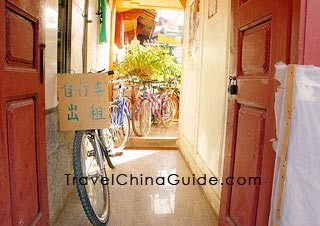 |
| A Bicycle for Rent at Local Hostel |
Some hotels in the city rent bicycles to visitors who would like an unrestricted trip by themselves. Usually, the rent is CNY15 for a day.
Taxi
Although the city is not large, around 1,000 taxis are operating to serve the numerous tourists. Once hailing a taxi in town, the driver usually uses the taximeter: the flag-down rate is CNY7 for the first 3km (2mi) and every additional kilometer (0.6mi) costs CNY1.8. If wanting to go to a far destination, you need to bargain for a reasonable price beforehand. Here is the taxi fare for your reference:
For Lashi Lake: CNY30-40 for a single trip
For Jade Dragon Snow Mountain: CNY150-250 for a round trip
From/To Sanyi Airport: CNY80-100 for a single trip
Transport to Other Cities
How to Travel between Kunming and Lijiang
How to Travel between Lijiang and Shangri-La
How to Travel between Lijiang and Dali
 Reply
Reply 0
0 0ReplyReply00Reply
Another one bus from Xinnanmen Coach Station departs at 12:50.
Reply00ReplyReply00ReplyReply00Reply00Reply