Best Tour Destinations in China
 |
| Our tour group in Forbidden City, Beijing |
The Most Popular Destinations in China
Besides, you may go to visit Shenzhen, Guangzhou, Hangzhou, Suzhou, Guilin, Lijiang, Jiuzhaigou, Sanya, Tibet or Xinjiang. Shenzhen and Guangzhou are well-known coastal cities with fast economic development; Hangzhou and Suzhou boast beautiful water towns, lakes and gardens as well as favorable climate; Guilin, Lijiang and Jiuzhaigou are famed for unique natural scenery, and characteristic ethnic minorities' culture; Sanya in Hainan Province makes you enjoy the charming tropical scenery; Tibet has mysterious religious beliefs, vast grasslands and highest mountains; and Xinjiang attracts visitors by its various ethnic minorities and numerous historical relics along the Silk Road.
 See Top 10 China Destinations for First Time Travelers
Mountain Climbing
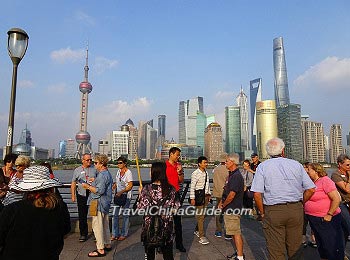 |
| Many visitors at the Bund, Shanghai |
River Cruises
 Yangtze Cruise Tours
Great Wall Trekking
 |
| Our clients on Badaling Great Wall |
Great Wall of China is amazing. Its remains can be found in Gansu, Ningxia, Shaanxi, Inner Mongolia, Shanxi, Hebei, Beijing, Tianjin, and Liaoning. If you want to have a Great Wall hiking tour, Beijing, Tianjin and Hebei are highly recommended. Especially, the Badaling Great Wall in Beijing, the Huangyaguan Great Wall in Tianjin and the Shanhaiguan Pass in Qinhuangdao (in Hebei) are must-sees. Additionally, the Jiayuguan Great Wall in Gansu is a good choice.
Silk Road Adventure
 |
| Our Tour Group in Guilin |
Ancient Towns Visiting
See Top 10 Water Towns in ChinaOther Featured Tours
Another kind of featured tours is coastal cities tours. You can go to Qingdao, Yantai, Weihai, Dalian, Qinhuangdao and Xiamen
Best China Tour Destinations by Month:
- Last updated on Aug. 29, 2022 -
Questions & Answers on Best Tour Destinations in China
Asked by Chandra from SRI LANKA | Oct. 06, 2018 05:12 Reply
Reply
ReplyDo travelers need to bring warm cloths when visiting Shanghai in October?
Answers (1)
Answered by Cindy from MALAYSIA | Oct. 08, 2018 03:00 0
0 0Reply
00ReplyYes, I think sweaters or jackets are necessary since the temperature is from 15C to 25C.
Asked by Nia from MALAYSIA | Sep. 15, 2018 05:26Reply
ReplyWhat is the weather in Shanghai in March? And what are the other places that we can visit?
Answers (1)
Answered by Mina from CANADA | Sep. 16, 2018 19:3200Reply
00ReplyThe temperature is about 5C to 20C and it's still a little cold. Preparing some warm clothes is very necessary and you can wear a sweater and a jacket. Besides Shanghai, you can visit Suzhou and Hangzhou, which are very close to Shanghai and the gardens in Suzhou are very beautiful.
Asked by KimH from USA | Jul. 06, 2018 10:28Reply
ReplyWeather in March/Travel Options
What is the weather like in Beijing in March?
If I want to also visit Shanghai, what's the best way to travel from Beijing to there?
If I want to also visit Shanghai, what's the best way to travel from Beijing to there?
Answers (1)
Answered by Webster from UNITED KINGDOM | Jul. 08, 2018 20:1200Reply
00ReplyAverage temperature in March Beijing is 0 - 12C. It is cold, with an average temperature of 12C during the day, and it is recommended for you to wear suits, windbreaker and sweater to keep warm. The average temperature at night is 0C, and it is suggested to wear thick cotton-padded clothes, gloves…
You can take the high speed trains to Shanghai from Beijing within 5 hours.
You can take the high speed trains to Shanghai from Beijing within 5 hours.