Earthen Buildings of Hakkas
Overview
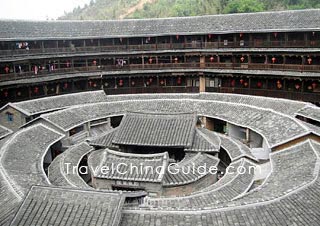 |
Earth Tower of Hakka, Yongding, Fujian Pictures of Yongding Earth Towers Pictures of Nanjing Earth Towers Pictures of Yongding Earth Towers Pictures of Nanjing Earth Towers |
Chinese ancestors thought the sky was round and the earth square. So, round and square buildings are representative of the sky and the earth. Round also implies unification and perfection, which is a foremost ideal of Chinese people.
Architectural Features
The earthen buildings known as tu lou are made of rammed earth and timber with neither concrete nor steel. A Hakka saying has it that one bowl of rammed earth is worth a bowl of meat. The main material is a mixture of fine laterite, fine sand from the river, silt from the bottom of paddy fields and even re-cycled ancient wall mud. After these materials are thoroughly mixed together, quality brown sugar, whisked egg white and the strained liquid from sticky rice soup are added and a new turn of mixing begins. The resultant material is then used for the earthen buildings. The ingenious Hakkas use this method to compensate for the lack of raw materials normally used for building.
As well as providing a defense from enemies, the tu lou has the following advantages: quakeproof, fireproof, theft proof, good ventilation and day lighting. Also due to their thickness, the earthen walls help to provide thermal insulation and preservation, which makes the building warm in winter and cool in summer.
The Influence of Ba Gua
Originally, the Hakkas came from central China and were influenced profoundly by traditional Chinese culture. Earthen buildings were created using the ba gua (Eight Trigrams) theory, more widely known in the West as Feng Shui, which was thought to be the essence of ancient Chinese culture. From a more practical point of view, as the Hakkas usually lived in barren and remote hilly environments, they needed to defend themselves from wild animals as well as other clans.
|
|
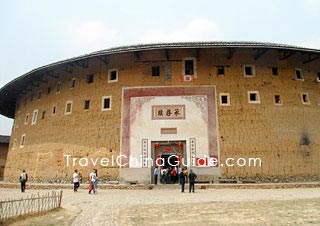
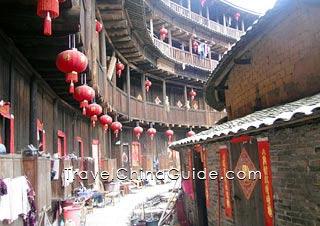
Highlight of Earthen Buildings
This complex of four stories and four circles won fame by its grand and classic architectural style. The base of the wall is 3 meters (9.8 feet) thick and from the lower to the upper the width diminishes from 1.5m (4.9 feet) to not less than 0.9 meters (3.0 feet). There are 72 rooms on each story. In the center of the building lies a rectangle ancestral hall. The configuration conforms with the ancient Chinese idea of a round sky and a square earth.
In Splendid China in Shenzhen, Guangdong, a miniature representation of Chengqi Building stands with dignity among other Chinese architectural wonders.
Hakkas, the Owner of Earthen Buildings
Hakka, literally, means 'guest' in Chinese. They are not an ethnic group like the Tibetans or Mongolians. Their nationality is Han. The ancestors of Hakkas used to live in central China and were forced to move southward due to wars, famine and political reasons.
There were 5 major migrations:
From the end of the Han Dynasty to Jin Dynasty, Han people crossed the Yangtze River to avoid wars.
From the East Jin to the Five Dynasties, Han people moved further south from the Yangtze River.
During the Southern Song Dynasty when the Mongolians spread rapidly southwards and the Song moved their capital to Hangzhou, the Hakkas moved from Fujian and Jiangxi to the north and east of Guangdong.
At the end of the Ming Dynasty as the Mandarin army and farmers' uprising were rampant, Hakkas moved on to central Guangdong and coastal area, also to Sichuan, Guangxi, Hunan and Taiwan with a minority going to southern Guizhou.
During the reign of the Qing Emperor Tongzhi (1862-1874), Hakkas moved on to Hainan, Taiwan, Hong Kong, Macau, South-eastern Asia and even to Europe and America as a consequence of the Taiping Tianguo uprising.
Over their long history, Hakkas have formed their own unique culture. They adhere to Confucianism and give importance to education. Often referred to as the Jews of China, Hakkas excel in many fields from academe to politics and commerce. They are spread around the world and especially in South-east Asia. Notable figures include Deng Xiao Ping, the chief designer of the opening-up and reform of modern China, Li Ka-Shing, a Hakka from Chaozhou, Guangdong Province, is the Asia's richest and most powerful man and No. 22 in the list of the World's Richest People 2005, according to Forbes. Lee Kuan-Yew, the former prime minister of Singapore, also is Hakka.
Tips:
No direct bus is available from Xiamen to Yongding. A better solution would be to hire a car or a minivan.
 Read more:
Hakka Cuisine – Cooking Style of Hakka People in Asia