 |
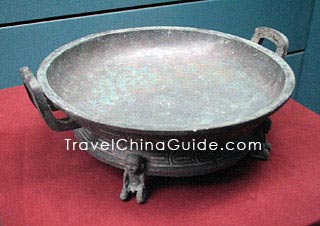
| Bronze Plate |
Bronze is the alloy of copper, stannum and plumbum. After the invention of this alloy 5,000 years ago, it prevailed immediately and led Chinese ancestors into a newstage - the bronze era. Generally speaking, bronze culture underwent three stages, that is, the forming period, the thriving period, and the turning period. The forming period indicates the Longshan Culture 4,500 - 4,000 years ago in the Neolithic Age; while the thriving period from Xia, Shang to the Zhou Dynasties (11th century BC - 221 BC), the artistic achievements were extremely brilliant: bronze was widely used mostly as musical instruments in sacrificial temples, as weapons of war and other vessels in court life.
Decorative patterns then were the most delicate and diverse. Popular patterns were the lines of beasts' faces which seemed mysterious and the lines depicting dragons and phoenix which were believed to be mighty and auspicious. Gradually people developed more complicated means of adorning their vessels. They inset jade, turquoise, iron or copper into the bronze vessels for which posterity admired their wisdom with awe. Ding, is a kind of vessel that could cook and be only possessed by kings and officials, excluding common people. 133 centimeters (52.4 inches) high and 875 kilometers (1,929 pounds) heavy, Simuwu Fang Ding, the largest and heaviest bronze vessel in China, was believed to be forged by a king of the Shang Dynasty (16th - 11th century BC) for worshiping his mother. It represented the highest artistic level.
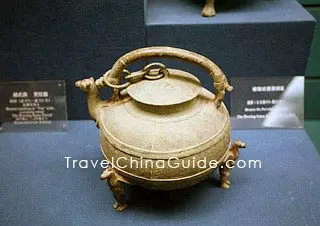 | | Bronze Pot | | 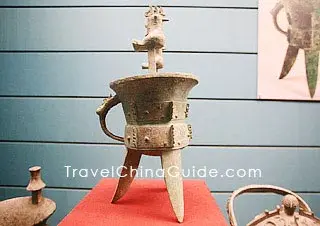 | | Bronze Wine Cup | |
In the Spring and Autumn Period and the Warring States Period, military affairs depended highly on
weapons so that each state tried to make practical bronze ones. The king of the Yue State, Gou Jian, had made the famous Goujian Sword which was still sharp and without any rust when excavated. Another legendary artisan Gan Jiang was even said to be able to cast a bronze sword possessing a wizard's power!
Till the Han Dynasty (206BC - 220), the place of bronze vessels was substituted for those of jade, pottery, and iron. Afterwards, bronze was mostly used for mirrors in various shapes and patterns, although the inscriptions on them are of a very high value.
Suggested Places to See Bronze Vessels in China:
- Last updated on Apr. 20, 2021 -