Education in Zhou & Han Dynasties
Private School Thriving in the Spring and Autumn Period
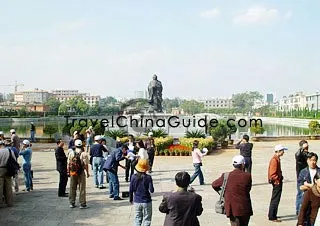 |
| Confucius Temple, Jianshui County, Yunnan |
Confucius, the great educator, devoted all his life to the private school system and instructed most students. It is said that over three thousand disciples followed him, among whom there were 72 sages who went on to broaden the acceptance of the philosophy set out by their master - Confucianism: a philosophy embracing benevolence in living, diligence in learning, and so on.
Besides that, other schools such as Taoism, also taught widely and this led afterwards to 'a hundred schools of thought' in the Warring States Period. During the succeeding years, private schools continued to exist although there were times when state education became fashionable.
Recommendation through Observation in the Han Dynasty (206 BC - 220)
In 136 BC during the reign of Emperor Wudi (156 BC - 87 BC), the government introduced a system which was named 'taixue'. Usually the students were provided with a free diet and mainly studied the classical Confucian books. Following examinations, those with good marks would directly be given official titles.
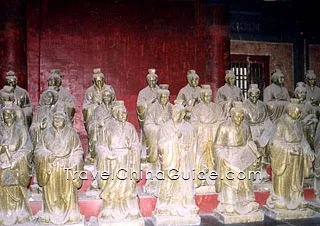 |
| Figurines of 72 disciples of Confucius |
The Nine Grades of Rank in the Regime System in the Jin, Northern and Southern Dynasties
The Nine Grades of Rank in the Regime System (or Jiupin zhongzheng system), employed the following method: in each state and county there was official acting as 'Zhongzheng' with authority to decide how people were ranked in the local precincts according to ability. By ranking candidates for official positions in this way, the government was able to make a choice of the best people for various posts.
Although it had no relationship originally with family background, the 'Zhongzheng' was himself invariably a member of the upper classes and he would often show partiality to families of dignitaries and other upper class people. Thus the disadvantages gradually became apparent and the system was abolished before long.
- Last updated on Aug. 08, 2022 -
Questions & Answers on Education in Zhou & Han Dynasties
Asked by neha from MAURITIUS | Apr. 22, 2016 10:51 Reply
Reply
Replyhow was the education in ancient poor chinese people
Answers (1)
Answered by Lucy | Apr. 22, 2016 20:15 9
9 2Reply
92ReplyIn ancient China, poor people did not go to school or only attended school for a few years. So many people back then could not read or write and there were people making a living by reading and writing letters for others.
Asked by mike from USA | Jun. 22, 2013 13:33Reply
Replywhat kind of education did they have in ancient china
Answers (2)
Answered by Mark from CANADA | Jun. 23, 2013 02:00215Reply
215ReplyIn ancient time, only the morals stardards and Confucianism were taught for the students. Students studied in order to be an officer in the government. To some extent, the education is a elite education.
Answered by anne from LONDON | May. 24, 2015 23:0851Reply
51Replyin the past, to become an officer, you had to pass a difficult test. if you did not pass, then you were still likley to find a job because you were well educated
Asked by Ms.lover power from CANADA | Mar. 22, 2010 16:55Reply
Replywow i'm doing a project on ancient china and this helps me know more about china's education prosses and will help me on the project
Answers (2)
Answered by Mr.josh from CAN | Apr. 12, 2010 14:432126Reply
2126Replyare u a person in mrs vandesters class in2010
Answered by huNTER | May. 22, 2013 12:491119Reply
1119Replyme too!! thanks.