Banpo Culture
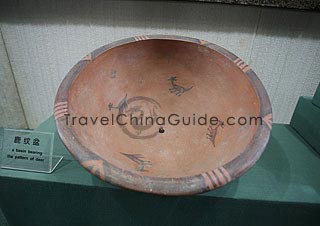 |
| A Basin Bearing the Pattern of Deer |
Banpo Culture originating from the middle reaches of the Yellow River is part of the Yangshao Culture of the Neolithic Age. The culture is so named because it was founded in Banpo Village in Xi'an, Shaanxi Province. The culture lasted from 6,800 to 6,300 years ago and reflects the geographical situation of northern China at that time.
Residents in Banpo lived in villages in clans or tribes. Agriculture, fishing and hunting were their main ways of acquiring food. The dwelling place for a clan was surrounded by a moat as a way to prevent invasion by wild animals. Houses were square or round in shape and were built so that some of the building extended under the ground.
Banpo Culture is renowned for its fine painted potteries. The pottery-painting skills displayed here are listed the top among all the cultures at that time. Not only are the pottery wares of different kinds but they are also meticulously painted with unusual patterns. Human faces, fish, deer, plants and other geometric figures are commonly seen on the wares, which were usually dyed red with black-lined patterns. The most representative design is a basin with human face and fish patterns found in Banpo, Xi'an that is the crystal of art and characters of that time. Judging from the patterns painted on the pottery, archaeologists have concluded that the fish symbol was regarded as a good omen by clans that time.
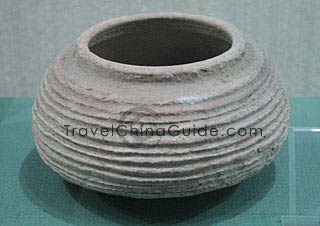 |
| Earthern Pot, Xi'an Banpo Museum |
As for the burying custom, people were buried in the common cemetery. Adornments were usually buried together with the dead body. As for the children, after they died, they would be put into urns and then buried in dwelling areas. As women played a significant role in society during that period, there were more sacrificial articles buried in the girls' graves than those of young boys.
Excavated in 1954, the ruin of Banpo Village lies in the east suburb of Xi'an. In 1958, a large Banpo Museum was built there presenting the production scenes of Banpo people, and social life and artistic achievements to modern people.
 Reply
Reply 0
0 0
0