Bouyei (Buyi) Nationality
 Language:
They speak their own language belonging to Sino-Tibetan phylum; and some are able to read write and speak Mandarin and as well. Belief:
They believe in many gods. There is a God for each Mountain; River, Lake or Pond; for each old and unusual tree, for megalith, caves, paddy field, and for when it rains or thunders, there are various gods. They also worship ancestors' supreme might with each family setting niches in their home, holding activities during the Spring, Pure Brightness, and the Zhongyuan Festivals.
Besides that, as many families are of the same origin, they often worship again together, sacrificing and praying for peace and happiness. Food and Food Culture:
They dwell along nearby valleys and rivers, so they benefit from fertile land and mild climate. Their agriculture and forestry are advanced rice as their staple food; they also enjoy the pickled sour vegetables, glutinous rice, brawn, sausage and blood curd. Their tea culture is all their own, making tea themselves that includes honeysuckle and other plants. Among those, there is a very precious tea named 'Girl's Tea' (Guniang Cha), made by unmarried girls. Usually this is not for sale and only sent as gifts to friends and the girl's boyfriend to indicate her chastity.
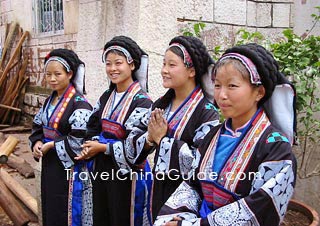 |
| Girls of Bouyei Minority |
When entertaining guests, they will be welcomed with delicious wines and meat. If pork is served, it symbolizes that the guests will have a good harvest; if chicken is served, the chicken's head means auspice, the wings success, and the drumstick, free from anxiety.
Crafts: The Bouyei batik has enjoyed great fame for thousands of years. Firstly, painting various patterns upon white cloth with molten wax, then dyeing with indigo liquor and herbal medicine, and finally dewax the cloth. A finished piece of batik cloth is dainty with brilliant lines. The common patterns are pear flowers, fleuret, waves, eddies, chains, and so on.
Brocade and embroidery are the Bouyei people's fortes. Deft people design their craftworks with splendid patterns and named them as 'lamb brocade', 'fish brocade' and 'butterfly brocade'.
Wood carving is also their famous handiwork, especially masks in Anshun County carved from Clove or Poplar, and the characters can be quite vivid.
Arts:
It is not exaggerating to say that the Bouyei are versatile musicians and are able to play well so many of their traditional instruments such as the Atabal, Gong, and Suona horn.
They are also good singers and dancers. They are also inquisitive, asking others questions about life, nature, animals or even puzzles in the form of a song, which requires quick thinking. The Bouyei also like to perform operas, their arias being loud and sonorous, with actions both lively and unstrained with the common theme being the praise of heroes who were loyal and patriotic.
The Weaving dance was created in the course of laboring, imitating Bouyei girl's diligence; and the Dragon Lantern dance, that derived from their fondness for dragon.
Festivals:
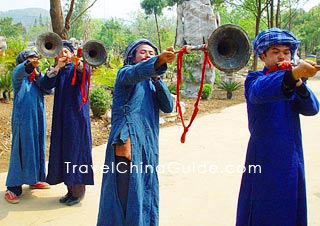 |
| Bouyei men play suona in a festival. |
The third day of the third lunar month it is the time when the Bouyei offer a sacrifice to the gods of land and mountain. On the eighth day of the fourth lunar month is the Ox-God Festival so as to relax their cattle and feed them on cake. On the sixth day of the sixth lunar month, people worship the Gods of the field, land and mountains; and on the 14th day of the seventh month they honor the dead.
More Ethnic Groups in Guizhou Area:
Miao Dong Tujia Yi Gelao Shui Bai