Kirgiz Nationality
The Kirgiz ethnic minority is named after a word meaning forty girls. It has a population of 160,823 mostly distributed throughout the Kirgiz Autonomous Prefecture, Ili, Dacheng, Aksu, Kashgar, the southwest of Xinjiang Autonomous Region, as well as in Heilongjiang Province.
 Language and Belief:
Most of them speak the Kirgiz language, which belongs to the Turkic group of Altaic phylum, and has a written form based on Arabic letters. They living in the south of Xinjiang speak Uigur while those in the north of Xinjiang speak Kazak. Some believe in Islam and others believe in Tibetan Buddhism.
Food and Food Culture:
They make a living doing animal husbandry together with agriculture and livestock product processing, which has influenced their life style greatly.
Usually they have three meals a day. Nang, a kind of pie, and milk tea are their breakfast; at noon and in the evening, they eat mainly flour-based food, horsemeat, beef and mutton. Boiled mutton, which is eaten directly with the hands, makes visitors feel as if they are part of Kirgiz life.
If you are the guests of a Kirgiz family, you will be warmly welcomed by the hosts. They will prepare the most delicious mutton for you. They believe the choicest pieces are the oil of sheep's tail and the meat near vertebral and head. Before enjoying a meal, guests should cut and share the food with the women and children of the host; in the dishes that guests have used, there should not be any leftovers.
Arts and Crafts:
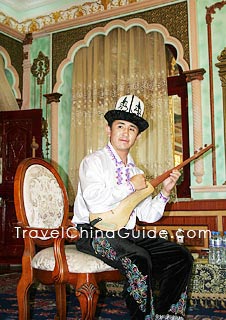
They are adept at literature, music, sports and handicrafts. The most renowned epic 'Manas', containing more than 200,000 lines, narrates the heroic events of eight generations of Manas family - resisting invasion by other groups and protecting the peace of the Kirgizs. There are many musical instruments that are played every time the epic is recited, such as the flute, and the kumuzi - a kind of bandore made of corean pine.
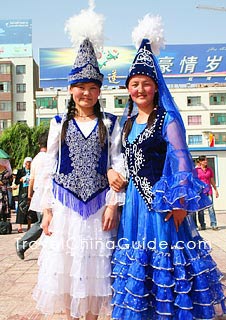
Kirgiz women like embroidering and weaving. On coifs, pillows, bedcovers, clothes, carpets, and other hanging adornment, there are all kinds of patterns containing flowers, birds, beasts, and so on. They like fresh colors like blue and white, and especially red, which is also the most popular color for their clothes.
Marriage Custom:
Different from other ethnic groups, the Kirgiz marriage ceremony is held in the girl's house. Before the ceremony, the bridegroom will ride there with a freshly slaughtered sheep accompanied by his relatives; the girl's family will also slaughter livestock to prepare feasts for guests.
Festival:
The most significant festival ethnic minority is the Norooz Festival. They celebrate it at the beginning of the first month according to the Kirgiz calendar. Similar to the Chinese New Year of the Han people, all the families prepare sumptuous dinners with a special food made of seven grains such as wheat and barley in the hope they will have a great harvest next year.
More Ethnic Groups in Xinjiang Area:
Uygur Kazak Hui Mongol Uzbek Tatar Dongxiang Xibe Tagik Russ
Language and Belief:Most of them speak the Kirgiz language, which belongs to the Turkic group of Altaic phylum, and has a written form based on Arabic letters. They living in the south of Xinjiang speak Uigur while those in the north of Xinjiang speak Kazak. Some believe in Islam and others believe in Tibetan Buddhism.
|
|
 Food and Food Culture:
They make a living doing animal husbandry together with agriculture and livestock product processing, which has influenced their life style greatly.
Usually they have three meals a day. Nang, a kind of pie, and milk tea are their breakfast; at noon and in the evening, they eat mainly flour-based food, horsemeat, beef and mutton. Boiled mutton, which is eaten directly with the hands, makes visitors feel as if they are part of Kirgiz life.
If you are the guests of a Kirgiz family, you will be warmly welcomed by the hosts. They will prepare the most delicious mutton for you. They believe the choicest pieces are the oil of sheep's tail and the meat near vertebral and head. Before enjoying a meal, guests should cut and share the food with the women and children of the host; in the dishes that guests have used, there should not be any leftovers.
Arts and Crafts:They are adept at literature, music, sports and handicrafts. The most renowned epic 'Manas', containing more than 200,000 lines, narrates the heroic events of eight generations of Manas family - resisting invasion by other groups and protecting the peace of the Kirgizs. There are many musical instruments that are played every time the epic is recited, such as the flute, and the kumuzi - a kind of bandore made of corean pine.
Kirgiz women like embroidering and weaving. On coifs, pillows, bedcovers, clothes, carpets, and other hanging adornment, there are all kinds of patterns containing flowers, birds, beasts, and so on. They like fresh colors like blue and white, and especially red, which is also the most popular color for their clothes.
Marriage Custom: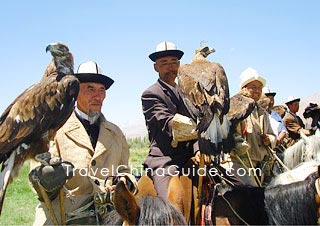 |
| Hunting by using a falcon |
Festival:The most significant festival ethnic minority is the Norooz Festival. They celebrate it at the beginning of the first month according to the Kirgiz calendar. Similar to the Chinese New Year of the Han people, all the families prepare sumptuous dinners with a special food made of seven grains such as wheat and barley in the hope they will have a great harvest next year.
More Ethnic Groups in Xinjiang Area:Uygur Kazak Hui Mongol Uzbek Tatar Dongxiang Xibe Tagik Russ
- Last updated on Aug. 07, 2025 by Gabby Li -