Oroqen Nationality
 Distribution and Population: The Oroqen ethnic minority lives primarily in mountainous areas of the Inner Mongolian Autonomous Regions and Heilongjiang Province, an area known for its abundant wild animal resources. The name Oroqen appeared as early as the Qing Dynasty (1644-1911). The current population is 8,196. In their language, two explanations are given for the name Oroqen - one being people living in the mountains and the other meaning people domesticating reindeers.
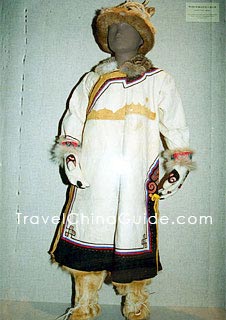 |
| Clothes of Oroqen Nationality |
Language:
Their language belongs to the Tungus-Manchu group of the Altaic phylum. Since there is no written form of the language they usually use Chinese whilst some use Mongolian.
Religion:
They hold their faith in the power of nature, ancestors and totems. This is a kind of Shamanism. There are many gods such as the god of the sun, moon, fire, wind, mountains, etc. Oroqen people also worship the bear and tiger. They are known to Oroqen people as god, lord, and governor.
Life and Handicrafts:
Bestowed with rich resources, there are a large variety of wild animals, which have provided the Oroqen people with a hunting life for hundreds of years. Records of their hunting can be traced back more than 1,000 years. In the 1990s the Chinese government enacted laws forbidding all hunting. This meant that the Oroqen people had to dramatically change their way of life.
Oroqen men are apt at making wares with bone, wood and iron. Women are good at sewing leather clothes and carving on wares made of birch-bark. Birch-back is a durable, light and water-proof variety of wood. Oroqen people take great pride in their boat building abilities. Boats are a very important form of transportation and have retained their importance even though other forms of vehicles are now available to them.
Food:
Their staple food is meat from a variety of animals in the area e.g. deer, boar, pao (a kind of roe deer), however, as they consider horses and dogs their faithful friends, they usually refuse to eat meat from these two animals. In recent years, the Oroqen people have turned to growing vegetables which they never did in the past. This has resulted in a dramatic change in their diet. Fried flour rolls are a favorite and it is said that this food will improve your intelligence.
Arts:
Like many ethnic groups, they are also creative in oral literature and musical performances. They have passed on legends, fairytales, ballads and riddles based on historical events, hunting life and customs. Meanwhile, they sing and dance, vividly imitating hunters' shrewdness and other life scenes. A dance with masks is commonly performed at sacrificial occasions.
Festivals:
Influenced by the Chinese, Man and other ethnic groups, Oroqen people celebrate the Chinese New Year, Dragon Boat Festival, Mid-Autumn Day, and other popular Chinese festivities. On the eve of the Spring Festival, they put on bonfires to indicate harvest and happiness. On the first day of the lunar New Year they eat dumplings, sing and dance and, worship their gods and ancestors. On the sixteenth day, they smear ash onto their faces to symbolize that they will avoid evil. More Ethnic Groups in Inner Mongolia and Heilongjiang Area:
Mongol Manchu Hui Daur Ewenki