Folk Customs along Yangtze
Tujia Ethnic Minority Customs
Marriage Custom: Weeping Marriage
 |
| Weeping Marriage, Tujia Ethnic Minority |
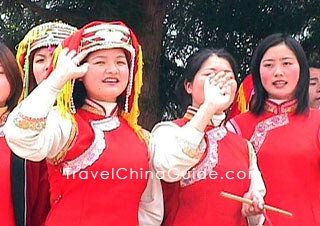
The marriage date for girls of Tujia Ethnic Minority is usually welcomed with crying. According to custom, the new bride should begin to cry half a month or one month before the wedding ceremony. Whether a girl can cry about her marriage has become a criterion to value the girl's ability and virtue.
In order to be regarded as a good girl, the girl begins to study how to cry for marriage when she is twelve years old. Some will invite an experienced person to teach them. When 15 years old, girls will invite each other to match who cries best and teach each other. Some even will discuss methods of crying.
There are songs which are sung when weeping for marriage. These include singing for parents, sister, brothers, the matchmaker and ancestors. When singing the weeping marriage songs, the emotions are fully expressed through the mournful tones. On hearing the vivid and strong words of the song, even a stony-hearted man can't fight back his tears. In fact, girls sing songs before marriage to protest the arranged marriage system under the feudalism and express sentimental attachment to their relatives.
The weeping songs can be sung by one person or two. If one girl sings, she will cry for her destiny, the deep affection to her relatives and the feudalistic marriage custom she suffers under. When two girls weeping together, it is called "sister crying." The bride cries and sings first, and then the other one will sing together with the bride to console her.
It is said that, the weeping marriage custom originated from the unconscionable marriage system in the old times. Girls sang and cried denouncing the marriage system and dreaming of flinging off the chains of the system. Now, although Tujia girls can choose their loves freely, they still cry out of tradition.
Funeral Custom: Funeral Dance
The funeral dance is a unique custom for Tujia people living in the western part of Hubei Province. Through the happy folk dance, prayers for a happy life to the deceased are expressed.
When an elder of Tujia ethnic minority dies, he is placed in the coffin which is put in the main room of the house for one to three days. Every night, relatives and friends dance for the deceased. One person beats a cowhide drum and sings while the others dance around the coffin. Usually there are two to four men dancing together; no women dance for the dead. The songs the drummer sings are usually lively with differing words. They include the story of the dead, legends, love stories, and interesting episodes. When the last sentence of the song comes, the dancers usually sing together with the drummer to help lift the pall of grief for the family.
Fishermen and Their Fishing Boat
 |
| Fishermen and Their Fishing Boat |
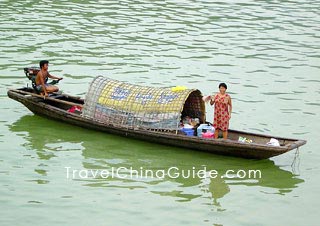
Cruising along the Yangtze River, one can see some fishermen rowing a wooden boat to fish from. It is a unique scene on the river. The history of fishing on the Yangtze River can be traced back seven thousand years.
The small wooden boat which usually cost about one thousand RMB to built one is the vehicle used by the ancient people to catch fish from. Twelve feet long and three or four feet wide, the boat usually has five to six cabins including the navigation cabin, engine room and the living cabins. With the rise in the living standard of the people living along the Yangtze River, fishermen have installed diesel engines on their boats to save manpower.
To catch fish, there are usually two ways: net casting net and using hooks. In the daytime, fishermen cast nets with large stones as anchors. Then, one or two boats drag two ends of the net to catch the fish. Fishing hooks are put out before sunset and reeled in with the fish in the morning. From their long experience fishing on the river, the fishermen know well the fish's gathering places and life cycle.
Every year, the fishermen repair the boat in the dog days of summer. ("The dog days" refers to the hot days of July and August.) When the Chinese traditional Lantern Festival comes, the family usually eats a reunion lunch in the cabin and sticks incense on the fore at the same time burning papers and shooting off firecrackers to sacrifice to the god of water. Thus, the hope of good sailing and catch is expressed.
 |
| Yangtze River Trackers |
Yangtze Trackers
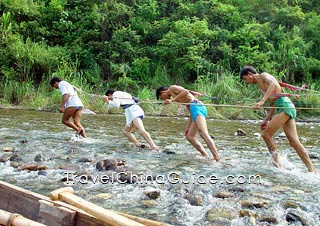
Down through the ages, the dangerous waterway in the Three Gorges brought many inconvenience to the freight and passenger traffic through the Yangtze River, which gave rise to a unique profession – trackers. They tugged the wooden boats against the rapid while singing work songs to cheer up and coordinate the rhythm of the work. Today, due to the finish of the Three Gorge Dam, the dangerous rapid has risen to smooth channel, which announced the end of tracker's life. But the surviving state and tracker's culture including those fiery work songs will be cherished forever.
 Further Reading:
How does Yangtze River civilization affect China?
 Reply
Reply 4
4 1Reply14Reply