 Chengyang Wind and Rain Bridge
Mapang Drum Tower
Situated in Mapang Village, 16 miles away from Sanjiang County, the Mapang Drum Tower is a typical drum tower in Sanjiang. Paying a visit to it is one of the top things to do in a Sanjiang trip. Built in 1928, it has nine floors and is 16.4 yards high. Shaping like a pagoda, the tower was engraved with dragons and phoenixes on the eaves. A sculpture of crane is standing on the top of the tower which symbolizes auspiciousness. The entire structure is joined together with redwood, without a single iron nail. It is said that the Dong architect drew the blueprint with only a carpenter's square and a bamboo marker.
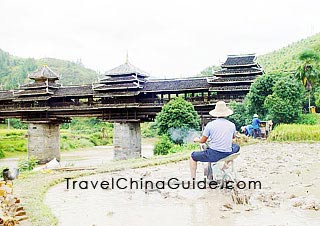 | | Chengyang Wind and Rain Bridge | |  | | Local farmers harvest the rice | |
The Wind and Rain Bridge is another characteristic attraction among the Dong minority's architecture. The most well-known one in Sanjiang is Chengyang Wind and Rain Bridge. Located in the Chengyang Village of Sanjiang County, the bridge spans the Linxi River. Thus it is also called Linxi Wind and Rain Bridge. Built in 1916 and was once damaged by super floods, it is now well-preserved and still keeps firm. While the Batuan Wind and Rain Bridge which situates in Batuan Village, is of another kind. Although smaller than the Chengyang Bridge, this bridge is six years older and is unique for having two separate lanes for people and livestock.
If visitors want to see more of the local bridges and drum towers, they may go to the Dong Ethnic Eco-museum. Centered on the Dong Ethnic Museum in the county, the eco-museum consists of nine Dong villages including 28 drum towers and 13 bridges, where visitors can have an eyeful of the Dong architecture. 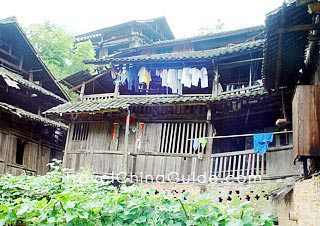 | | Local residence in a Dong village | | 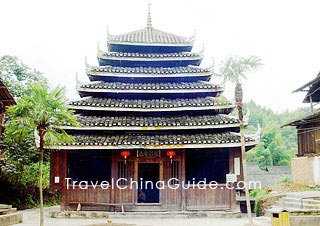 | | Mapang Drum Tower | |
Each city has its history. The history of Sanjiang can be traced in the Liangkou Scenic Area and the Danzhou Scenic Area, where many of the ancient constructions were built in the Ming Dynasty (1368 - 1644). Among them, the Sanwang (Three Kings) Palace and the Ancient Banyan of the Liangkou Scenic Area deserve a visit. - Last updated on Apr. 15, 2021 -