Mt. Jinggang
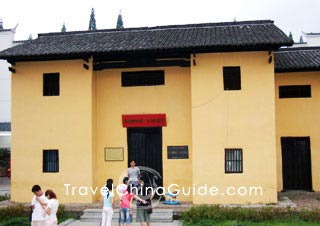 Mt. Jinggang has great significance in the annals of modern Chinese history for it was here that important events during the Chinese revolution took place. For those who are interested in the history of the revolution, it is possible to take a tour on the mountain that the people who against great odds struggled to establish the People's Republic of China. Mt. Jinggang is famous for the fact that it was here that forces led by Zhu De joined those headed by Mao Zedong. Together, the combined forces of the CCP (Chinese Communist Party) marched on to a victory that was to establish the new China under the Chairmanship of Mao Zedong. The mountain with its special features is quite different from the other sights, which makes a visit so rewarding.
Mt. Jinggang is located on the common boundary of Jiangxi Province and Hunan Province, 352 kilometers (about 219 miles) southwest from the capital city - Nanchang. The mountain areas have a high center that is surrounded by a somewhat lower level and between them they present two obvious steps. At the point that these steps are divided the relative height is 500 meters (about 1,640 feet). It was here that the famous Five Sentries (the five Red Army military strongholds built) stood overlooking the difficult terrain. Another feature of the area is the many well-shaped basins among the ridges. It was these natural indentations that gave the mountain its name of Jing, meaning well and gang, meaning ridge - hence 'Jinggang'. It covers a fairly wide area but it is possible to arrange for a car to carry you to the various separate sites of interest. These are not far from each other and the cost, which can be negotiated, will be reasonable.
Five-Fingers (Wuzhi) Peak
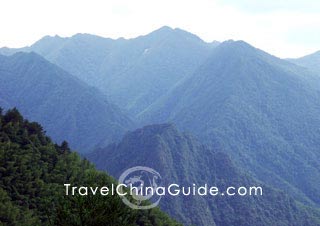 The first site of interest is Five-Fingers (Wuzhi) Peak; this is the highest in the Jinggang mountain range. The peak has the appearance of five extended fingers, hence its name. It is not only the highest point but is the largest and considered to be the most beautiful sight on the mountain. The steep peak extends in an imposing way from southeast to northwest. There is no path on which to climb and the unspoiled virgin forest on the mountain is almost without any trace of human beings, which means it remains the home of rare animal species including bobtail monkeys, sambars and the yellow-stomached tragopan. Hence it is a secret world even now. Tourists may climb up to the Sightseeing Platform opposite, which is the best view point for seeing its majestic appearance. The huge peaks confront each other on two sides to form a valley. The Mt. Jinggang River twists and turns as it races through this valley. On the mountainside, and visible from a long distance, is a large waterfall that appears like a thin silk veil hanging from the sky. The group of lakes at the foot of Five-Fingers (Wuzhi) Peak is like a bright moon shining upon the boundless sea of clouds. Five-Fingers Peak is now the nature reserve of Jiangxi Province.
Dragon-Pond Waterfalls
The next site is the Dragon-Pond (Longtan) waterfalls also referred to as the Five-Dragon-Pond. When you enter this area long before you catch sight of the falls, you will hear the thunder-like roar of the water. Upper most is the Jade Waterfall that drops down to the green and limpid Jade Pond. The second is Lock-Dragon-Waterfall which spews out from the yellow cliff top into the Golden-Lock-Pond. The flow of water is not large but it is famed for what appears like a dragon trapped in it. The next are Pearl Waterfall and Pearl Pond. The waterfall rushes down from a 30 meter (about 99 feet) high cliff and is caught in its path by a large rock that causes the water to break into thousands of pearl-like droplets that glisten in the bright sunshine, hence its name. The forth are the Flying-Phoenix-Waterfall and Flying-Phoenix-Pond. At the bottom are the Maiden-Waterfall and Maiden-Pond. In addition to these spectacular falls there are unique peaks, rocks and an echo cliff to be found in the sightseeing area.
Huangyang Jie
Huangyang Jie is one of the five famous sentries. The well-known Defence of Huangyang Jie happened here and Mao Zedong's poem-Xijiang Moon was written to commemorate it. The monument to the Defence of Huangyang Jie is made up of an upright stele and a transverse stele, on which are carved the inscriptions of Mao Zedong and Zhu De. The old residences of the Red Army leaders remain here and many stories about the revolutionary period have come down to us. A trench is also preserved and many tourists put on Red Army attire to be photographed near the trench as a souvenir. The Up-Well (Shangjing) Red Army Mint in Huangyang Jie played a very important role during the Chinese revolution and helped the revolution base to cover the hard period at that time and collected experiences for the other bases. Some of the old equipment is kept there as well as the tools and materials used to make currency. Some Silver dollars (Yinyuan) were unearthed when the mint was restored and in the Currency Museum you can see these coins that were minted by the Red Army.
Ciping
Ciping, the center of the Mt. Jinggang area and red revolution base of China, is the place where many sights can be seen. Ciping is a mountain city and was the location of the highest leading department of the mountain revolutionary base. Now many places of interest in connection with the revolution can be seen here. Among these are the Mt. Jinggang Revolution Museum, the Tower of the Revolutionary Martyrs and military statues. Mt. Jinggang Revolution Museum was established here in 1959. The museum uses modern techniques of sound, light and models to illustrate the important events of the revolution. The main natural beauties in this area are the Southern Mountain Park in south Ciping and the Yicui Garden. On the way to the mountaintop there are five kiosks. There is a pentagon exhibition hall on the mountaintop decorated with the statuary of workers, peasants and soldiers.
Pen-Rack-Mountain
Pen-Rack-Mountain (Mt. Bijia) is famed for the steep peaks, unique rocks, old pines, sea of clouds, sunrise and the 5 kilometers (about 3.1 miles) patch of rhododendrons-the flower of Mt. Jinggang City. The blooming rhododendrons here can be called a wonder, every March or April thronged people came here to take photos for the beautiful natural sight.
Maoping
Maoping is located in the north foot of Huangyang Jie with many revolutionary sites. Here we have Bajiao Lou (a two-story building), those who are familiar with Chinese history may recall that Mao Zedong lived, worked and finished two splendid revolutionary works here. The first hospital of the base was established in Panlong Shuyuan (a classical academy in ancient times) of Maoping. You can visit the treatment room, medicine room and see some of the equipment used at the time. Another site that provided support to the base is a bedclothes factory which mainly produced the army clothes, hats and bullets bags. Each of these sites made a contribution to the achievements of the Red Army.
Monument and Memorial
The famous Monument and Memorial to the joining of Forces on Mt. Jinggang is situated in the Dragon-city (Longshi) area, southwest of Huangyang Jie. The monument commemorates the achievement of Mao Zedong and Zhu De. The five exhibition rooms present the important event in Chinese history to visitors. The monument is 19.28 meters (about 21.1 yards) high, 5 meters (about 5.5 yards) long and 4 meters (about 4.4 yards) wide which indicates the date of join forces-May 4th, 1928. The two sides of the monument are inlaid with red marble, symbolizing two oriflammes, depicting the successful meeting of the two forces on Mt. Jinggang.
The mountain has an indispensable place in Chinese revolutionary history and offers a good insight into the history of the Chinese revolution. However, this is not only a Red Army tourist spot but is also an area of natural beauty that offers you plenty of scope for relaxation.
How to get to Mt. Jinggang
1. From Jinggangshan Airport, there is a shuttle bus to the scenic area directly. It takes around 1.5h and costs CNY 30.
2. From Jinggangshan Railway Station, take a taxi to reach there and it takes about 20 minutes.
3. Take a bus from Nanchang Long-distance Bus Station at 9:02am or from Nanchang Xufang Bus Station at 9:30am to Jinggangshan. The ticket fare is CNY 96.
| Entrance Fee | Feb. 16 - Nov. 15: CNY 165 Nov. 16 - the next Feb. 15: CNY 150 Sightseeing Bus: CNY 80 Half-price ticket is available from children between 1.2 and 1.4m (3.9 - 4.6 feet); Free for children under 1.2m. |
|---|---|
| Opening Hours | 8:00 - 17:00 |
| Best season | Late March to early April |