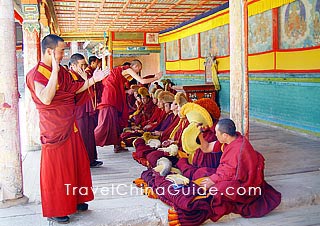
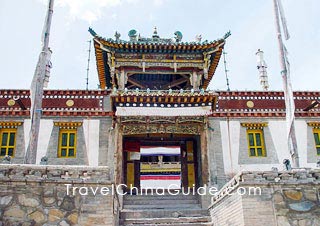
As the religious activity center of both monks and followers of the Yellow Hat Sect (also named Gelugpa Sect, a branch of Tibetan Buddhism), the Kumbum Monastery (Ta'er Monastery) is located in Huangzhong County, Qinghai Province, 25 kilometers (about 16 miles) away from the capital city of Qinghai Province - Xining.
In order to commemorate Tsong Khapa (1357-1419), founder of the Yellow Hat Sect, the Kumbum Monastery was built in 1577 more than 150 years after his death. Now it is considered a sacred place in China.
In the Tibetan language, Kumbum Monastery is called 'gongben', which means '10,000 figures of Buddha'. During its long 400 years of history, it has gradually become a place of interest for its distinct ethnic color and native style. The whole area covers more than 144 thousand square meters (about 36 acres) with mountains surrounding it. It has 9,300 rooms and 52 halls. Just judging from these figures, you can imagine what a splendid place it is. The Kumbum Monastery is a group of fine buildings in a combination of both the Han and Tibetan styles of architecture on the mountain slopes. It has lofty temples and halls rising one upon another. The palace buildings, Buddhist halls, sleeping quarters, as well as the courtyards echo each other and thus enhance the beauty of the whole area. Among so many buildings, the Great Hall of the Golden Roof and the Great Hall of Meditation are the main parts.
Great Hall of the Golden Roof
As the center core building, the Great Hall of the Golden Roof is in the middle of the monastery. Its colorful gates, which are different in length, are carved into various flower patterns and painted with multifarious fresh colors. The surfaces of the walls are covered with green ceramic tiles and embedded with countless pearls, agates, and gems, making the whole hall sparkle.
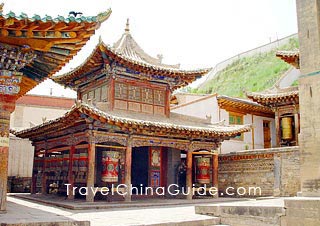 |
Inside the hall, there is a silver tower built to commemorate Tsong Khapa. This tower is also embedded with many kinds of jewels and wrapped with ten layers of pure white Hada (raw silk fabric presented to exalted guests to express purity, honesty and respect) to show its grandness. In front of the tower golden and silver lights and old flasks are displayed with more than 5,000 small golden figures of Buddha surrounding them, which enhance the stateliness of the Tsong Khapa's statue in the shrine. In the ark behind the hall, the treasures of the Yellow Hat Sect are stored. They are considered very precious relics of the Kumbum Monastery.
 |
| Prayer Wheels |
Great Hall of Meditation
The Great Hall of Meditation is the authoritative institution for the religious organization of the monastery. It is the biggest structure and lies rightly in front of the Great Hall of the Golden Roof. Long and short pillars are carved with beautiful patterns and swathed with colorful felts on which there are embroideries and long narrow flags for decoration. Hanging from all four walls, there are lively and unique pictures of the story of Buddhism and religious life. A pure gold tower stands in the hall that contains the ashes of Tsong Khapa.
The Kumbum Monastery is rich in fascinating arts. The famous butter sculptures, the barbolas, and the murals are considered to be the three most unique arts of superb craftsmanship.
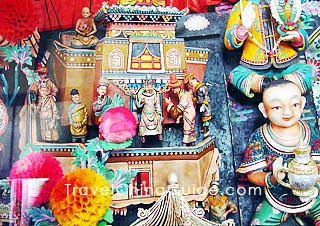 | | Butter Sculpture | |  | | Interior Decoration | |
How to get to Kumbum Monastery
Take a bus from Xining Xinninglu Bus Station and then take a taxi to the temple.
| Entrance Fee | April - October: CNY 70; November - March: CNY 40
Free for children under 1.2m (3.9 feet). |
| Opening Hours | 7:30 - 18:00 |
| Recommended Time for a Visit | 2-3h |
- Last updated on Aug. 13, 2025 by Demi Li -

 Kumbum Monastery Pictures