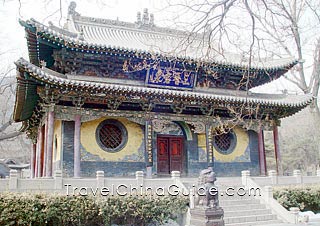
Located 25 kilometers (16 miles) to the southeast of downtown Taiyuan City, Jinci Temple (Jin Ancestral Temple) is a combination of historical cultural relics and beautiful landscapes. The welcoming boughs of a multitude of ancient trees provide an eye-catching entrance. Beyond this, the numerous halls, cabinets, pavilions and bridges are guaranteed to keep any visitor enthralled. Jinci Temple is world-famous because it is an ancient ancestral temple, something which is rare in China.
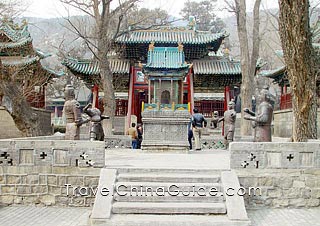 | | Iron Statues Terrace | | |
Jinci Temple has a long history, which can be traced back to the Western Zhou Dynasty (11th century BC to 711 BC), when King Cheng made his younger brother Yu a leader of one of his states. Yu was an intelligent leader who devoted all his energies to making the state prosperous, so his descendants built a temple for him after his death, in order to honor his achievement.
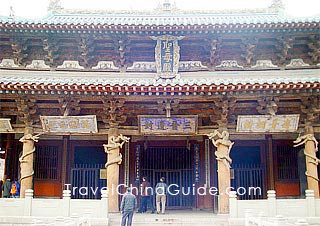 | | Goddess Mother Hall | | 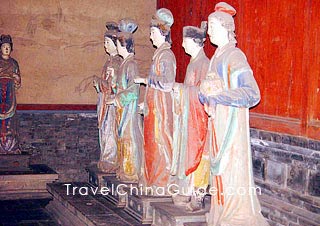 | | Figures of Maidservants in the Song Dynasty | |
Saint Mother Hall, the oldest building in Jinci Temple, is one of the main reasons that so many visitors come to visit. Together with the Flying Bridge across the Fish Pond, and the Offerings Hall, these exquisite buildings provide evidence of a new era in Chinese architecture. For example, the Flying Bridge across the Fish Pond is the only one of its kind that exists now; accordingly, it plays an important role in an investigation of the ancient bridges of China.
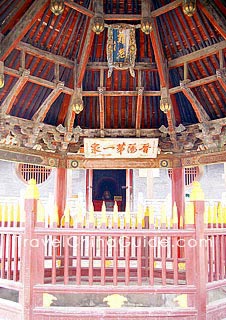 |
| Never Aging Spring Pavilion |
There are three additional wonders here that draw people from across the world. These are: The Figures of The Maidservants, the Zhou Cypress and the Never Aging Spring. Each of the Figures of the Maidservants that stand in the Saint Mother Hall, colored clay sculptures made during the Song Dynasty (960-1279), are unique. Whether these statuettes are washing, sweeping or dancing, they are all sculpted in a vivid and natural way.
Jinci Temple was, to a certain extent, an imperial garden. Accordingly, some three hundred tablets were inscribed for it with writings by emperors, officials and poets, and these now line a scenic path in Jinci Temple. The most famous stele was written by the Emperor Taizong of the Tang Dynasty in 646, and it was kept in a pavilion which is now known as 'Zhen Guan Bao Han Pavilion'. Taizong was one of the great emperors of Chinese history. The time from which he inherited the throne from his father became known as the Prosperity of Zhenguan, and people referred to the calligraphy written by him as 'Bao Han', meaing a kind of treasure.
How to get to Jinci Temple
Take Bus 79, 301, 308, 319, 804, or 856 to Jinci Xinzhen, and you will see it.
| Entrance Fee | Apr. - Oct.: CNY 80
Nov. - Mar.: CNY 65 |
| Opening Hours | Apr. - Oct.: 8:00 - 18:00
Nov. - Mar.: 8:00 - 17:00 |
| Recommended Time for a Visit | 2-3h |
- Last updated on Aug. 14, 2025 by Demi Li -