Kizil Thousand-Buddha Caves and Subashi Ruins
Kizil Thousand-Buddha Caves
 |
Kizil Thousand-Buddha Caves, Xinjiang Pictures of Kizil Thousand-Buddha Caves Pictures of Kizil Thousand-Buddha Caves |
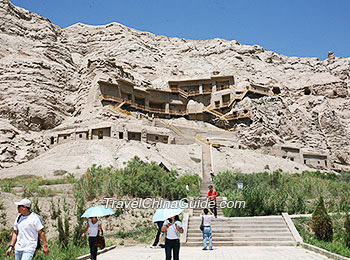
Sixty kilometers (37.2 miles) east of Baicheng County, the Kizil Thousand-Buddha Caves sit on the cliffs on the northern bank of the Muzat River, 7 kilometers (4.34 miles) southeast of Kizil town. Cut the third century to eight or ninth century, it is the earliest Buddhist art treasure trove in China, even one century earlier than the famous Mogao Grottoes. Currently there are 236 coded caves preserved, which are divided into west and inner valley and rear mountain areas extending to over 3 kilometers (1.86 miles). On June 22, 2014, it was included in the World Heritage List.
The Kizil Thousand-Buddha Caves are corridor of murals surpassing other existing caves in China in its abundance in content, quantity and long duration. It is significant in Buddhism as well as in the history of Qiuci. Baicheng County, where these caves are located, used to be under the reign of ancient Qiuci (today's Kuqa). As a communication hub of the ancient Silk Road, Qiuci was the political and economic center of the West Region as well as the focal point of Central Asian and Indo-European cultures. Several facts support these. The earlier caves took the shape similar to Bamian Caves and the murals suggested the influence of Gandhara arts, a Buddhist visual art prevailing in today's Northwestern Pakistan and Eastern Afghanistan in First Century B.C. and Seventh Century A.D. The written documents discovered here were composed in Tocharian B language, a branch of the Indo-European language family that originated in central Asia during the first millennium.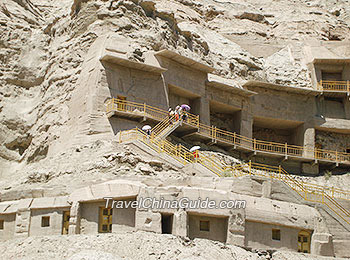 Qiuci's geographic location became to be the center of Buddhism in the West Region as well as a key point for propagating Buddhism in the Central China. Before it was taken place of by Islam in 13th century, Buddhism prevailed in Xinjiang for more than one thousand years. This explained why caves or grottos, an important medium of Buddhist arts, which illustrated sutra by architecture and murals, have been found in Xinjing.
The Kizil Thousand-Buddha Caves come in two forms, one as living quarters with earthen bed and simple facilities, and the other one as temple for worshiping. Caves of different form and function were combined into one unit. It is assumed that one unit was one temple. This is to say that temples stood shoulder to shoulder in the Kizil Thousand-Buddha Caves at that time.
The murals in the Kizil Thousand-Buddha Caves are reputed as "The most beautiful murals in Central Asia". They are found in 81 caves with a total area of more than 10,000 square meters (11,960 yards). The diamond grid pattern is the most impressive feature. There is a story about Buddha's reincarnation in every gird. Each story was portrayed by a single picture instead of a series of pictures as in Mogao Grottoes.
|
|

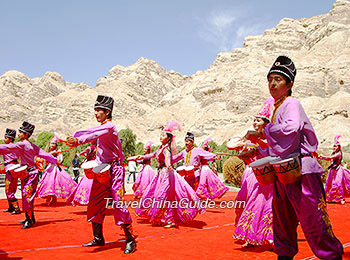
Besides the themes of Buddha, Bodhisattva, Arhat, Flying apsaras, and Buddhist fables, a variety of depictions on production and daily life, farming, hunting, pastures, riding, mountains and rivers in the West Region, animals, birds and ancient architectures can also be seen in the Kizil Thousand-Buddha Caves. The styles were not limited to the local arts. Traditional Central Chinese painting styles were also popular. All these revealed advanced art achievements in Qiuci. The No. 38 Cave (Music Cave) murals here proved this as a case in point sufficiently. The murals depicted a scene of Qiuci band with20 musicians playing their respective instrument, on both sides of the cave. Amazingly, it was found out that looking closely into the gestures and position of the musicians' hands on the instrument, all stopped at the same meter!
Undoubtedly, the Kizil Thousand-Buddha Caves are considered to be art crystallization of the local tradition and of the central Chinese culture as well as foreign ones. This priceless encyclopedia of Qiuci culture depicted here surely deserves worthwhile reading!
| Admission Fee: | CNY 55 for Guxi Area CNY 55 for Gudong Area |
Subashi Ruins
The ruins of the Subashi Temple, Subashi Ruins, are located 23 kilometers (about 14 miles) northwest of Kuqa County, Xinjiang Province. It was added to the World Heritage List on June 22, 2014.
The Subashi Ruins occupy a relatively large area, divided by Kuqa River into eastern and western areas. The eastern area is over 530 meters (about 580 yards) long and over 140 meters (about 153 yards) wide and the western area is over 680 meters (about 744 yards) long and 170 meters (about 186 yards) wide. The extent of the ruins reflects the temple's past brilliance.
|
|
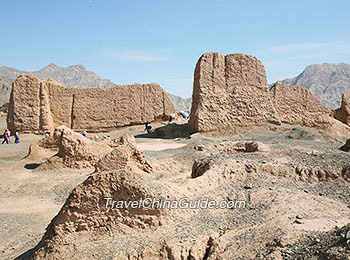
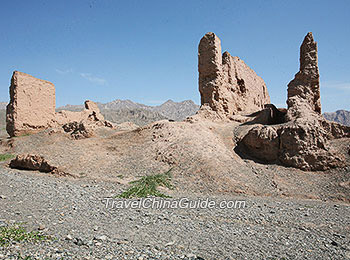
Today only the ruins of this temple remain. The pagodas, murals, walls and archaeological discoveries bear witness to the years of change, the stories of Buddhism and the development of civilization in this vast land.
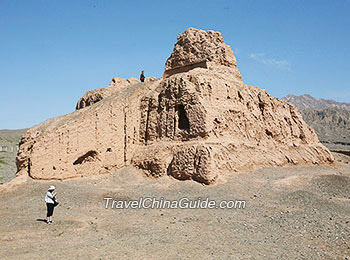 | 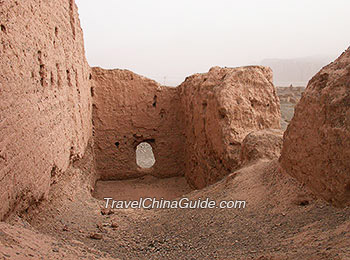 |
 Reply
ReplyThanks a lot
David
 0
0 1ReplyReply
1)Kizil Thousand Buddha Caves 2) Bezeklik Thousand Buddha Grottoes
pleaase ans me
yahoo.com|faryad.raza
01Reply