 |
| Mount Kongtong |
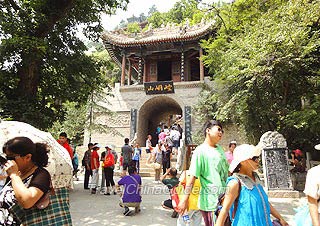
Lying 7.5 miles (12km) to the west of Pingliang City in Gansu Province, Kongtong Mountain is noted for its marvelous natural scenery and exquisite manmade landscapes. It enjoys the reputation as "The Holy Land of Taoism", "The Remarkable Spectacle of Western China" and "The First Mountain in Western China".

Beautiful Natural Scenery
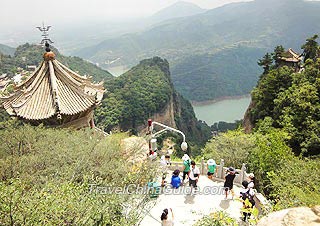
Kongtong Mountain is a branch of Liupan Mountain. Though located in the western plateau area, the mountain is endowed with the characteristics both of the magnificence of China's northern mountains and the beauty of southern mountains. Huge mountains stand one after another with vast patches of green forests as their clothes and ethereal mist as their white belt. This mountain is abundant in stone caves and houses, many of which are located in the cliffs or dense forest where nobody sets foot. The famous ones include Guangcheng Cave, Zhaoyang Cave, Xuanhe Cave and Kongtong Cave. In addition, it is a rich water resource. The Yanzhi River flows from the north. Every spring, peach blossoms fall into the water and float on the current: a lovely sight
. At the foot of the mountain, Tanzheng Lake flows calmly like a mirror, and its murmuring water sounds like a Chinese zither, giving the lake its name, Tanzheng Lake (Playing Zither Lake). Long History and Profound Religious Culture
The father of Chinese culture, the Emperor Xuan Yuan, once visited Mount Kongtong to consult the wise man Guang Chengzi on how to manage the country and maintain good health. From then on, the mountain rapidly gained prestige. Later on, the King of Mu in the Western Zhou Dynasty (11th century BC-771 BC), the Emperor Qin Shi Huang and the Emperor Wu in Western Han Dynasty (206 BC - 24 AD)
, all followed him to visit Mt. Kongtong, which made the mountain more and more famous. 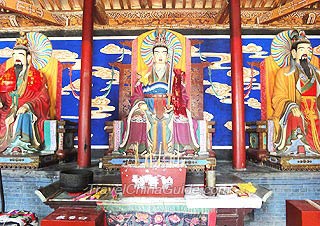 | | Meeting the Immortal Temple | | 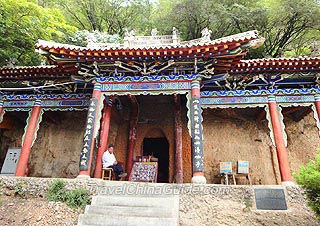 | | Holy Shrine Visited by Huangdi | |
Kongtong Mountain is the holy mountain of three religions: Taoism, Buddhism and Confucianism. It is said that Taoism temples were being built on the mountain as early as in the Wei (220-265) and Jin (265-420) Dynasties. In the Ming Dynasty (1368-1644), construction began on Taihe Palace and other attached Taoist buildings. Since then, Taoism has been handed down from one generation to another. Buddhism also flourished in this mountain, as evidence of Buddhist rituals can be found in it from the Tang Dynasty (618-907). There are 19 Buddhist temples from the early Qing Dynasty (1644-1911). Today Buddhism and Taoism grow together in a harmonious atmosphere on the mountain, a situation which is unique to Kongtong Mountain. In addition, the mountain has cultivated many Confucianism scholars such as Huang Fumi, the talented founder of Chinese Acupuncture. Prolific Resources of Plants and Animals
 Kongtong Mountain is home to various species. There are over 1,000 kinds of plants, many of which are precious medicinal herbs. The famous trees include Chinese pines and cypresses. Some trees are about one thousand years old but still grow vigorously with green boughs covering the sunlight. Over 300 kinds of wild animals live protected on the mountain. Among them, the vulture, sparrow-hawk, white crane, and leopard are listed in rosters for the national conservation of wild life.
In past dynasties, many men of letters and philosophers visited Mt. Kongtong and left poems and articles to praise its beauty and glorious culture. Today more and more visitors are enchanted by its irresistible charm. Thanks to its endless beauty, it deserves to be called "The First Mountain in Western China". 
How to get to Kongtong Mountain
1. Most visitors choose to take bus 13 to Kongtong Ancient Town first, and then from there take the tourist bus to Zhongtai to begin the journey. In Kongtong Ancient Town, there are also tourist buses bound for the cable car station in South Gate and the Xiangshan Temple at the mountain top. Visitors can take them to Xiangshan Temple and then stroll downwards. Or they can take one to the cable car station. The cable car will head for Zhongtai.
2. For hikers, they can take bus 13 or 21 to Kongtong Mountain. Walk for about three hours to Zhongtai and then explore the main scenic area.
3. Visitors can also take bus 13 and get off at Juxianqiao. Then take the cable car to Zhongtai.
| Admission Fee | April - October: CNY 110
November - March: CNY 55 |
| Tourist Bus | To Zhongtai: CNY 36
To Xiangshan Temple: CNY 48
To Cable Car Station: CNY 9 |
| Cable Car | CNY 50 for a single trip |
| Opening Hours | 07:00 - 19:00 |
| Recommended Time for a Visit | 4 hours |
- Last updated on May. 24, 2022 -