Guiyang Travel Tips
 Dialing Code: 0851 Zip Code: 550000 Post Offices
Guiyang Post Office: No. 19, Shachong Zhong Lu
China Post: Shapo Lu Bank
Bank of China Guizhou Branch: No. 30, Dusi Lu Telephone
Telephone booths can be found in the street, but an IC card is required to use them. Universities
Guizhou University
Location: Huaxi District
Guizhou University of Technology
Location: Caijia Guan
Guizhou Normal University
Location: No. 116, Baoshan Bei Lu
Useful Numbers
Tourist Complaint Number: 0851- 5864091
Guiyang Nightlife
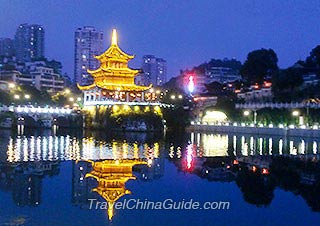 |
| Jiaxiu Tower at Night |
Guiyang's night often begins later, sometimes after 21:00. Guiyang is energetic and so are the local people. Shopping malls and large marketplaces are usually closed at 22:00. People do not worry about their safety at deep night and many local people would like to spend their nights in snack stalls.
Every day, after 18:30, street stands on the popular snack street-Shaanxi Lu will begin repairing mouth watering snacks. As with Sichuan people, the local people like the spicy food, but the spicy food in this place tastes a little numb and spicy,which is different from Sichuan food. Hot pepper is indispensable to the local dishes and even the three meals a day. In addition to some home style dishes, beer and various kinds of snacks, sea food from southern coastal area are becoming popular in Guiyang too. As local people say by themselves that they enjoy eating and life.
Besides the local snacks, Guiyang has a special nightlife destination, the Vinegar Bar. In the city, young people like bars, pubs cafes and Koraoke just as people in other big cities, but Vinegar Bar are unique to Guiyang. As the name suggests, the vinegar bar is actually a place offering vinegar drinks. Upon hearing this,a picture of people taking a cup of vinegar and drinking appears, but actually it is much different from the vinegar used as culinary ingredients. You may be attracted by a variety of vinegar drinks such as the fruit vinegar drinks, drinks with special material like the sticky rice and the pearl powder. Vinegar drinks are called the healthy drinks. Get ready to have a cup?
The bars congregate on Shaanxi Lu, Hequn Lu, Beijing Lu and Nan Men. With undistinguished features and common themes, bars in this city look similar to each other in both beer and music. Bars 9 Ku Music Bar
Address: Cishan Xiang (Lane), Fushui Bei Lu
Average cost per person: CNY100 SOHO Club
Address: F2, Sheng'an Hotel, Zhongshan Dong Lu
Average cost per person: CNY100 Lvdao (GreenIsland) Bar
Address: Yan'an Dong Lu
Average cost per person: CNY200 Shangri-La Bar
Address: on Hequn Lu is where young people like to gather. Coffee Shops
Master Morgan
Address: No.178, Hequn Lu Zuo Ri ChongXian
Address: on Shaanxi Lu UBC Coffee
Address: No. 155, Ruijin Bei Lu Victoria Coffee
Address: Xi Hu Lu Theaterand Cinema Guiyang Grand Theater
Address: No.2, Shi Nan Lu Renmin Cinema
Address: No.79, Zhonghua Zhong Lu Dramas
Guizhou folk drama has a long history. Qian Drama, Qian Opera and the Di Xi are popular in Han areas. The Dong Drama and Buyi Drama are performed mainly in the minority ethnic group areas.
Anshun Di Xi (Di Xi literally means the Field Drama) and is known as the Living Fossil of Chinese Drama. The performance of the Di Xi indicates the minority people worshiping the god, expelling the ghost and praying for peace. You may find the Di Xi performances in some minority villages such as Tianlong Tunbu.
 Reply
Reply 1
1 0Reply
From Kaili to Xijiang, at Kaili Train Station, you can catch the local bus no. 1 to Kaili Bus Station, where there are frequent buses to Xijiang.
I'm afraid there is no direct transport between GY and Xijiang. To travel for this journey, you have to pass Kaili.