Shijiazhuang Transportation
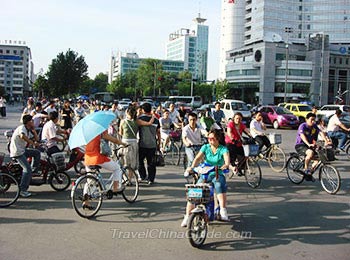 |
| Main Street of the City |
Almost since the mid-age of 20th century, the city has been the goods and capital distributing center of Shanxi and Hebei provinces. Transportation by road in this area then kept developing at high-speed to satisfy the requirement of trade. So far, 4 expressways, 4 national highways, 2 provincial highways, and 42 county highways forms a huge network in a total length of 6375 kilometers (3963.7 miles), which makes places in and around the city easily reachable.
Air
Airport Code: SJW
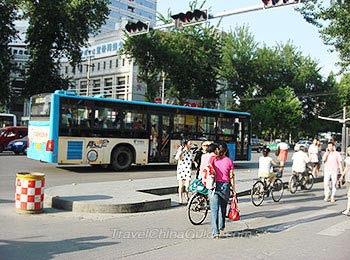 |
| Street View |
Location: Shijiazhuang Zhengding International Airport is at Zhengding County, about 21 miles (34 kilometers) northeast to the city center.
Brief Intro: It was put into service in 1995 as the largest civil airport in Hebei Province. Zhengding International now serves many air routes to more than 70 domestic and international cities.
Airport Transportation: downtown shuttle buses, high-speed train, and long-distance buses to nearby cities.
Train
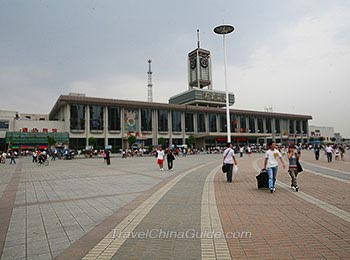 |
| Railway Station |
Zhengding Airport High Speed Railway Station is within 10min driving distance from the airport and offers great convenience for passengers who want to transfer between flight and train.
East Railway Station has come into use since December 28th, 2017 along with the opening of Shijiazhuang – Jinan High Speed Railway. High speed trains to/from many domestic cities such as Jinan, Nanjing, Hefei, Shanghai, Fuzhou, and Beijing are operated here.
 Major Rail Lines from Shijiazhuang to:
Long-distance Bus
Shijiazhuang Passenger Transport Station lies in No.81 Zhanqian Street, which stands to the south of the Railway Station. Here, buses connect this city with other cities inside Hebei Province, such as Baoding and Qinhuangdao as well as cities outsides Hebei like Shanghai and Beijing. The station can be reached by city bus No. 3, 16, and 33.
Tips: Tickets here can be purchased 1 day prior to your departure.
North Passenger Transport Station is situated in No.257 Shizhuang Road. It can be reached by City-bus No.40. Coaches heading for Shanxi, Shaanxi, Ningxia and places within this city are available here. Moreover, tourism lines to Mt. Wutai and Xibaipo etc. can be found in this station. There are some tourist lines within the city. Buses to Lingshou, Pingshan counties, Tiangui Mountain, Xipaipom Tuoliang and Juguiyuan are all available there.
Currently, Shijiazhuang metro line 1, metro line 2 and metro line 3 are in operation. Line 1 connects Xiaohedadao and Xiwang with the length of around 24 kilometers (15 miles). Line 2, passing Yuhua, Qiaoxi, Chang’an Districts, serves between Liuxinzhuang and Jiahua Road. It covers distance of around 15.5 kilometers (10 miles). Line 3 runs between Shi'erzhong and Shijiazhuang Railway Station. According to long-term plan, this city will operate 6 metro lines totally. Metro Map
City-bus
Note:
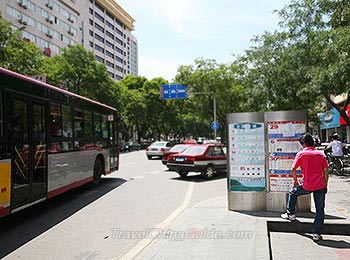
1. You just need to slip the right fare into the cash box inside the front gate of the bus when you get on it. Charges of the Tourism Lines:
2. Tour 1, Tour 5, Tour 7: CNY2 for the whole routes
Tour 6: CNY1
3. Tour 5 can take you to the Baoduzhai Scenic Area, the Zoo and the Martyr's Cemetery;
Tour 1 can take you to the Botanical Garden;
Tour 6 can take you to the Zoo, Zhongshan Park, and Zhaotuo Park;
Tour 7 can take you to the Longquan Temple.
|
|
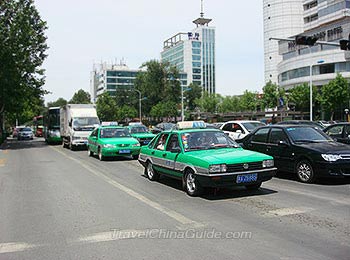
Taxi
If running during 23:00 – 05:00 the next day, additional CNY0.2 is to be charged per kilometer. Within 5 minutes’ waiting, it is for free; for the exceeding time, CNY1.6 shall be charged for every 5 minutes.
 Reply
Reply 0
0 0ReplyReply10ReplyReply00ReplyReply00ReplyReply
Thank you for ur help in advance.
:)
20Reply10ReplyAnd, could u help me more: how to go to HeBei provincial museum from SJZ north railway station via bus or subway?
Sorry for asking a lot because I can't find info. about notth railway station.
Thanks for ur help again.
I am really appreciated.
20Reply