Labrang Monastery
About 1 km (0.6 miles) west from Xiahe County in the Gannan Prefecture, Gansu Province, lies the Labrang Monastery. A propitious place in the hearts of the Tibetans, it stands by the Daxia River and faces the Dragon Mountain. The monastery is renowned for its rich Tibetan culture, imposing Buddhist structures, unique Tibetan food, and the long corridor of prayer wheels. Since the famous Chinese movie "World Without Thieves" was screened in 2004, the Labrang Monastery has become known to visitors as the film’s shooting place.
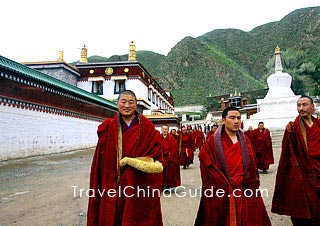
It is a holy place where Buddhism followers learn the essence of Buddhism. In its heyday, there were over four thousand monks. As in the past, every day early in the morning, monks chanted sutras together. The Labrang Monastery holds seven large-scale assemblies a year, with the Summons Ceremony in the first lunar month and the Buddhist Doctrine Explaining Ritual in the seventh lunar month being the grandest ones. The former one lasts for fifteen days from the3rd – 17th in the lunar January.
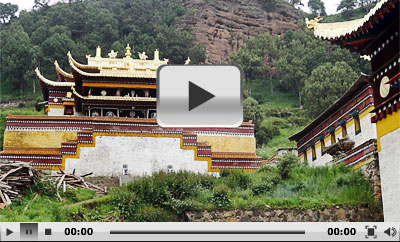
 Covering an area of 866 hectares (about 2,140 acres), the monastery contains tens of thousands of rooms that are painted red, yellow and white according to function and class. At dawn or at dusk, when the sun illuminates the golden spires with its rays, they all look imposing and majestic. At night, a starry sky over the monastery is also very impressive, creating a mystical atmosphere.
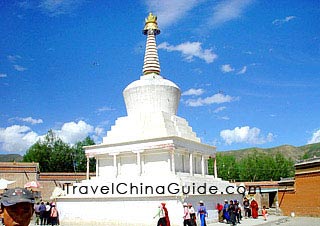
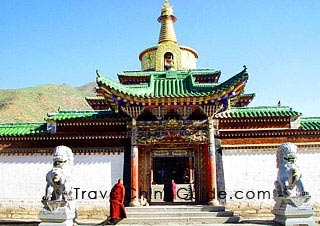
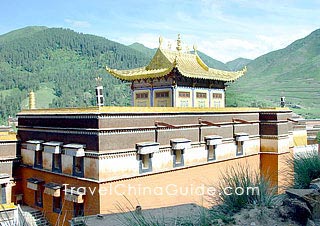 The architectural layout of the Labrang Monastery is presented in typical Tibetan style. The symbols of the whole construction are the white stupas in the northeast and northwest. There is Wensi College, an Exoteric Buddhist college and five Esoteric Buddhist colleges in the monastery. Wensi College is the center of the monastery, also called the Grand Sutra Hall. Buddha halls are located in the northwestern part around the Grand Sutra Hall. Other halls are spread out in a shape similar to a crescent moon, all richly ornamented.
The Grand Sutra Hall is the dominant place for the religious activities of the Labrang Monastery and for adherents' worshipping. On the inside walls there are portraits and shrines of Buddha and bookcases.
Located in the northwest of the Grand Sutra Hall, the Grand Golden Tile Hall is the highest building in the Labrang Monastery and is strongly tinged with Nepalese flavor. It is six-storied and the roof is constructed of bronze bricks beautifully gilded in gold. Inside the hall there is a bronze figure of Buddha created by Nepalese artisans.
The Buddha statues in the temples are all lifelike with kind, benign expressions. Various butter sculptures are also on display. The temple walls are decorated with colorful and elaborate paintings. Walking within them, one will feel inner peace.
To get a fascinating vista of the monastery, you need to pay an extra CNY 20 for Gongtang Pagoda, which is situated at the southwest corner. Visitors can go to the top of the pagoda and admire the grandness of the Labrang Monastery, or go across the wood bridge over the Xiahe River and climb the hill facing the monastery. These are the best lookouts for a full panoramic view.
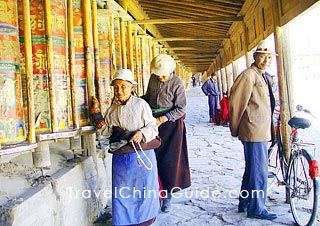
Labrang Monastery boasts the longest corridor of prayer wheels over the world, with over 1,700 scripture wheels. The hexagonal wood cylinders are carved with different scriptures and patterns on each side. The whole monastery is encircled by the corridor, stretching as long as 2.2 miles (3.5km). Walking to the end of the corridor takes more than an hour. Walking clockwise along the corridor and rotating the wheels, you can get your troubles melt away.
In the dining hall, you will have a special local meal. Ordering is not needed. Instead, monks will serve you with local dishes one by one. The first is a bowl of milk tea, and then comes the boiled mutton and highland barley wine. Interestingly, you will not be served with rice until you finish the wine. The last course is a Tibetan bun with mutton stuffing. In summer, the meal always ends up with a cup of cool yogurt.
Do take off hats when you enter the main halls.
Don't touch or point at the Buddhist statues.
Don't take pictures in the main halls and Gongtang Pagoda.
 1. From Lanzhou, visitors can catch a direct bus at Lanzhou South Coach Station to Xiahe County, with departures at 7:30, 8:30, 09:30, 14:00 and 15:00. The fare is around CNY 75 and the journey takes about five hours. Since it is a long distance, it’s best to leave for Xiahe in the morning. After arrival, take a taxi to the Labrang Monastery.
2. From Xining, you can take a bus at Xining Passenger Transport Center, located on the east side of the South Square of Xining Railway Station. It departs around 07:00. The journey costs CNY 80 and takes about six hours.
3. From other counties like Linxia or Hezuo, there are buses to Xiahe every day.
It is a holy place where Buddhism followers learn the essence of Buddhism. In its heyday, there were over four thousand monks. As in the past, every day early in the morning, monks chanted sutras together. The Labrang Monastery holds seven large-scale assemblies a year, with the Summons Ceremony in the first lunar month and the Buddhist Doctrine Explaining Ritual in the seventh lunar month being the grandest ones. The former one lasts for fifteen days from the3rd – 17th in the lunar January.
Layout and Structures
The architectural layout of the Labrang Monastery is presented in typical Tibetan style. The symbols of the whole construction are the white stupas in the northeast and northwest. There is Wensi College, an Exoteric Buddhist college and five Esoteric Buddhist colleges in the monastery. Wensi College is the center of the monastery, also called the Grand Sutra Hall. Buddha halls are located in the northwestern part around the Grand Sutra Hall. Other halls are spread out in a shape similar to a crescent moon, all richly ornamented.The Grand Sutra Hall is the dominant place for the religious activities of the Labrang Monastery and for adherents' worshipping. On the inside walls there are portraits and shrines of Buddha and bookcases.
Located in the northwest of the Grand Sutra Hall, the Grand Golden Tile Hall is the highest building in the Labrang Monastery and is strongly tinged with Nepalese flavor. It is six-storied and the roof is constructed of bronze bricks beautifully gilded in gold. Inside the hall there is a bronze figure of Buddha created by Nepalese artisans.
The Buddha statues in the temples are all lifelike with kind, benign expressions. Various butter sculptures are also on display. The temple walls are decorated with colorful and elaborate paintings. Walking within them, one will feel inner peace.
To get a fascinating vista of the monastery, you need to pay an extra CNY 20 for Gongtang Pagoda, which is situated at the southwest corner. Visitors can go to the top of the pagoda and admire the grandness of the Labrang Monastery, or go across the wood bridge over the Xiahe River and climb the hill facing the monastery. These are the best lookouts for a full panoramic view.
Long Corridor of Prayer Wheels
|
|
Tibetan Meal
Dos and Don'ts:
Don't touch or point at the Buddhist statues.
Don't take pictures in the main halls and Gongtang Pagoda.
 |  |
How to get there
2. From Xining, you can take a bus at Xining Passenger Transport Center, located on the east side of the South Square of Xining Railway Station. It departs around 07:00. The journey costs CNY 80 and takes about six hours.
3. From other counties like Linxia or Hezuo, there are buses to Xiahe every day.
| Admission Fee | CNY 40 for visiting several main halls. Otherwise, you can tour the grounds for free. CNY 20 for Gongtang Pagoda |
| Opening Hours | 08:00 - 18:00 (Grand Sutra Hall and Gongtang Pagoda) 08:00 - 16:00 (other halls) The whole monastery is open all day long. |
| Recommended Time for a Visit | Four hours |
- Last updated on Aug. 06, 2025 by Demi Li -