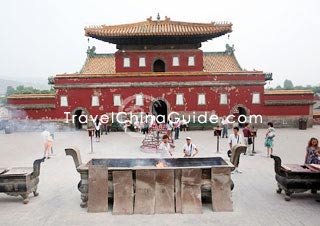
To the north-east of the Mountain Resort of Chengde, lies the Eight Outer Temples, the emperor's summer residence during the Qing Dynasty (1644-1911). 'Eight Outer Temples' is a collective name given to 12 temples located outside Gubeikou - a section of the Great Wall. Eight of the temples were administered by Lifan Yuan, an administration department for the affairs of minorities such as Mongolian and Tibetan, and so the name stuck. Together with the Mountain Resort of Chengde, the temple has been as a World Heritage Site.
The 12 temples were built in succession. Construction began in 1713 in the Qing Dynasty and completed in 1780. Six temples are now open to tourists - Putuo Zongchengzhi Temple, Puning Temple, Xumi Fushouzhi Temple, Pule Temple, Anyuan Temple, and Puyou Temple. Each one has its own particular features and special appeal.
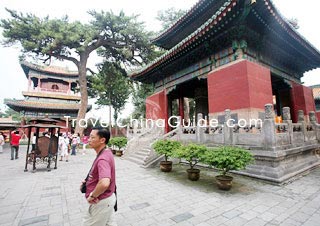
Putuo Zongchengzhi Temple is located to the north of Mountain Resort of Chengde. It is the biggest and the most magnificent building in Eight Outer Temples. Built in 1767 imitating the style of the
Potala Palace, the temple is also named 'little Potala Palace'. For another reason that 'Putuo Zongchengzhi' is a Tibetan language meaning 'Potala Palace' in Chinese. The halls and pavilions in it were designed to naturally strew on hillside according to the hypsography. The Big Red Platform is the principle construction of the temple. The platform and the three halls on it are all with the copper gold tiles roof.
| | 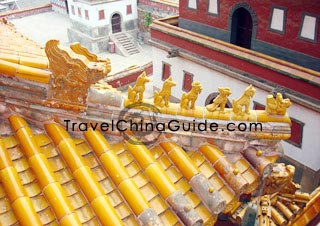 | | Roof-figure Decoration in Imperial Eaves | |
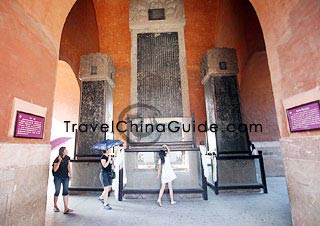 | | Stone Steles in Putuo Zongcheng Temple | | 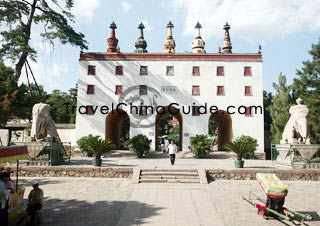 | | A While Building in Putuo Zongcheng | |
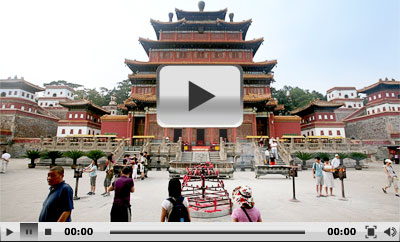
Also located to the north of the Mountain Resort of Chengde is Puning temple which was built in 1755. It is also known as 'Big Buddha Temple', for a big wooden Buddhist statue housed there. The Buddhist statue is unusual, being of Kwan-yin, standing 22.23 meters (approx. 72.93 feet) tall, with a thousand eyes and a thousand arms. It is made with five kinds of lignum - pine, cypress, elm, fir and linden, and is one of the biggest preserved wooden statues in China.
| |  | | View of Puning Temple | |
To the north of the Mountain Resort of Chengde and to the east of Putuo Zongchengzhi Temple, lies Xumi Fushouzhi Temple, which was built in 1780. It is said that this temple was built as a residence for Panchen Lama (head of Tibet), who traveled far to celebrate the 70th birthday of Qianlong - a famous emperor of the Qing Dynasty.
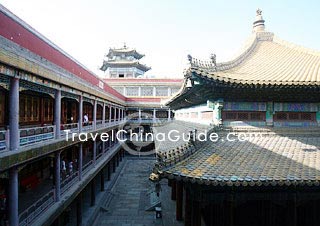
The temple not only has Han characteristics such as the square kiosk and glazed tile roof, but also has characteristics of Mongolian and Tibetan nationalities, which you can see in the trapezoidal windows, Lama pagodas, and copper gold tiled roofs.
Pule Temple, to be found to the northeast of the Mountain Resort of Chengde, was built in 1766. The temple is divided between a front part, which reflects a traditional Han style, and a back part which has three walls from outside to inside.
The Eight Outer Temples were built by the Qing government to strengthen a unity with the minorities, thus the temples not only feature Han style, but also the Mongolian and Tibetan styles, with the symbolic meaning of unity in China. The architectures, inscriptions, sculpture, and murals in these temples are important materials for the study of history, culture, religion, and architectural art.
Transportation:
To get there, you can take bus No. 6 outside the Mountain Resort of Chengde.
| Scenic Area | Admission Fee |
| Budala Xanadu Area (including Putuo Zongcheng Temple and Xumi Fushou Temple) | CNY80 (April 1 - October 31)
CNY60 (November 1 to March 31 of the next year) |
| Puning Temple Area (including Puning Temple and Puyou Temple) | CNY80 (April 1 - October 31)
CNY60 (November 1 to March 31 of the next year) |
| Qingchuifeng Area (including Pule Temple, Anyuan Temple and Qingchuifeng National Forest Park) | CNY50 |
- Last updated on Aug. 08, 2025 by Demi Li -
 More
More