Potala Palace
 From September 20, 2026, Potala Palace offers the Snow City Only visit line for tourists. The ticket can be booked seperately.
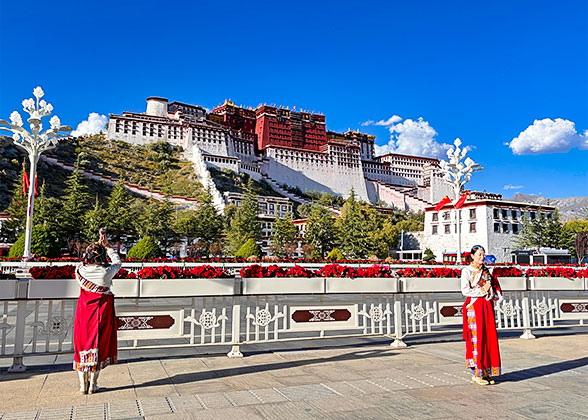
Perched atop Red Hill in the heart of Lhasa, the Potala Palace stands at 3,767.19 meters (12,359.55 ft) above the sea level, making it the highest ancient palace in the world. Built in 631 AD and designated a UNESCO World Heritage Site in 1994, this iconic structure once served as the supreme political and religious center of Tibet. Today, it remains the most recognizable and visited landmark in Lhasa, and arguably all of Tibet.
Potala Palace History
It is commonly believed that the Potala Palace was built by Tibetan King Songtsen Gampo (617–650) to welcome his bride Princess Wencheng (625-680) of the Tang Dynasty (618–907). However, according to historical records, the construction of the complex began in 631, while Princess Wencheng married him in 641, suggesting the two events may not have been directly related. Actually, the true reason Songtsen Gampo built the Potala Palace was to build a symbol of royal authority and to consolidate his rule.
 |
| Night View of Potala Palace |
After unifying the Tibetan Plateau and establishing the powerful Tubo Empire, Songtsen Gampo moved the capital northward to Lhasa, which was in central Tubo and allowed him to better control the whole empire. Then he began construction of Potala Palace in 633, sending a clear message that he was the true ruler.
Songtsen Gampo was regarded as an incarnation of Avalokitesvara, the guardian deity of the plateau in Tibetan Buddhism. Thus, his palace was named Potala, meaning "the dwelling place of Avalokitesvara."
However, following the collapse of the Songtsen Gampo dynasty, the ancient palace was largely destroyed in war.
Most of what we see today was rebuilt from the 17th century onward. The Fifth Dalai Lama (1617–1682), the spiritual and political leader of Tibet at that time, initiated a large-scale reconstruction beginning in 1645, transforming the site into a winter palace and administrative center. Expansion continued during the rule of subsequent Dalai Lamas and throughout the Qing Dynasty (1644–1911), gradually shaping the complex into the massive fortress-like structure seen today.
After 1959, the palace ceased functioning as a political seat and was gradually converted into a museum and cultural heritage site. In 1994, UNESCO recognized the Potala Palace as a World Heritage Site, citing its outstanding architectural ensemble and its role as a living testament to Tibetan Buddhism and history. Inside, stupas, murals, thangkas, and historical artifacts are displayed, offering visitors a rare glimpse into mysterious Tibetan civilization.
Must-Sees: Red Palace & White Palace
Red Palace – Sacred Tombs, Ancient Chapels & the West Great Hall
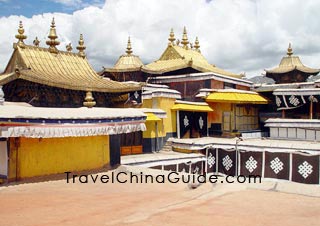
The West Great Hall, covering 725 square meters, (7,804 sq ft) is the largest hall in the Red Palace, adorned with vivid murals depicting scenes from Buddhist scriptures and the life of the Buddha. The Red Palace also houses the Dharma Cave and the Saint's Chapel, the only surviving structures from the 7th century, containing statues of King Songtsen Gampo alongside his two wives, Princess Wencheng and Princess Bhrikuti (?-649) of Nepal.
Additionally, it contains the elaborate stupa tombs of several Dalai Lamas. A must-see is the Stupa Hall of the Fifth Dalai Lama, the first, largest, and most iconic stupa in the Potala Palace, and the absolute centerpiece of the Red Palace. Built between 1690 and 1693, the stupa stands 14.85m (48.72ft) tall, roughly a five-story building, and is wrapped in about 3,721 kg of gold foil, with nearly 20,000 jewels hammered and inlaid across its surface. The central spherical chamber holds the consecrated body of the Fifth Dalai Lama.
 The Red Palaces walls are actually made from "grass".
 |
| Red Palace |
The red walls of the Potala Palace look solid and heavy, but they are made of bundles of plant called pema or baima grass, a kind of willow branches harvested from alpine slopes above 4,000m (13,123 ft) high. The grass was used mainly for its light weight and easy transport along hillside and to reduce the load on the complex foundation. It also breathes well, allowing air to circulate through the walls while resisting alkali and decay. On top of that, this natural material insulates against the plateau's extreme temperatures, keeping the interior cooler in summer and warmer in winter.
White Palace – Administrative Hub & Living Quarters of the Dalai Lamas
It is seven stories high. On the fourth floor lies the East Great Hall, the largest hall in the White Palace, covering an area of 717 square meters (7,717 square feet). This was the venue for major religious and political events such as the enthronement of the Dalai Lama and important ceremonies. Notably, the murals named “Princess Wencheng Entering Tibet”are preserved here, depicting the princess brought Buddha statues and Han craftsmanship to Tibet.
The fifth and sixth floors housed offices and living quarters for regents and other officials, while at the top, the seventh floor features the Sunlight Hall, named for its all-day sunlight exposure. Consisting of the East and West Sunlight Chambers, this was the Dalai Lama's winter living quarters.
The West Sunlight Chamber is divided into four connected spaces. At the first glance, you’ll see the audience hall used for government affairs, with soft lighting and a formal atmosphere. Then is a meditation chapel for practice and study, where high windows and yellow silk curtains filter the light into a calm, muted glow. Step further in, there is a guardian god chapel housing deity statue and a warm, carpeted bedroom and antechamber, where a delicate embroidered appliqué panel hangs on the wall.
The White Palace's walls are nicknamed "Milk Wall" or "Sweet Wall".You may have seen photos online of people licking the white walls of the Potala Palace. This is because that though the main paint of the wall is white clay, edible ingredients like milk, sugar and honey were used to increase stickiness, prevent peeling, and give the wall a smooth, creamy sheen. There is also ox bone glue to reinforce adhesion, and saffron to repel insects and neutralize odors. This is why locals call it the "milk wall" or "sweet wall."
Every year in the ninth month of the Tibetan calendar, just before the Festival of Descent from Heaven, monks and devotees gather to whitewash the walls. It's both a maintenance routine and a ritual of blessing.
More to See in Potala Palace
Snow City
Snow Prison, first used as a lockup and later rebuilt as the judicial prison in the 17th century, held lighter offenders and political prisoners. Restored as a public exhibition hall, the small, low-ceilinged rooms now display chains, wooden collars, whips, and reconstructed torture scenes, a blunt reminder of how harsh justice was in the past. Xueba Liekong, literally meaning "administrative office of the lower town", is a two-story Tibetan building just northwest of the Snow Prison. The upper floor is restored with the magistrate's office, clerks' desks, and a grain storehouse stocked with wheat, barley, butter, and dried curd seized as tax. A small exhibit on the side tracks the palace's modern conservation works. Treasure Hall, set in a three-story former aristocratic house, showcases around 200 items including palm-leaf sutras from the 9th century, gilt bronze Buddha statues, ancient porcelain, imperial seals and plaques, agate cups, and finely painted thangkas. See detailed introduction to Collections of Potala Palace, including its stupas, frescos, thangkas, carvings and sculptures, etc.Highest Toilet in the World
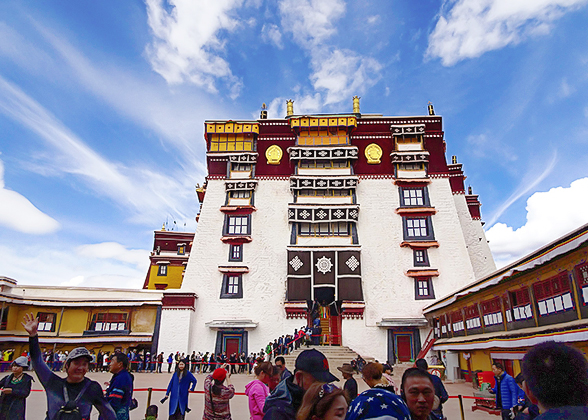 |
| Deyangshar Courtyard |
Best Photo Spots for Potala Palace
The Chakpori Hill platform is a rocky ridge west of the palace offering the most famous panoramic view of the entire complex against the Lhasa skyline. From here, the view of Potala Palace lines up exactly with the back of the CNY50 note. Try folding the banknote in half and holding it up against the actual palace. The printed image and the real building align perfectly, creating a fun and creative photo. Read more: China Sightseeing Tours to Top 6 Attractions on CNY Banknotes For the clear front shot of Potala Palace, go to Potala Palace Square. The paved ground turns into a mirror after rain or when lightly wetted, so crouch down or lay your phone flat on the ground to catch a clean, full reflection of the facade. If you want to skip the front-side crowds, after exiting Potala Palace north gate, walk to Zongjiao Lukang Park. This quiet park was built to honor the water deity of Tibetan Buddhist mythology. Its lake, Dragon King Pool, sits peacefully beneath the palace's back face, surrounded by willow trees and birds. The still water mirrors the red and white walls above, giving you a softer, reflective angle that most first-time visitors miss.
|
|


How to Visit: A Recommended Route
 |
| Click to enlarge, or go for more Lhasa maps |
08:30 – Chakpori Hill 09:00 – Potala Palace Square 09:30 – Security Check at Snow City South Gate 09:45 – 10:45 Snow City 11:00 – 14:30 Potala Palace Inner Visit 14:45 – Exit from Potala Palace, and cross into Zongjiao Lukang Park for the final panorama of the palace.There are three visit lines, Line 1, Line 2 and Snow City Only Line. Aside from the areas covered by these lines, the rest of the palace is closed to visitors.
The Snow City Only line covers 8 sites, including the Treasures Hall, Snow Prison, Xueba Liekong, Ancient Rulers' Households etc., which excludes the Potala Palace main buildings.
Details of the other two lines are listed as follows:
| Line 1 (Full Tour) | Line 2 (Short Tour) | |
|---|---|---|
| Covered Attractions | Snow City | |
| White Palace: East Great Hall & East Sunlight Chamber Red Palace: 7 Buddha Halls and 4 stupa Halls of the 7th, 8th, 9th and 13th Dalai Lamas Golden Roof: Panoramic views over Lhasa. | White Palace: East Great Hall Red Palace: West Great Hall, 4 Buddha Halls and 3 stupa Halls of the 5th, 10th and 12th Dalai Lamas | |
| Duration | 3.5 – 4 hours | 2 hours |
| Recommended For | First-time visitors; history & architecture enthusiasts; anyone seeking the complete cultural experience. | Those with tight schedules; visitors with limited mobility/stamina; families with little children. |
Tours of TravelChinaGuide follow Line 1, which covers more of the main palace. In comparison, Line 2 covers fewer interior halls and skips the upper sections.
Recommended Tours

Best Time to Visit: May – October
April and November offer the best balance overall. You'll find fewer tourists, tickets are easier to get, and the sunlight is still good for photography. During December to March, there are fewest visitors, the lowest prices and enough tickets. However, some halls may be closed for rotating maintenance, and Lhasa’s climate is cold, less ideal than other months.
Potala Palace Travel Tips
2. Oxygen canisters, drones, selfie sticks, lighters, any liquids over 200ml including water are not allowed to bring into the attraction area.
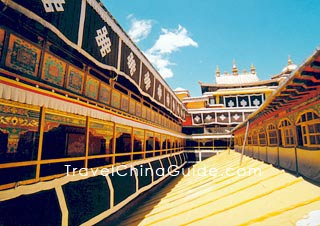
3. Wear comfortable sneakers or hiking shoes. Dress in long pants and cover your shoulders, as required inside the temples. Remember to remove hats and sunglasses when entering chapels to show respect, and always bring an additional coat since it is cool and damp inside those halls.
4. No photography inside the Red and White Palaces.
5. The visit route is almost all steep stone staircases, with no ramps or elevator inside the historic palace, hard for visitors with wheel chairs.
|
|
Since independent travel isn't allowed in Tibet, your tour agency will take care of everything for your Potala Palace visit. But if you want to know more, here's some information for reference.
Opening Hours & Closed Days of Potala Palace
Opening Hours
Nov 1 – Apr 30: 09:30 – 15:20.
Closed Days
Note: Opening hours can also shift during Tibetan New Year around late February, Chinese New Year in late January to early February, and National Day holiday in October's first week.Tickets & Booking
| May 1 – Oct 31 | Nov 1 – Apr 30 | |
|---|---|---|
| Line 1 | CNY200 | CNY100 |
| Line 2 | CNY100 | CNY100 |
| Snow City Only Line | CNY25 | CNY10 |
Children under 1.2m (3.9 ft) or under 6 years old enter free.
When to Book
May 1 – Oct 31: book up to 10 days ahead. During the busiest stretch from July to October, it’s possible to book up to 15 days in advance.
Nov 1 – Apr 30: book up to 7 days ahead.
Release times: 00:00 and again at 08:30 daily. The 08:30 release tends to offer the most availability, so set your alarm at least for 8:25.
The tickets are generally sold out immediately. Sometimes, Line 2 tickets may be available on site.How to Get to Potala Palace
Take bus 1, 6, 12 or 24 to Labai Bus Stop, then walk north for about 8 minutes to Potala Palace Square.
How to get there from Gonggar Airport: Take the airport shuttle bus to Minhangju Civil Aviation Office Stop at CNY 30 and in about 70 minutes, then walk west for 15 minutes to the palace.
How to get there from Lhasa Railway Station: Take bus 13 and get off at Baita Bus Stop. The South Gate is a 5-min walk eastward.