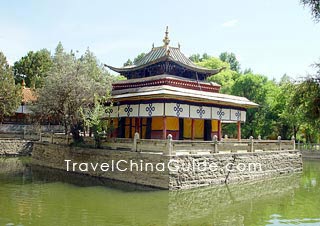
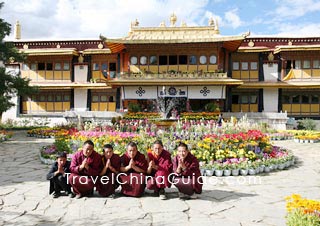
Norbulingka, meaning 'Treasure Park' in Tibetan, is situated in the western suburb of Lhasa City, at the bank of the Kyichu River, about one km (about 0.6 mile) southwest of Potala Palace. The garden covers an area of 360,000 square meters (about 430,000 square yards), with 374 rooms inside. It is the biggest man-made garden in Tibet Autonomous Region.
Construction began in the 1740s. The area used to be wasteland with wild animals, weeds and scrub which the Seventh Dalai Lama liked and often visited, and, as a result, the Qing magistrate had a palace built. Years later, Kelsang Potrang was built by order of the Seventh Dalai Lama. Later it was used as the Summer Palace for successive Lamas, where they solved the political problems and held festive celebrations. After a series of expansions and renovations, the appearance was improved with potrangs, pavilions, gardens and woods. It has now been turned into a park open to the public.
Norbulingka consists of several palace complexes, such as the Kelsang Potrang, Tsokyil Potrang, Golden Linka and Takten Migyur Potrang. Each palace complex is divided into three sections - the palace section, the section in front of the palaces and the woods.
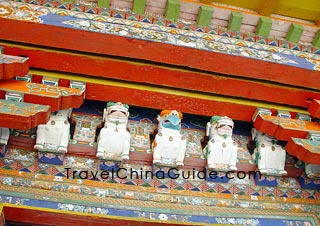 |
Kelsang Potrang, named after the Seventh Dalai Lama, is a three-storey palace with halls for worshipping Buddha, bedrooms, reading rooms and sanctuaries. Tsokyil Potrang, when the Eighth Dalai Lama was in power, is considered to be the most attractive in Norbulingka. Khamsum Zilnon built during that time is really a striking pavilion of the Han architecture style, where Dalai Lamas enjoyed Tibetan opera. In 1922, a wealthy benefactor had Golden Linka and Chensel Potrang constructed for the Thirteenth Dalai Lama. Meanwhile, a lot of flowers, grass and trees were planted. In 1954, the Fourteenth Dalai Lama built Takten Migyur Potrang, which is also called the New Summer Palace, means 'Eternal Palace' in Tibetan. The architecture has combined the characteristics of temple and villa and is more magnificent than other palaces. The exquisite murals in the palace are well worth a mention and visit. The murals in the northern hall show the kind, calm Sakyamuni and his eight contemplative disciples. However, the murals in the southern hall vividly tell the development of Tibet in comic strips.
 |
Norbulingka both reflects the ethnical, religious features of the Tibetan people and embodies the architecture style of inland China. It is of great cultural value and was listed by UNESCO as a World Cultural Heritage Site in 2001 as an extension of Potala Palace.
How to get to Norbulingka
1. Take bus 14 or 24 to Luobu Linka (Norbulingka).
2. Take bus 2 to Luobu Linka Nan.
| Entrance Fee | CNY 60
 Free admission from Jan. 1 to Mar. 15 and Oct. 15 to Dec. 31, 2021. Free admission from Jan. 1 to Mar. 15 and Oct. 15 to Dec. 31, 2021. |
| Sightseeing Bus | CNY 20 |
| Opening Hours | 9:00 - 17:30 |
| Recommended Time for a Visit | 3h |

You may like:
Top 10 Things to Do in Lhasa- Last updated on Apr. 22, 2026 by Gabby Li -
 Norbulingka Pictures