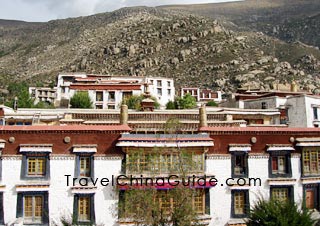
Situated at the foot of the Mountain Gambo Utse, 5 kilometers (3.1 miles) from the western suburb of Lhasa, the Drepung Monastery is known as the most important monastery of Gelugpa in Tibetan Buddhism. It is considered one of the 'Three Great Monasteries' (the other two are the
Ganden Monastery and the
Sera Monastery). Covering an area of 250,000 square meters (299,007 square yards), it held 7,700 monks in total and possessed 141 fazendas and 540 pastures in its heyday, and is the largest-scale monastery among the ones of the same kind. Seen from afar, its grand, white construction gives the appearance of a heap of rice. As such, it was given the name 'Drepung', which, in the Tibetan language, means 'Collecting Rice'.
History of Drepung Monastery
The Drepung Monastery was established in 1416 by Tsong Khapa's disciple Jamyang Qoigyi, who was versed in both Esoteric
and Exotoric Buddhism and became the first Kampo there. With the support of plutocrats, it developed as the richest of its kind of Gelugpa and became the mother temple of Dalai Lamas. In 1546, the third Dalai was welcomed as the first Living Buddha into it. At the invitation of Mongolia's king, he went to Qinghai Province to preach. He was dignified with the title 'the third Dalai Lama' the first and second Dalai were entitled, too. It is the very place that the second, third, and the fourth Dalai Lama held the Sitting-in-Bed Ceremony, as well as the residence of the fifth Dalai before his nomination by the government of the Qing Dynasty (1644 - 1911).
Organizational System and Education System
The organizational hierarchy of Drepung Monastery is rather complex. The main branches of the organization consist of Coqen, Zhacang, Kamcun, and Myicun. Coqen is in the highest position, to which Zhacang belongs, and Kamcun is under the jurisdiction of Zhacang, with the Myicun as its subordinate. Monks belonging to respective Zhacangs cannot interblend with each other.
The education system in Zhacangs is set up such that, every year there are eight chances to study the sutra collectively, each time spanning from half a month to a month. Monks are tested before the Kampo in the method of reciting sutras and debating, and based on their performance; receive the degrees of different levels.
What to See inside Drepung Monastery
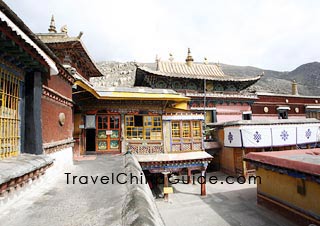
The ground of the monastery is organized on the caves and temples for Jamyang Qoigyi, together with two magnificent white pagodas. The buildings here then are centered on these pagodas, The major buildings are Ganden Potrang, Coqen Hall, the four Zhacangs (or Tantric colleges), and Kamcuns.
Ganden Potrang
The Ganden Potrang, in the southwest corner, was built under the supervision of the second Dalai Lama Gendun Gyaco around the year of 1530. It became the residence of the second, third, fourth, and the fifth Dalai Lamas. After the fifth Dalai Lama moved to the Potala Palace, it was served as the meeting place for the local regime for both politics and religion.
Coqen Hall
The Coqen Hall is located in the center. In front of it, is a square occupying an area of about 1,850 square meters (2213 square yards). Stepping on the wide stone stairs, you will see the grand Entrance Hall. Inside is the Sutra Hall supported by 183 pillars, and spanning 1,850 square meters. Amongst the colorful decorations, there are fine and vivid statues of Buddha. The second story houses collections of precious sutras. There are a set of Gangyur Tripitaka written in gold powder, and woodcarving sutras of the Qing Dynasty. On the third story is enshrined a huge bronze statues of Qamba Buddha, which is said to be the future appearance of the Qamba Buddha in his 8th year. It is worshiped by the disciples of Buddhism.
Four Zhacangs
The monastery is composed of 4 Zhacangs, functioning as the sutra-learning places and the subordinate organization. Loseling Zhacang is the largest with the most lamas. The Loseling, Gomang, and Deyang Zhacang focus on the Esoteric Buddhism, while the Ngaba Zhacang on the Exotoric Buddhism.
Courtyards
Several courtyards in the dense forests on the grounds there are used for monks to debate on the sutras. The courtyards sites are always chosen near Zhacang and various trees are grown. After enduring the debating period in both Zhacang and the entire monastery, the winner will obtain the qualification to attend the test for the senior degree of Geshi.
Other Cultural Relics
The Drepung Monastery houses many cultural relics, which adorn and make it more superb. Statues of Manjushri Bodhisattva, and Sitatapatra found on the first storey of the Coqen Hall, rare sutras on the second storey and Jamyang Qoigyi's conch shell given by Tsong Khapa on the third one, all add to the wonderment. Exquisite statues of Tsong Khapa, Kwan-yin Bodhisattva, Manjushri Bodhisattva, Amitayus, and Jamyang Qoigyi in other sutra halls, as well as flowery murals on walls also fully present the wisdom of the Tibetan people.
How to get to Drepung Monastery
1. Take bus 24 to Zhebangsi (Drepung Monastery).
2. Take a taxi to the monastery, and the fare is around CNY 20.
| Entrance Fee | CNY 60 |
| Opening Hours | 9:00 - 16:00 |
| Recommended Time for a Visit | 3h |

You may like:
Top 10 Things to Do in Lhasa
- Last updated on Mar. 25, 2026 by Gabby Li -

 Drepung Monastery Pictures