Ramoche Monastery is situated in the northwest of Lhasa, covering a total area of 4,000 square meters (one acre). This temple is one of the key cultural relic protection sites of the Tibet Autonomous Region as well as a hot attraction in Lhasa.
The original building complex has a strong Tang architecture influence, for it was first built by Han Chinese architects in the middle of the 7th century during the Tang Dynasty (618 - 907). Han Princess Wencheng took charge of this project and ordered the temple be erected facing east to show her homesickness.
Ramoche Monastery - the 3-storey Building in Han and Tibetan Styles
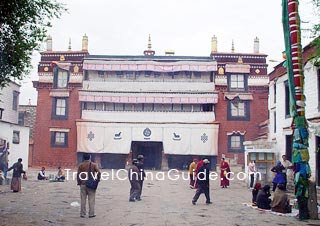
Ramoche Monastery fell into ruins and went through many reconstructions - only the Buddha palace on the first floor is left in its original state. The present temple is the result of the large restoration of 1986. The main building in the Ramoche Monastery has three stories. The first story includes an atrium, a scripture hall, and a Buddha palace with winding corridors. The third story was the bedroom once reserved for Dalai Lama. Upon entering the main building, one can see the ten pillars holding some of the remaining local relics such as the encased lotus flowers, coiling cloud, jewelry, and particular Tibetan Characters. The golden peak of the temple with the Han-style upturned eave can be seen from any direction in Lhasa city. Needless to say, the temple is a wonderful example of the combination of Han and Tibetan architectural styles.
The Statue of 8-year-old Sakyamuni inside Ramoche Monastery
One of the temple's prized artifacts is the life-sized statue of the 12-year-old Sakyamuni. The Wencheng Princess brought it from the capital Chang'an during the Tang Dynasty. As one of the precious cultural relics of Tibet, the statue is now placed in Jokhang Temple (Da Zhao Si), 500 meters (0.31 miles) south of Ramoche Monastery. Residing within the Ramoche Monastery is the life-sized statue of the 8-year-old Sakyamuni. Carried into Tibet by the Nepalese Chizun Princess, this figure is regarded as the greatest saint in the monastery.
Nowadays, the temple has become the very place for the Tibetan monks to study the Mi Zong (one of the sects of Buddhism).
How to get to Ramoche Monastery
1. Take bus 1, 2, 4, 16, 28,29 or 31 to Remuqi and you will see the temple.
2. Take bus 7, 8, 14, 20, 25, 28, or 32 to Cuomeilin and walk north for about 10mins to reach the temple.
| Entrance Fee | CNY 30 |
| Opening Hours | May - October: 08:30 - 18:00
November - April: 09:00 - 17:30 |
Jokhang TempleSera MonasteryZaki Temple (Zhaji Temple)
- Last updated on Apr. 22, 2026 by Gabby Li -
 Ramoche Monastery Pictures