Sera Monastery
Standing at the foot of Tatipu Hill in northern Lhasa, Sera Monastery ranks among the city's three greatest monasteries alongside Drepung and Ganden. Founded in 1419, it has been there for over six centuries. Most visitors come here for the famous monk debates, as well as its Tibetan Buddhism architecture and two annual festivals, the Shoton Buddha unfolding and the Sera Bengqin ceremony.
Sera Monastery belongs to the Gelugpa school, or Yellow Hat Sect, the reformist Tibetan Buddhism founded by Tsong Khapa (1357-1419) in the early fifteenth century. Tsong Khapa sent his disciple Shakya Yeshe (1354-1435) to establish the monastery in 1419.
 Why named Sera Monastery?
The name Sera is usually explained through a local legend about wild roses. The hillside behind the monastery once bloomed with se ra flowers, a Tibetan term for the wild rose, so the new institution came to be called Sera, meaning a place with wild roses. There is another saying that just when the construction of the monastery began, a heavy hailstorm fell. And since hailstorm in Tibetan language is pronounced "sera", the site was named "Sera Monastery".
As Emperor Yongle (1360-4124) treated Shakya Yeshe as an important religious figure, he presented the monastery with a set of Kangyur, the core scriptures of Tibetan Buddhism, which was brought to Tibet in 1416 and then preserved in Sera Monastery upon its completion. Nowadays, Sera Monastery still keeps 105 of the original 108 Ming era engraved volumes, which makes the gift one of the monastery's most valued historical holdings.
The complex covers roughly 115, 000 square meters (28 acres) and spreads across the lower hillside, with a main road running from southwest to northeast as its axis. The buildings are distributed at both sides along the axis. The main hall, Coqen Hall, is located slightly northeast of the central axis. It is the assembly building where the full monastic community gathers for major ceremonies.
Radiating outward from the main hall are three Dratsangs (Buddhism colleges), Me Dratsang, Je Dratsang and Ngaba Dratsang, each functioning as a teaching unit with its own assembly hall, chapels and administrative offices. These Dratsangs break further into smaller units called Kamcuns, literally monk’s dormitories, where monks from the same home region live, study and eat together.
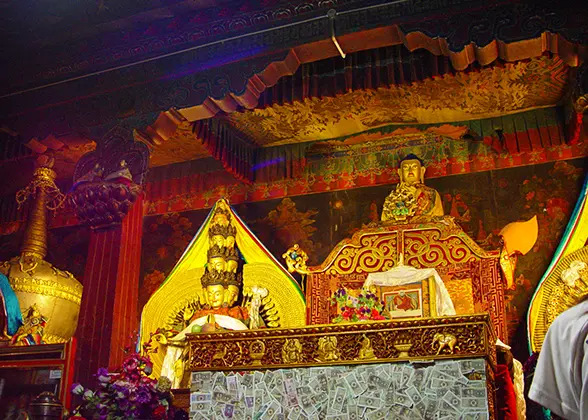
The Hayagriva statue is one of Sera Monastery's most defining treasures. Depicted with a fierce, wrathful expression, Hayagriva is a protector deity in Tibetan Buddhism, with supernatural power of cutting through obstacles and dispelling harmful forces.
According to local legend, Tsong Khapa once heard a horse neighing while having a stroll. Following the sound, he dug and dug and unearthed the statue. This miraculous discovery was seen as a sign of the deity's power, and ever since, the statue has been renowned for its exceptionally strong protective power.
Visit Tip:
Since many pilgrims regard Hayagriva statue as the spiritual center of the entire monastery, you'll often see a long queue in front of the chapel. You can join the line of devotees, and at the chapel, follow the worshippers as they bow down, place their heads into a small opening beneath the niche, and touch the statue's base with their foreheads. It is believed this small ritual can bring protection and remove misfortune.
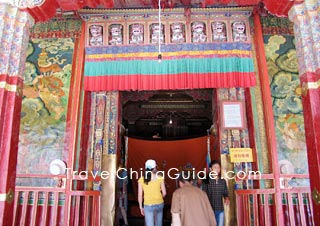
Coqen Hall is the largest and most important structure in Sera Monastery, serving as the monastery's main assembly space. Supported by 125 pillars, the four-story building houses the central debating and chanting hall along with several chapels. Entering the main hall, you'll face the 5-meter-high (16 feet) Maitreya Buddha in the center, with a small statue of Shakya Yeshe right in front of it, wearing the black hat gifted by Emperor Yongle.
At the rear of the hall, five chapels line up, with the central Maitreya Chapel being the most imposing, enshrining a 6-meter-high (20 feet) Maitreya Buddha. Up on the second floor, walk to the far left of the rear section, and you'll find another of the monastery's treasures, the Thousand-Armed Avalokiteshvara said to fly from India. Here, monks use one end of a bamboo pole touching the statue's heart and the other touching pilgrims' foreheads, to bestow blessings.
Kora means walking around monasteries or mountains. It is a traditional religious ritual of Tibetan Buddhism, believed to cleanse sins and accumulate merit.
Sera Monastery features a kora trail with the starting point inside the monastery's security gate, and it takes about 30 to 50 minutes to finish the kora. Join the local disciples and walk in a clockwise direction. Along the way, you will experience a profound religious atmosphere and unique views:
Stone Carvings and Murals: You'll find some white ladders painted on stones, which are blessings for the deceased to ascend to heaven. Additionally, numerous exquisite carvings like the Buddha's eyes that symbolize wisdom and insight, and Buddhist murals with vivid colors adorn the rocks.
Sacred Spring: The spring is regarded as holy water from a divine pond. Devotees frequently collect water here to drink or wet their foreheads for blessings.
Choding Gang Meditation Cave: Choding Gang means "high above the summit". It's high above Sera Monastery and the summit of the kora trail. Upon reaching here, you'll see sweeping views of the Lhasa Valley and the entire Sera Monastery.
Historical records indicate that Tsong Khapa had long practiced meditation and wrote many books here, and then led to build up Sera Monastery. Therefore, the cave is considered the monastery's birthplace and spiritual origin.
Visit Tip:
Nearby Choding Gang, there is a wild trekking path, which is recommended to energetic visitors with non-slip hiking shoes. It takes about 1 hour to walk and ascends about 400 meter (1,312 feet), reaching the yellow Sera Uzi Monastery at an altitude of 4,100 meters (13,451 feet). From here, you can enjoy a magnificent view of the Potala Palace, the Lhasa city area, the valley and the continuous snow-capped mountains.
As a part of their Tibetan Buddhism study, lamas at Sera Monastery must participate in debates to further their comprehension and proceed to more advanced levels of study. This tradition has been lasting for centuries and it is said millions of debating have been held here. During the debate, standing monks fire rapid doctrinal questions while sitting monks answer from cushions, with the whole communication punctuated by clapping, lunging, and other exaggerated body gestures. Actually, each gesture carries a specific meaning. Learn some beforehand and you’ll find the scenes very interesting even though you don't know what they are talking about:
1. High-fiving usually indicates the beginning of a debate;
2. Stomping feet shows determination;
3. A high leg lift indicates that the monk will deliver a powerful blow with strong logic;
4. A clap signals the end of one point and pushes the answerer to respond without hesitation;
5. A pulled rosary marks the counting of arguments or reminders of learned texts;
6. A forward shove expresses urgency rather than anger.
Visit Tip
1. The debate ground is located at the northernmost end of the monastery. After entering the gate, follow the main path straight ahead, then climb the stairs to reach the debate ground, a gravel clearing shaded by large trees.
2. The debating runs from 15:00 to 17:00 on every Monday to Saturday, with Sunday and major religious festivals off. It is advised to arrive at the monastery the latest at around 14:30, to ensure yourself enough time to buy tickets and walk to the debate ground.
3. During the session, it is allowed to photograph with cellphones, but no flash. Visitors should stay outside the monks' circle, keep voices low, and move clockwise through temple areas.
Sera Bengqin is Sera's unique vajra blessing rite, held on the twenty-seventh day of the twelfth month in Tibetan calendar, which usually falls near February in Gregorian calendar. On the night or late day of the event, a senior lama uses a yellow satin-wrapped vajra to touch pilgrims' heads to give them protection, clear obstacles, and give new year blessings.
During Shoton Festival, usually in August, pilgrims gather at Sera Monastery's rear hillside before dawn in silence, then monks unfurl the huge Buddha image as long horns ring through the morning air. People offer white scarves, bow quietly, and receive the blessing of seeing the Buddha bathed in the first sunlight. For visitors, this solemn and grand religious spectacle is truly worth witnessing.
1. The monastery sits at about 3,650 m (about 11,975 ft) above sea level with dry and thin air. Walk slowly and drink enough water throughout the visit.
2. Wear clothes that cover your shoulders and knees to show respect, and take off your hat and sunglasses before entering chapels.
3. There are many stray dogs around the monastery. Keep your distance and never feed them to avoid troubles.
09:00-17:00
Before 17:00: CNY 50, including access to the halls and the monk debate session.
After 17:00: CNY 10. The halls are closed and no debate takes place, but you can still walk around to appreciate the architecture.
Sera Monastery lies about 5 km (about 3 mi) north of central Lhasa.
By Bus: Buses no. 16, 20 and 24 have a stop at Sera Monastery. The fare is usually CNY 1–2.
By Taxi: A taxi from Barkhor Street or Potala Palace takes roughly 15 to 20 minutes and costs around CNY 15 to 20.
|
|


History - Dating Back to 1419
Why named Sera Monastery?The name Sera is usually explained through a local legend about wild roses. The hillside behind the monastery once bloomed with se ra flowers, a Tibetan term for the wild rose, so the new institution came to be called Sera, meaning a place with wild roses. There is another saying that just when the construction of the monastery began, a heavy hailstorm fell. And since hailstorm in Tibetan language is pronounced "sera", the site was named "Sera Monastery".
As Emperor Yongle (1360-4124) treated Shakya Yeshe as an important religious figure, he presented the monastery with a set of Kangyur, the core scriptures of Tibetan Buddhism, which was brought to Tibet in 1416 and then preserved in Sera Monastery upon its completion. Nowadays, Sera Monastery still keeps 105 of the original 108 Ming era engraved volumes, which makes the gift one of the monastery's most valued historical holdings.
Layout - Arranged Along a Slant Axis & Centered on Coqen Hall
 |
| Sera Monastery Courtyard |
Radiating outward from the main hall are three Dratsangs (Buddhism colleges), Me Dratsang, Je Dratsang and Ngaba Dratsang, each functioning as a teaching unit with its own assembly hall, chapels and administrative offices. These Dratsangs break further into smaller units called Kamcuns, literally monk’s dormitories, where monks from the same home region live, study and eat together.
Must-Sees of Sera Monastery
Hayagriva Chapel at Je Dratsan
According to local legend, Tsong Khapa once heard a horse neighing while having a stroll. Following the sound, he dug and dug and unearthed the statue. This miraculous discovery was seen as a sign of the deity's power, and ever since, the statue has been renowned for its exceptionally strong protective power.
|
|
 Visit Tip:
 Since many pilgrims regard Hayagriva statue as the spiritual center of the entire monastery, you'll often see a long queue in front of the chapel. You can join the line of devotees, and at the chapel, follow the worshippers as they bow down, place their heads into a small opening beneath the niche, and touch the statue's base with their foreheads. It is believed this small ritual can bring protection and remove misfortune.
Coqen Hall
 |
| Coqen Hall |
At the rear of the hall, five chapels line up, with the central Maitreya Chapel being the most imposing, enshrining a 6-meter-high (20 feet) Maitreya Buddha. Up on the second floor, walk to the far left of the rear section, and you'll find another of the monastery's treasures, the Thousand-Armed Avalokiteshvara said to fly from India. Here, monks use one end of a bamboo pole touching the statue's heart and the other touching pilgrims' foreheads, to bestow blessings.
|
|

Others Worth Seeing - Kora Trail
Sera Monastery features a kora trail with the starting point inside the monastery's security gate, and it takes about 30 to 50 minutes to finish the kora. Join the local disciples and walk in a clockwise direction. Along the way, you will experience a profound religious atmosphere and unique views:
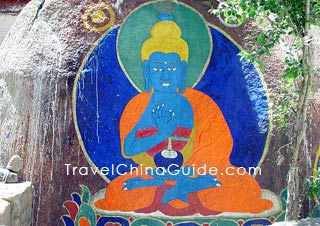 |
| Stone Mural at the Hill |
Stone Carvings and Murals: You'll find some white ladders painted on stones, which are blessings for the deceased to ascend to heaven. Additionally, numerous exquisite carvings like the Buddha's eyes that symbolize wisdom and insight, and Buddhist murals with vivid colors adorn the rocks. Sacred Spring: The spring is regarded as holy water from a divine pond. Devotees frequently collect water here to drink or wet their foreheads for blessings. Choding Gang Meditation Cave: Choding Gang means "high above the summit". It's high above Sera Monastery and the summit of the kora trail. Upon reaching here, you'll see sweeping views of the Lhasa Valley and the entire Sera Monastery.Historical records indicate that Tsong Khapa had long practiced meditation and wrote many books here, and then led to build up Sera Monastery. Therefore, the cave is considered the monastery's birthplace and spiritual origin.
Visit Tip: Nearby Choding Gang, there is a wild trekking path, which is recommended to energetic visitors with non-slip hiking shoes. It takes about 1 hour to walk and ascends about 400 meter (1,312 feet), reaching the yellow Sera Uzi Monastery at an altitude of 4,100 meters (13,451 feet). From here, you can enjoy a magnificent view of the Potala Palace, the Lhasa city area, the valley and the continuous snow-capped mountains.
Unmissable Activities in Sera Monastery
Debating of Buddhist Doctrines
 |
| A Monk with a High Leg Lift |
1. High-fiving usually indicates the beginning of a debate;
2. Stomping feet shows determination;
3. A high leg lift indicates that the monk will deliver a powerful blow with strong logic;
4. A clap signals the end of one point and pushes the answerer to respond without hesitation;
5. A pulled rosary marks the counting of arguments or reminders of learned texts;
6. A forward shove expresses urgency rather than anger.
Visit Tip1. The debate ground is located at the northernmost end of the monastery. After entering the gate, follow the main path straight ahead, then climb the stairs to reach the debate ground, a gravel clearing shaded by large trees.
2. The debating runs from 15:00 to 17:00 on every Monday to Saturday, with Sunday and major religious festivals off. It is advised to arrive at the monastery the latest at around 14:30, to ensure yourself enough time to buy tickets and walk to the debate ground.
3. During the session, it is allowed to photograph with cellphones, but no flash. Visitors should stay outside the monks' circle, keep voices low, and move clockwise through temple areas.
Sera Bengqin Festival
Shoton Festival Thangka Unveiling
Travel Tips
 |
| A Narrow Pathway at Dormitory Area |
2. Wear clothes that cover your shoulders and knees to show respect, and take off your hat and sunglasses before entering chapels.
3. There are many stray dogs around the monastery. Keep your distance and never feed them to avoid troubles.
Opening Hours
Tickets
After 17:00: CNY 10. The halls are closed and no debate takes place, but you can still walk around to appreciate the architecture.
Getting There
By Bus: Buses no. 16, 20 and 24 have a stop at Sera Monastery. The fare is usually CNY 1–2.
By Taxi: A taxi from Barkhor Street or Potala Palace takes roughly 15 to 20 minutes and costs around CNY 15 to 20.
- Last updated on Oct. 09, 2026 by Jally Zhang -