 |
|
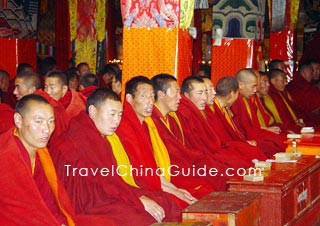
Buddhism had established a following in Tibet, as in other places, due to its spread from India. It received a boost when it was actively promoted in the 7th century during the reign of King Songtsen Gampo (?- 649 or 650 AD), who was married to a Nepalese Princess as well as a Chinese Princess, both of whom were Buddhists. As part of their dowries, they brought many Buddhist scriptures and statues to the court. As a consequence, Buddhism began to infiltrate Tibetan culture and to displace the indigenous Bon religion. However, during Landama's (or Lang Darma) reign, Buddhism was banned and went into decline. The distinct form of Tibetan Buddhism also called (incorrectly) Lamaism developed during the 10th century and it became firmly established from this time onwards. The Buddhism has its particular form as it absorbed aspects of the Bon religion as it gradually established its dominance. It also spread into neighboring provinces and countries. As the years passed a number of different sects evolved and which were to develop political as well as religious influence.
Tibetan Buddhism is based on Madhyamika and Yogacara and belongs to the Mahayana school. It also utilizes the symbolic ritual practices of Tantric Buddhism (Vajrayana) while incorporating features of the indigenous Tibetan Bon religion, that had continued its opposition to the new faith. The influence of Tantric doctrines and Bon make much more mystical than other forms of Buddhism. There is a strong reliance on mudras (ritual postures), mantras (sacred speech), yantras (sacred art) and secret initiation rites.
Five Main Sects
 |
| Pilgrimage |
Tibetan Buddhism has many sects and sub sects of which the following five are the most influential.
1. Nyingmapa, the Ancient Ones, dates from around 750 with Padmambhava. Its name means "old", since it was the oldest of the Buddhist sects in the high land. The Nyingmapa lamas wear red robes and hats, so it is also known as the Red Sect. It has a loose organization and focuses on mantra practice. Its lamas may marry and usually live in small groups. The sect retains many more of the Bon features than the other sects. Nyingmapa lamas believe that the mind is pure and that by cultivating one's being in such a way as to reject all outside influences, it is possible to become as one with Buddha. This sect has a greater number of deities than the other four. The major Nyingmapa monasteries are the Mindroling Monastery and the Dorje Drak Monastery. The former is particularly important for its collection of local calligraphy.
2. Kahdampa ordains that Buddha's acts and teachings should be the doctrines of cultivation. It is based on the teachings of Atisha, who arrived from India in 1042. The tradition lays stress on scriptures and discipline and emphasizes Tantra can be imparted to only to a select few. Kahdampa preaches samsara and retribution, so it underwent rapid development. By comparison with the other sects, its Yoga and Tantra remain pure. The main monastery is the Nechung Monastery, the hegumen (or abbots) of which acted as regents during the ethnic group of the Dalai Lamas and conducting the government of Tibet. Later this sect converted to Gelugpa.
 |
| Sakya Monastery, Sakyapa Sect |
3. Kagyupa was originated by two great teachers, Marpa and Milarepa. Kagyupa means "to teach orally" and its focus is on Tantric teaching. Since Marpa and Milarepa wore white robes, this sect is also called White sect. Its doctrines are unique and stresses a combination of the practise of quasi-qigong and Buddhist satori. It also advocates asceticism and obedience as the source of enlightenment. An important contribution of Kagyupa was the creation of tulku (reincarnating lamas) system, in which an existing lama can show evidence of his prior incarnations. Kagyupa's principal shrine is the Tsurphu Monastery, the traditional seat of Karmapa lama.
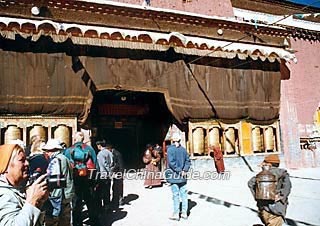
4. Sakyapa dates from 1073 and was founded at the Sakya Monastery after which it was named. Later, the sect was to govern the region for a period. As the monastery wall was painted with red, white and black stripes, the order became known colloquially as the Colorful Sect. Sakyapa's doctrines persuade people to do good deeds so that they may gain a good incarnation in their next samsara and to discard all temporal desires to ensure relief from pain.
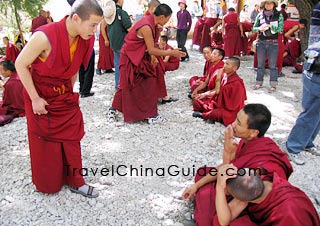
5. Gelugpa is the order of Dalai Lama and Panchen Lama and is also called the Yellow Sect since they wear yellow hats. It was founded by Tsong Khapa, a great Buddhist reformer, in 1407. It absorbed Kahdampa and carried on Atisha's tradition. It stresses strict discipline and study of the scriptures. Its successful reform made it dominant after the 17th century, leaving other sects to play a minor role. Its six main monasteries are the Ganden Monastery, Ta'er Monastery, Drepung Monastery, Labrang Monastery, Sera Monastery and Tashilhunpo Monastery.
 | | Sera Monastery, Gelugpa | | 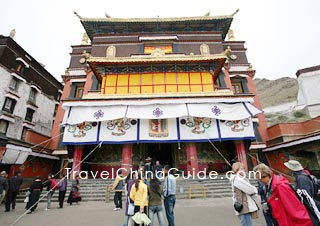 | | Tashilunpo Monastery, Gelugpa | |

Tibetan Buddhism
- Last updated on May. 11, 2026 by Rachel Hou -