Reincarnation System
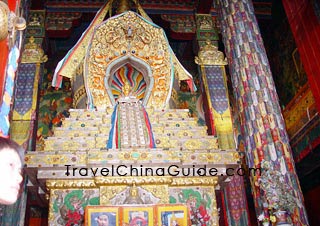 |
| Stupa - Panchen Lama's tomb |
The reincarnation system (tulku), a distinguishing characteristic of Tibetan Buddhism, is based the theory that Buddha's soul never vanishes, but reincarnates in succession to lead his followers and to accomplish his mission. One of first reincarnations among the Buddhist monks in Tibet is Karma Pakshi. In 1193, before Dusum Chenpa, a religious leader, the first Karmapa of the Karma Kagyu tradition of Tibetan Buddhism, passed away, he told his disciples that he would return as a reincarnated being. His disciples soon led a search for his infant reincarnation in accordance with his will. Several years later, Karma Pakshi turned out as the first reincarnation in Tibet and trained to be Karma Kagyu leader. After Karma Pakshi's reincarnation, the reincarnation system was adopted by other sects gradually to keep a consistent religious leadership. By applying the system, heirs for hundreds of Gyalwas (Living Buddhas) were selected, among whom the Dalai Lama and the Panchen Lama are the most prestigious. The Yellow Hat sect, Gelugpa tradition of Tibetan Buddhism also applied the system to hand down the titles conferred on the third Dalai Lama and the fourth Panchen Lama to keep their established religious and secular title and power. By the end of the Qing Dynasty there were 160 high lamas registered with the Board for Mongolian and Tibetan Affairs, each applying the reincarnation system to identify their next successors.
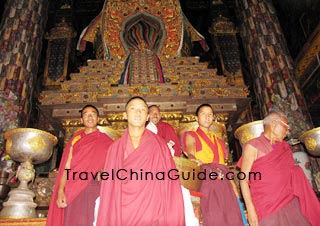 |
| Stupa-tomb of the Tenth Panchen Lama |
Religious methods and rituals are used to identify a reincarnation of a late high lama. A search party headed by another high lama begins the search. After a religious retreat, lamas, dispatched in disguise, scour Tibet for special signs: new mothers who had unusual dreams, children who have special knowledge without being taught, and special physical traits, such as big ear lobes. The lamas refer to oracles, portents, dreams and the late lama's prophesy in order to aid them in their search. Some lamas are sent to Lhamo Latso, the Oracle Lake, to look for prophetic visions to help locate the reincarnation. Usually, dozens of candidates are sought. They will be tested with the late lama's possessions; those who have amazing knowledge in identifying their predecessor's belongings win and become the final candidates. Since the search could be easily manipulated and dispute occurs (as in the case of the sixth Dalai Lama), Emperor Qianlong of the Qing Dynasty decided to use a gold urn lottery as a divination to eliminate false candidates. The names and birth dates of the final candidates are written on ivory lots, wrapped up and sealed in the urn. Religious rituals are held before the lottery. After holding the lottery in the Jokhang Temple, a new religious leader is soon installed if the procedure has been verified by the central government.
 Tibetan Buddhism