Dai Temple
 |
 Dai Temple Pictures Dai Temple Pictures |
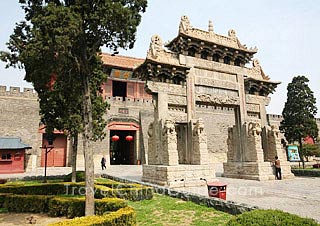
Covering an area of 96,000 square meters (24 acres), the Dai Temple is about 405 meters (1,329 feet) long from south to north and 237 meters (778 feet) wide from east to west. Constructed in the Han Dynasty (206BC-220), it had been renovated by the emperors in the past dynasties and became prosperous in the Tang (618-907) and Song (960-1279) Dynasties. It is where the emperors make sacrifice to the Gods of Heaven and Earth and worship the God of the Taishan Mountain. The Temple has various architectural structures including the Tiankuang Hall, the Yaocan Pavilion, the Zhengyang Gate, the Bell Tower, the Drum Tower, the Han Dynasty Cypress Courtyard and the Tang Dynasty Pagoda Tree Courtyard.
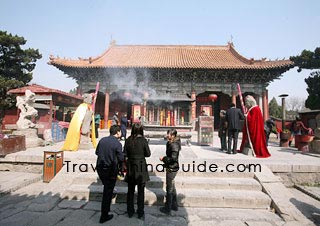
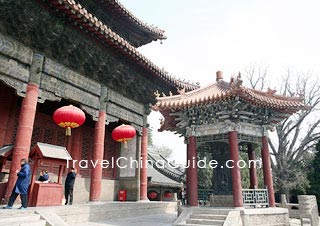
The Tiankuang Hall is the main structure here. Built in the Song Dynasty, it is also called the Ren'an Hall or the Junji Hall. In front of the hall there is a huge Ming Dynasty iron censer and two Song Dynasty pails. On each side of the censer and pails stands a pavilion with a stone tablet erected within it. On the tablets are inscribed the poems of Qianlong, a great emperor in the Qing Dynasty (1644-1911). In the hall is enshrined the God of the Taishan Mountain which is about four meters (13 feet) in a shrine. Above the shrine is hung the plaque inscribed with four Chinese characters 'Pei', 'Tian', 'Zuo' and 'Zhen' written by Kangxi, an emperor in the Qing Dynasty. On the walls of the hall is painted a giant Taoist mural. It is said that the mural had been painted in the Song Dynasty. With a height of three meters (10 feet) and a length of 62 meters (203 feet), it depicts the scene of the God of the Taishan Mountain having a tour of inspection and coming back to his palace.
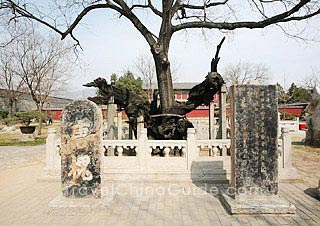 |
| The Tang Pagoda Tree Embraces Her Child |
In the Han Dynasty Cypress Courtyard grow five cypresses. It is said that Emperor Wu had planted those cypresses.
Other must-sees here include an archway, a bronze pavilion and an iron tower. Built in 1672, the archway is about 12 meters (39 feet) high and 10 meters (31 feet) wide. Various propitious relief patterns are carved on the archway, such as two dragons playing with a ball, a flock of cranes playing with a lotus and the red phoenix in the morning sun. The columns of the archway are also inscribed with couplets praising the God of the Taishan Mountain.
The bronze pavilion and the iron tower are located at the backyard of the Dai Temple. Also called Jin Que, the bronze pavilion was cast in 1615. In the pavilion is enshrined a Taoist deity. The iron tower was cast in 1565. Originally it was a 13-tier tower. During the Anti-Japanese War (1937-1945), it was destroyed and only left four tiers. Both of the bronze pavilion and the iron tower reflect the ancient Chinese artisans' exquisite workmanship of casting.
The Dai Temple is also famed as the forest of stone tablets. It houses many stone inscriptions of different periods in history and some Han Dynasty stone sculptures. The most celebrated is Li Si's inscriptions on the stone. Li was the Prime Minister in the Qin Dynasty (221BC-206BC). Meanwhile, there are also some cultural relics, offerings and the sacrificial utensils bestowed by the emperors in the temple.
|
|
Transportation
| Admission Fee: | CNY 20 |
| Opening Hours: | 08:00 to 17:00 |
 Notes:
1. A ticket of Taishan Mountain include a visit to Dai Temple.
2. Free for children under 1.4 meters (4.2 feet) or 6 years old; Children between 6 and 18 years old can buy half price ticket.
3. Seniors above 60 years old can enjoy free entry with a valid ID or passport.
- Last updated on Aug. 13, 2025 by Demi Li -