Yu Garden, aka Yuyuan Garden, Yu Yuan in Chinese, is a classical garden ranking among the must-see attractions in Shanghai. It dates back to the
Ming Dynasty (1368-1644) and was owned by a government officer named Pan Yunduan. Yu in Chinese means pleasing and satisfying, and this garden was specially built for Pan’s parents as a place for them to enjoy a tranquil and happy time in their old age.
Facts about Yu Garden
Location: No. 137, Anren Street, Huangpu District, very close to the Old City God Temple
Area: 20,000 square meters (about 5 acres)
Time Needed for a Visit: about 2 hours
History of Yu Garden
This garden was not constructed all at once since its inception in 1559. Instead, it was built in intermittent phases over nearly 20 years before the completion in 1590. After Pan Yunduan’s death, his family fell into decline, so the garden was poorly maintained and changed hands several times.
In 1760, to prevent the further decline of this garden, local wealthy merchants and gentry pooled funds to purchase Yu Garden and donated it to the
Old City God Temple nearby. The restoration of the garden took over 20 years, involving the reconstruction of pavilions and the addition of rockeries, among other efforts. Since the Old City God Temple already had an “East Garden” at the time, Yu Garden was named the “West Garden” to complement it. Later, Yu Garden was severely damaged again in wars. In 1956, the Shanghai government initiated restoration efforts, renamed the Old City God Temple’s “East Garden” as “Inner Garden”, and incorporated it into Yu Garden. In 1961, the Yu Garden was then officially opened to the public.
What to See in Yu Garden?
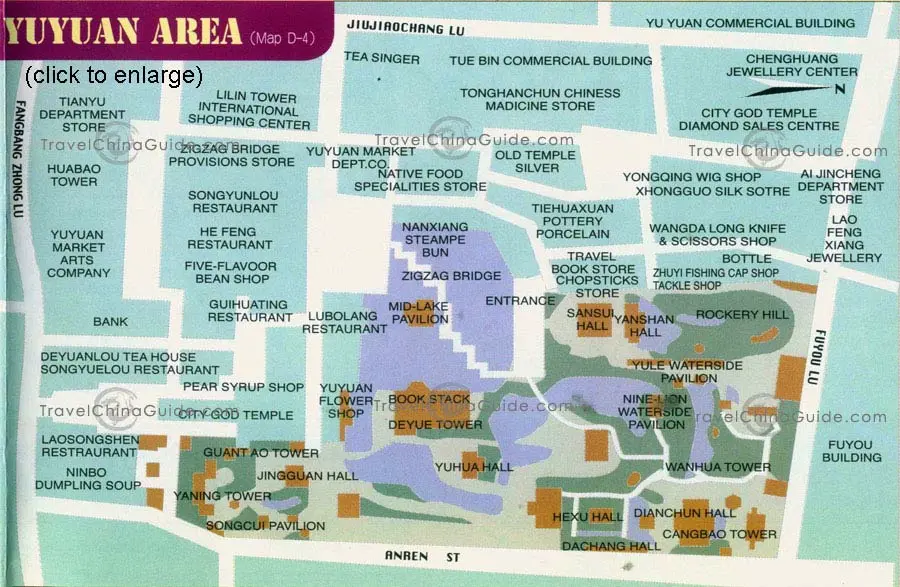
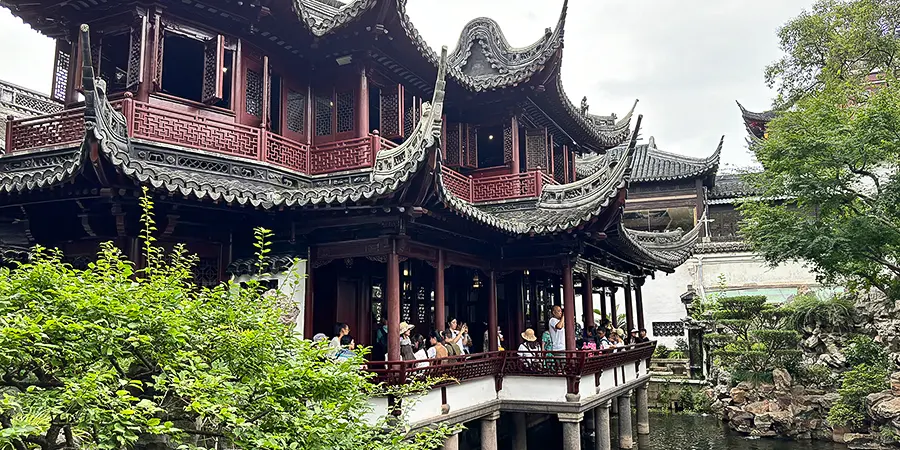
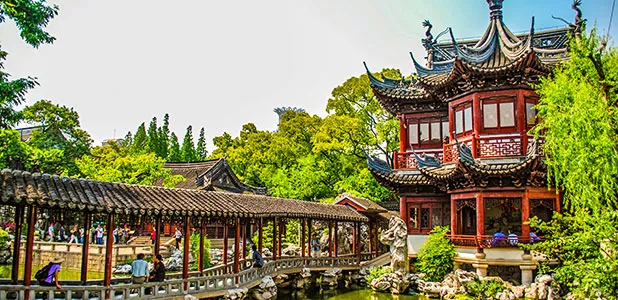
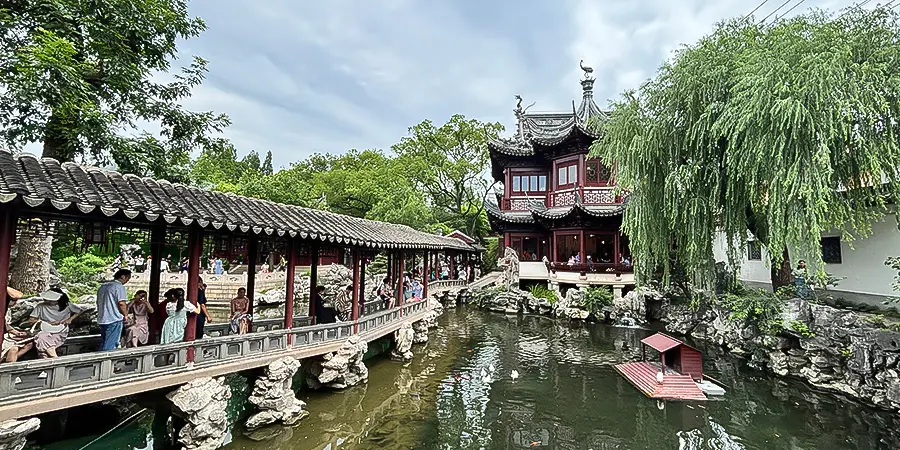
Although the scale of Yu Garden is not too large, it contains all elements that a classical Chinese garden should have—the pavilions, halls, rockeries, carvings, ponds and cloisters, all of which have unique characteristics. Here are some highlights in the garden that you would not want to miss.
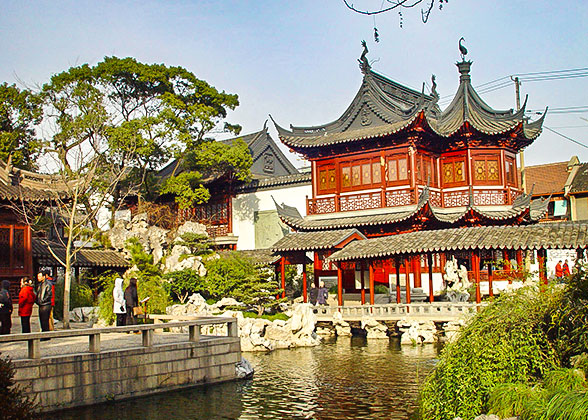
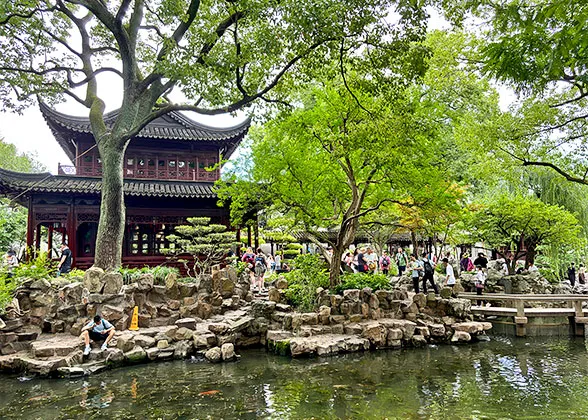 | | Pavillion and Pond in Yu Garden | | 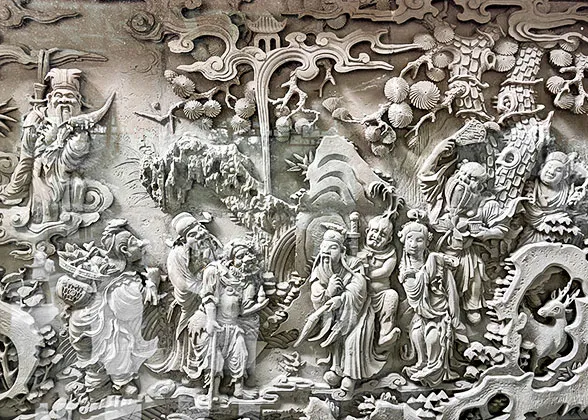 | | Exquisite Carvings in Yu Garden | |
Great Rockery
Upon entering Yu Garden, you will encounter a field of rockery which is called the Great Rockery. With a height of 14 meters (about 50 feet), it’s the largest as well as the oldest one in the southern region of the Yangtze River. Standing at the small pavilion on the top of it, you can get a bird’s eye view of the whole garden.
Sansui Hall
Sansui Hall features five bays, standing at a height of 9 meters. It’s the most commodious structure in the garden. This Hall was originally called Leshou by Pan, which means joy and longevity, and was used to entertain guests. Later in the Qing Dynasty (1636-1912), it was renovated and renamed as “Sansui”, symbolizing prosperous official career and the proper utilization of talents, as well as the people’s aspiration for bountiful harvests and favorable weather conditions. It served as a venue for official ceremonies, the dissemination of imperial edicts, and gatherings of local gentry.
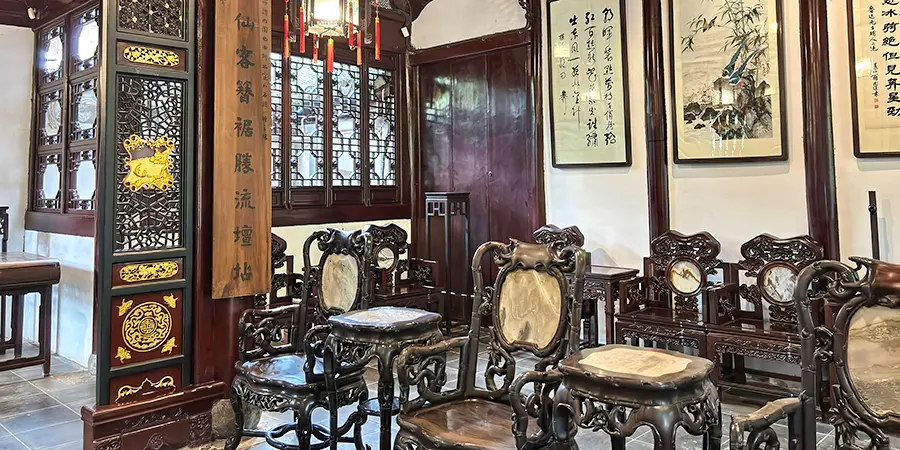 |
| Elegant Furniture in Yu Garden |
Wanhua Chamber
Wanhua Chamber is a two-story delicate building surrounded by devious cloisters. Its architectural details all carry a profound cultural significance: the fence is engraved with patterns of Chinese legends’ magical weapons and the traceries of the windows at the four corners of the ground floor are carvings in plum, orchid, bamboo and chrysanthemum shapes, respectively, symbolizing the presence of flowers throughout four seasons. In front of the Chamber stand two old trees, one being the 21-meter-tall (about 70-foot) ginkgo tree said to have been planted by the owner of Yu Garden over 400 years ago, and the other being the southern magnolia tree with a history of more than 100 years.
 |
| Pavilions of Yu Garden |
Dianchun Hall
Dianchun Hall, built later in the Qing Dynasty, was a place where families gathered for feasts on festive occasions. If you look at the details of this area, you will find there are many sculptures with the meaning of warding off evil spirits. In front of the hall, there is a water-facing opera stage. To the west is the “Cloud-Piercing Dragon Wall” featuring a clay dragon head with a tiled dragon body. This unique type of design is highly recognizable since it’s rarely seen in gardens of southern region of the Yangtze River.
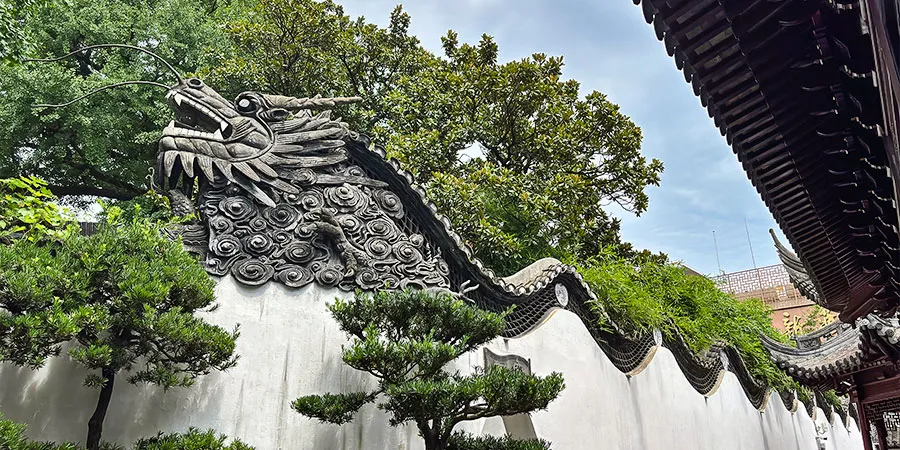 |
| Cloud-Piercing Dragon Wall |
Yuhua Hall
“Yuhua” means the “magnificence of the jade”, so Yuhua Hall is also known as “Jade Magnificence Hall”. It is a graceful constructure with furnishings made of top-grade rosewood and was originally the study of Pan where he read books and met friends. Stepping inside, you can still see Pan’s precious items such as the Four Treasures of the Study——writing brush, ink stick, paper, and ink stone, and the purple sandalwood drawing table.
Exquisite Jade Rock
The true treasure of Yu Garden is the Exquisite Jade Rock, one of the three most famous rockeries in south China. It’s 3.3 meters (about 10.8 feet) in height and has 72 holes. What is interesting about this rock is that if you burn a joss stick from its bottom, the smoke will magically float out from all the holes. Similarly, while you pour water into the rock from its top, the water will flow out from each hole, creating a spectacular sight to see. Yuhua Hall, located opposite the Exquisite Jade Rock, was specifically built for the purpose of appreciating this wonderful artifact.
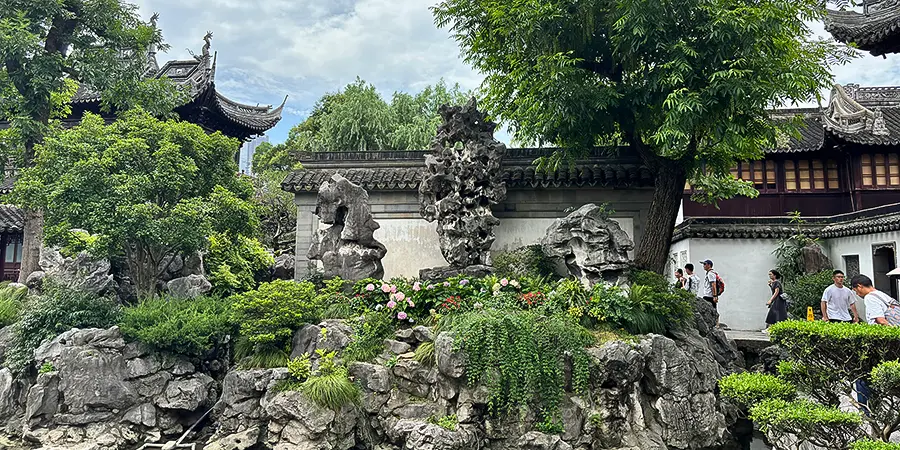 |
| Exquisite Jade Rock |
Inner Garden
The Inner Garden is long and narrow, but it is a very exquisite "garden within a garden". When entering this area, the first thing that catches your eye is the Hall of Serenity. Sitting in the hall, you can calmly observe the numerous strange peaks and rocks on the opposite side. Next is the Pavilion of Watching Waves. As the name suggests, when you climb up this pavilion and look eastward, you can see the waves of the Huangpu River. The most special feature is the Ancient Opera Stage. Its top is formed by the intersection of 22 circles and 20 arcs, which enables the singing to produce a lingering sound effect. In addition, there is a mirror on the top of the stage, and around it are 28 golden birds spreading their wings, creating a magnificent and exquisite visual effect.
What to Do in Yu Garden Area?
Apart from admiring those marvelous architectures, you have a lot of other interesting things to do around Yu Garden.
Stroll Around the Yuyuan Bazaar
Yuyuan Bazaar, on the periphery of Yu Garden, is a lively marketplace where all kinds of traditional craftworks, souvenirs, and food stalls are displayed in abundance. What a fulfilled journey to stroll along this street after exploring the garden! As a friendly reminder, bargaining is necessary.
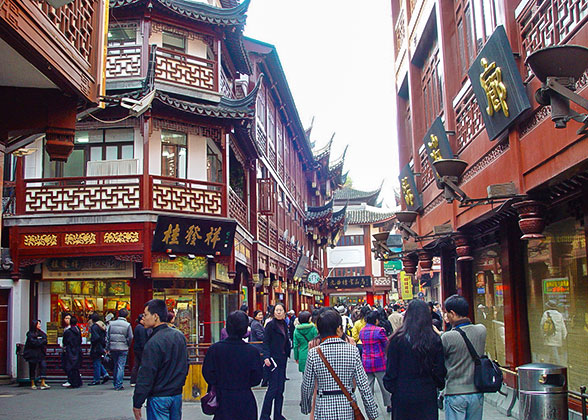 |
| The Commercial Street |
Appreciate the Night View on the Nine Bend Bridge
The zigzag Nine Bend Bridge is a part of Yu Garden, but outside the area that charges entrance fee. At night, colorful lights on both sides of the bridge are attractive. During the Chinese New Year, lantern exhibitions will be held there, adding more charm to the night piece.
Taste Local Delicacies
Near Yu Garden, there are many highly-rated century-old restaurants. If you don’t feel like leaving soon, you might as well try the flavors of Shanghai! The first one is Nanxiang Steamed Buns , a well-known Chinese traditional brand, famous for its soft and juicy soup-filled buns, which is definitely worth tasting. Then there is Lubolang Restaurant, where you can enjoy imperial-level delicacies such as osmanthus rice cake, crystal shrimp, and butterfly pastry. Shanghai Old Restaurant and Dexing Restaurant are famous for their Shanghai local cuisine and have remained popular for a long time. Chunfeng Songyue is the oldest vegetarian restaurant in Shanghai, making it perfect for vegetarian tourists.
Yuyuan Lantern Festival
The Yuyuan Lantern Festival originated during the Ming and Qing dynasties and has been resumed since 1995. Every year, before and after the Lunar New Year, various folk culture activities with different themes are held in the radiation area of Yu Garden. The Yuyuan Lantern Festival in 2026 will be themed around “Chinese zodiac horse” and will last for 36 days from January 26th to March 3rd. The main venue is Yuyuan Bazaar. During this period, the streets and alleys of this area are adorned with various horse-shaped lanterns. At the Yuyuan Golden Square, digital light projection technology presents scenes of traditional New Year customs, creating an exceptionally festive atmosphere.
Note: During the lantern festival, it is free to enter the venue before 16:00 from Monday to Thursday, and from Friday to Sunday as well as on February 17th and March 3rd before 14:00. For other time periods, the charge is CNY 80 per adult, and CNY 50 per child aged under 11 or under 1.4 meters (4.6 feet). Additionally, the venue will be closed on New Year’s Eve on February 16th.
Best Time to Visit Yu Garden
The best times to visit Yu Garden are late spring from April to May and Autumn from September to November. During the two periods, you can enjoy a harmonious combination of the garden’s own charm with its natural surroundings. In late spring, the garden is embellished with diversified flowers in full bloom as well as vigorously green willows. As autumn drives summer heat away, it becomes distinctively mesmerizing with the foliage turning colorful. Additionally, approximately from late December to February in winter is the best time to catch the grand Lantern Festival around Yu Garden where various Chinese Lanterns light up, enhancing its antique and lively ambience.
Time to avoid visiting: Spring Festival in late January to mid-February, May Day Holiday from May 1st to May 5th, and National Day Holiday from October 1st to October 7th. During these official public holidays in China, there is often a large number of visitors to the Garden, leading to crowdedness of the scenic spots.
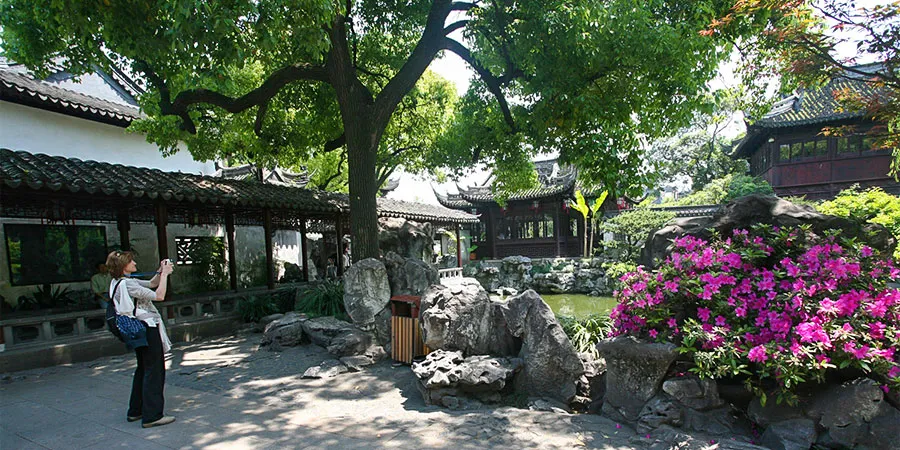 |
| Yu Garden in Late Spring |
How to Get to Yu Garden Shanghai?
By Metro
1. Take
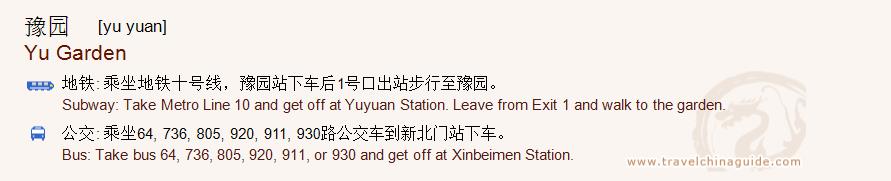
Metro Line 10 to Yuyuan Station, and then head out through Exit 1.
2. Take
Metro Line 14 to Yuyuan Station, and then head out through Exit 7.
By Bus
Take Bus No.11, 26, 64, 736, 920, 926, or 930, get off at Xinbeimen Station, and then walk along Anren Street for about 4 minutes to reach the Yu Garden.
Shanghai Bus / Metro Search Yu Garden Ticket
| Entrance Fee | April - June & September - November: CNY 40 |
| July -August & December- March: CNY 30 |
| Half price for seniors over 60 years old and minors aged 6-18 |
| Free for children under 1.3 meters (4.3 feet) or no more than 6 years old |
| Opening Hours | 09:00 - 16:30 (Ticketing stops at 16:00);
Closed on Mondays, except during National Day holiday |
There are mainly three ways to purchase Yu Garden ticket:
1. Booking online in advance via WeChat Mini Program with your valid ID or passport number. However, there’s no English translation provided.
2. On-site booking at the Yu Garden ticket office with a valid ID or your passport.
3. Choosing a trustworthy travel agent like TCG for more efficient ticket booking.
 Yu Garden Ticket Booking
See also:
Places of Interest in Shanghai: 12 Historical Sites to Explore 15 Most Beautiful Places in Shanghai in Spring Where to Go in Shanghai in Autumn - 11 Best Destinations Top 10 Places for a Shanghai Visit in Winter Top 10 Shanghai Tourist Spots for Solo Travelers
- Last updated on Mar. 03, 2026 by Shelly Wang -


 Yuyuan Garden Pictures
  Yuyuan Garden Video