Jiuzhaigou National Park
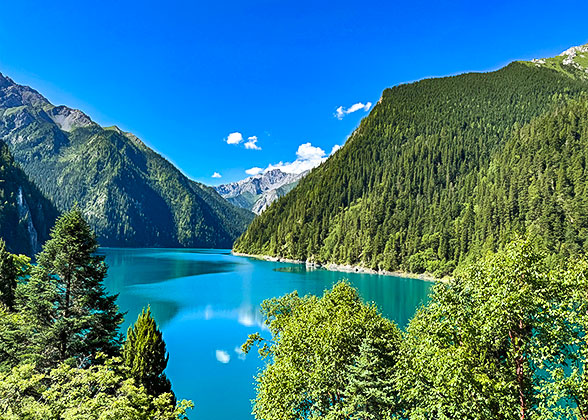
It is said that if there should be wonderlands on the earth, Jiuzhaigou National Park must be one of them. There is no equal elsewhere that has sceneries and fables of dreamlike eloquence, or natural purities like a fairyland as it.
 |
Jiuzhaigou National Park, aka Jiuzhai Valley National Park or Jiuzhaigou Valley, is located in Jiuzhaigou County, 450 kilometers (280 miles) to the north of Chengdu. Its name is due to the existence of nine stockaded villages of Tibetan origin, and it is always regarded as a holy mountain and watercourse by the Tibetan people.
 |
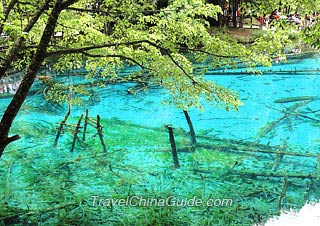
Jiuzhaigou National Park is a great masterpiece of nature having dreamlike scenery, which combines blue lakes, waterfalls, verdant forests, snow-covered mountains, and the folk customs of the Tibetan and Qiang peoples. Legend has it that long long ago the deity of mountain named Dago had a crush on the goddess Semo, and he gave a mirror that was made from wind and cloud to the goddess. However, the devil appeared and made trouble to Semo. Inadvertently, Semo broke the mirror into 108 pieces, which fell down to the earth and then turned to 108 colorful lakes. The lake is also called Haizi by local people.
 |
In addition to the dreamlike sceneries, there are numerous flora and fauna in Jiuzhaigou National Park. The natural forest covers an area of nearly 30,000 hectares (about 74,132 acres), including 2,576 higher plant species (24 species of national protected plants) and over 400 lower plant species (212 species of algae). The diversity of flora has provided a good environment for wild animals. There are 170 species of vertebrates, 141 species of birds and 17 species of rare animals. Among them the first rank has giant pandas, takins and golden monkeys and the second rank has lesser pandas, marmots, and blue sheep.
 |
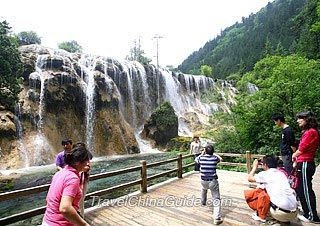
Jiuzhaigou Valley Scenic and Historic Interest Area covers more than 600 square kilometers (about 230 square miles). Shuzheng Valley, Rize Valley and Zechawa Valley are the three main valleys, but the sceneries are far more than you expect. There are Panda Lake Waterfall which has the longest drop in Jiuzhaigou Valley and freezes to a crystal world in winter, the giant calc-sinter beach Pearl Beach, the Arrow Bamboo Lake that has a large area of bamboo, the favorite food of pandas, and Swan Lake where swans inhabit ...
 |
Entrance Fee
| Apr. 1 - Nov. 15 | CNY 220 |
| Nov. 16 - Mar. 31 | CNY 80 |
 Notes:
Tourists need to book a ticket online at least one day before visiting, as there is no tickt counter at the entrance. Jiuzhaigou National Park Ticket Booking
 Preferential Policy:
1. Children and teenagers aged 7-18, as well as seniors aged 60-64 can enjoy half price of the entrance ticket with their certificates of identification, but without preference on the sightseeing bus.
2. Children aged 6 or younger and those under 1.2 m (3.9 ft), as well as seniors aged above 65 can enjoy free entry to the park, but without exemption of the sightseeing bus fare.
Opening Hours
Apr. 1 - Nov. 15: 8:00 - 17:00
Nov. 16 - Mar. 31: 8:30 - 17:00
 |
| Map of Jiuzhaigou (Click to enlarge) |
Visitors need to take the sightseeing bus to enter the scenic area. The green environmental-friendly sightseeing buses serve the whole scenic area. The bus fare is CNY 90 from April 1 to November 15, and CNY 80 from November 16 to March 31.
How to get to Jiuzhaigou National Park from Chengdu
By Air:
Jiuhuang Airport is about 88 kilometers (55 miles) from the mouth of the valley and about 53 kilometers (33 miles) from Huanglong. It takes 40 minutes to fly from Chengdu to the airport and nearly two hours' driving from the airport to the scenic area. Currently, the airport only operates direct air routes to Chengdu. By Bus:
Regular buses are available from Chengdu Xinnanmen Bus Station at 8:20 in the morning, and from Chadianzi Bus Station at 09:30 and 10:10. The bus fare is CNY 168 / 238. It is advised to buy the bus ticket in advance.
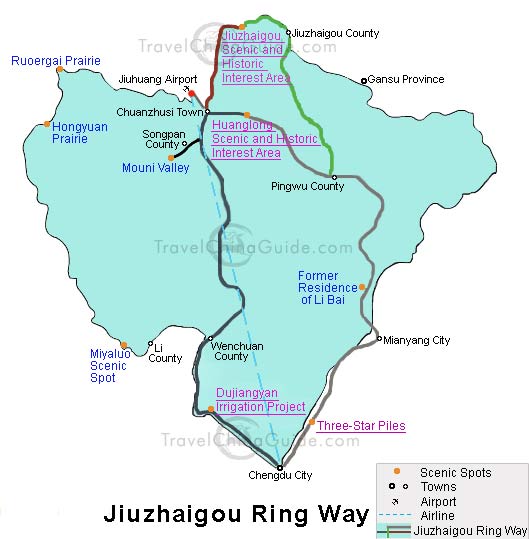 |
| Map of Jiuzhaigou Ring Way (Click to enlarge) |
By Train + Bus
Direct Chengdu - Jiuzhaigou Train with a duration of 2 hours is available. Passengers can take a 2 hours bullet train from Chengdu to Huanglongjiuzhai Railway Station, the nearest high speed train station from Jiuzhaigou, where tourists can take a direct bus to Jiuzhaigou with a duration of 2 hours and at a cost of CNY51. Further Reading: Best Way to Travel between Chengdu and Jiuzhaigou
How to get to Jiuzhaigou National Park from Xi'an?
At present, there are no direct flights from Xi'an to Jiuzhaigou. Visitors need to get to Chengdu first, and then follow the Chengdu - Jiuzhaigou guide above. From Xi'an to Chengdu, they can conveniently take high speed trains at Xi'an North Railway Station and the train journey only takes about 2.5 hours. Further Reading: How to Travel between Xi’an and Jiuzhaigou Read More: 15 Most Beautiful Places in China