 |
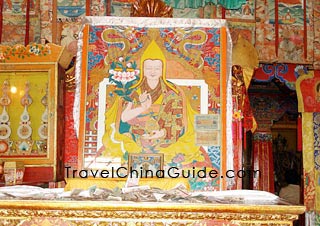
| Painted Thangka |
Thangka, seen in every monastery and family shrine in Tibet, is actually a kind of Tibetan scroll-banner painting and is a unique type of art that belongs to the Tibetan culture. It generally falls into several categories according to the techniques involved; namely painted Thangka, weaving Thangka, embroidery and paster Thangka, etc. Among them, painted Thangkas are most commonly seen. Thangka appeared around the tenth century, as a combination of Chinese scroll painting, Nepal painting and Kashmir painting. They are usually placed upright in a rectangular shape while there are a few that deals with subjects of Mandala that are square. Cotton canvas and linen cloth are the common fabrics on which pictures are painted on with mineral and organic pigments (important ones use ground gold and gemstones as pigments). A typical Thangka has a printed or embroidered picture mounted on a piece of colorful silk. A wooden stick is attached on the side from the bottom to the top to make it easier to hang and roll up. Its content cover various subjects including Tibetan astrology, pharmacology, theology, Mandala, images of great adepts, deities and Buddhas, and Jataka stories of the Buddha.
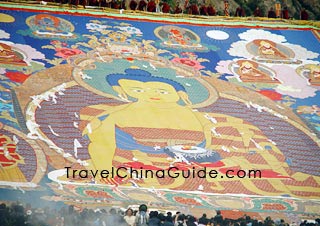 |
Thangka, a kind of
Tibetan scroll-banner painting |
Painting a Thangka usually starts by stretching a piece of cotton cloth on a wooden frame along its sides. Then, a certain type of gesso is spread over both the front and back of the canvas to block the holes and then scraped off to produce smooth surfaces. Afterwards, some orienting lines are drawn to guide the sketching. By following a fixed proportion,
images are then roughly drawn. The featured deity or saint occupies the center while other attendant deities or monks surround the central figure and along the border, and is comparatively smaller in size. Next is coloring. Painters apply pigments on the sketch. Black, green, red, yellow and white are the basic colors used in coloring. Shading is then done to produce better pictorial effects. At the final stage, facial features and eyes are finished, which is sacredly done only after a ritual held on a fixed day. After detail finishes, the canvas is removed from the frame and mounted on a piece of brocaded silk. The wooden sticks are attached to the top and bottom of the silk. After a dust cover of gossamer silk is attached it is ready to be hung up.
Karma Gadri tradition and Menri Karma Gadri tradition are the two major schools of Tibetan Thangka Painting.
- Last updated on Aug. 15, 2025 by Demi Li -